Rapid detox under anesthesia is a method in which an opioid user is put under general anesthesia for hours, then given a medicine that drives the substance out of its receptors in the brain, so acute withdrawal passes while they are asleep. The procedure is sometimes marketed with phrases such as “addiction treatment in one day” or “painless drug withdrawal under anesthesia”. But comparative studies didn’t find that it improves the chances of abstinence, and recorded serious heart and breathing complications with it, and deaths. This article explains what actually happens during the session and what research says about it, then sets out safer medical alternatives for anyone who wants to stop heroin, tramadol or other opioids.
What is rapid detox under anesthesia?
The procedure is known internationally as Rapid Detox, and its more precise medical name is anesthesia-assisted rapid opioid detoxification. It appeared in the 1980s, and its idea is that withdrawal itself can’t be avoided, but feeling it can. The patient enters general anesthesia or deep sedation, and the team gives them a large dose of an opioid-blocking medicine, such as naltrexone or naloxone. This medicine pushes the drug out of its receptors all at once, so a violent, intense withdrawal begins within a few hours instead of extending over days.
The method concerns opioids alone: heroin, morphine, tramadol, methadone, codeine and the like. It has nothing to do with withdrawal from hash, alcohol or sedatives, even if some adverts promote it as a solution for all types of addiction. To understand what happens in the body on stopping these substances, see the article on opioid withdrawal symptoms.
How does the session usually go?
The details differ from place to place, but the general steps described in the medical literature are similar:
- A check before the procedure covering the heart, breathing and basic tests, and questions about every substance the patient uses.
- General anesthesia or deep sedation in a room equipped for monitoring, sometimes inside intensive care.
- Giving the opioid-blocking medicine in a large amount to trigger acute withdrawal while under anesthesia.
- The patient remaining anesthetized for several hours until the peak of withdrawal is supposed to be over, then waking them.
- Usually one night of monitoring, then discharge, followed in some programs by starting naltrexone to prevent going back.
This short duration is what attracts patients. But withdrawal doesn’t disappear after waking, as we will see shortly.
Why does this promise seem tempting to the family and patient?
Fear of withdrawal pain is one of the things that most delays the decision to get treatment. The patient has tried stopping alone once or twice, lived through the sweating, diarrhea, insomnia and bone pain, and doesn’t want to live through it again. And the family wants a solution before their son backs out of his decision, and wants him to return to work or study as quickly as possible. Here the phrase “sleep and wake up clean” seems to answer all the fears at once. Understanding this motive matters, because the fear of pain is legitimate, and it has safer medical solutions.
What does research say about its effectiveness?
Any method of treating addiction is judged not by how quickly withdrawal ends, but by how many remain abstinent after weeks and months. On this measure the results were disappointing:
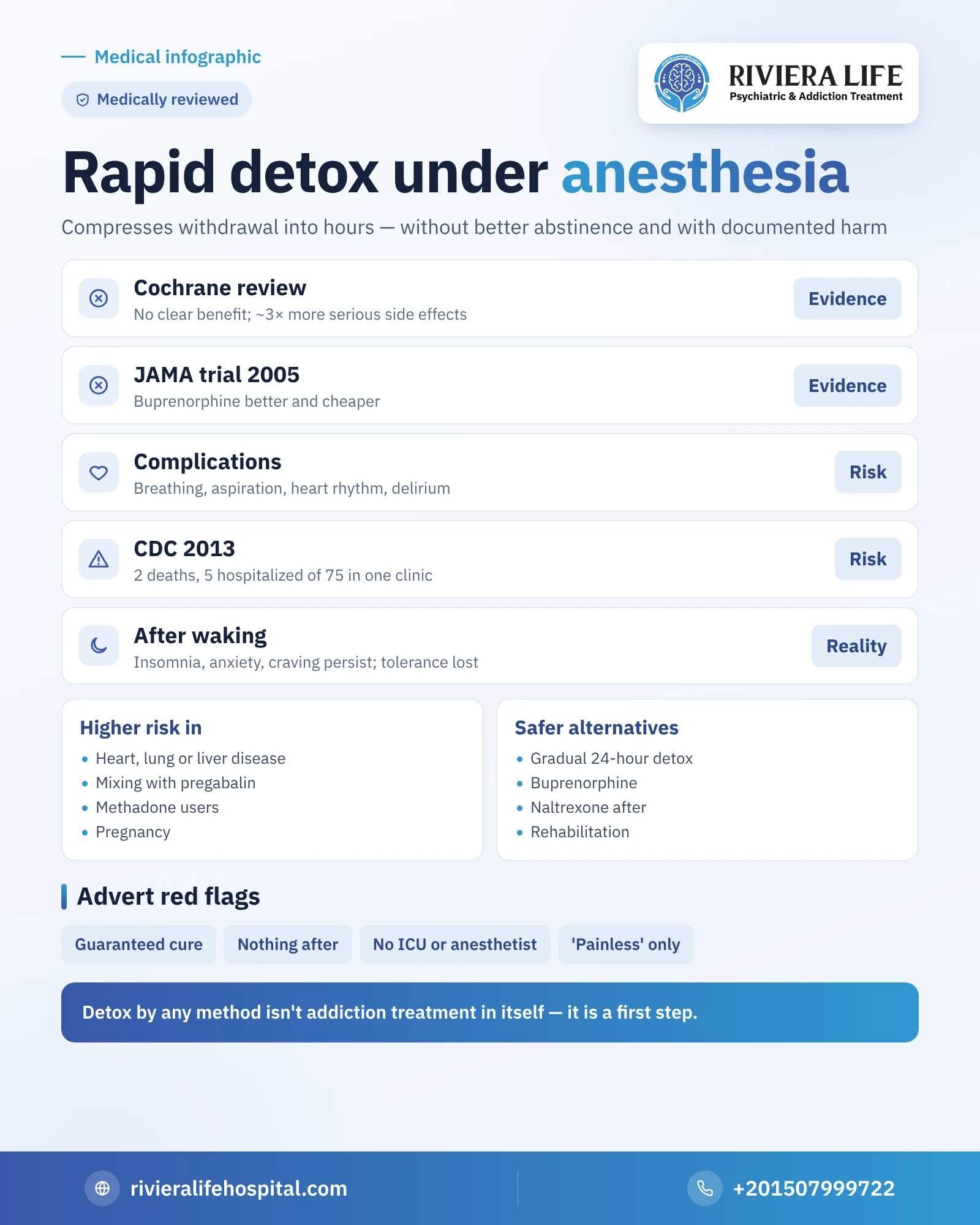
- The Cochrane systematic review (2010): gathered the comparative trials and found that withdrawal under deep sedation is more intense and shorter than withdrawal by tapering methadone. It found no clear benefit of deep anesthesia over light sedation, while serious side effects were about three times more frequent with it. The researchers concluded that its risks, cost and use of intensive care resources don’t justify its use.
- A randomized trial published in JAMA in 2005: compared heroin patients in three groups: withdrawal under anesthesia, withdrawal with buprenorphine, and withdrawal with clonidine. Anesthesia didn’t outperform in staying in treatment or in abstinence, buprenorphine was better and cheaper, and serious events were recorded with anesthesia.
In other words, the patient bears the risk of general anesthesia, then returns to almost the same point of relapse faced by someone who detoxed the conventional way.
The documented risks of detox under anesthesia
Withdrawal that naturally extends over days is compressed into hours, and the body pays the price of this compression. Among the complications recorded in studies:
- Depressed breathing and the patient needing respiratory support.
- Aspiration pneumonia, when vomit enters the lungs during anesthesia.
- Fluid build-up in the lungs.
- Heart rhythm disturbances.
- Delirium and confusion after waking, and electrolyte disturbance due to severe vomiting and diarrhea.
In a report published by the US Centers for Disease Control in 2013, health authorities in New York tracked a single clinic that performed this procedure on seventy-five patients over a few months of 2012. Two patients died, and five others were taken to hospital with serious complications. After that an official warning was issued to doctors to avoid the procedure and turn to proven treatments, and the American Society of Addiction Medicine also recommends against using it.
Call an ambulance on 123 immediately if you see
After any rapid detox procedure, in Egypt or abroad, don't wait if you notice:
- Difficulty breathing or very slow breathing
- Chest pain or severe palpitations
- Confusion, hallucinations or difficulty waking
- Vomiting or diarrhea that doesn’t stop, with dizziness or fainting
- Seizures
Withdrawal doesn’t end when the patient wakes
What most surprises those who have undergone the procedure is that the following days aren’t as comfortable as promised. The nerve receptors need time to regain their balance, which is why many return after waking to clear symptoms: insomnia, tiredness, anxiety, body aches and strong craving for the substance. These symptoms may last days, and some, such as disturbed sleep, mood and craving, last weeks.
This is where the most dangerous problem lies. The body’s ability to tolerate opioids has fallen a lot after withdrawal, so if the patient goes back to their old amount they become at risk of a fatal overdose. That is why detox, by whatever method, isn’t a treatment for addiction in itself. It is a first step that must be followed by psychological rehabilitation and follow-up, as the article on why addiction treatment fails explains.
Who is the procedure most dangerous for?
The risk rises in particular groups, which unfortunately are common among addiction patients in Egypt:
- Those with heart, lung or liver disease, or uncontrolled blood pressure and diabetes.
- Those who mix opioids with sedatives, pregabalin or alcohol. Tramadol with pregabalin, for example, is a widespread pattern, and an opioid-blocking medicine alone doesn’t treat it.
- Those who use a long-acting opioid such as methadone, because its symptoms may return after the procedure’s effect ends.
- Those with an accompanying psychiatric disorder, such as severe depression, psychosis or thoughts of self-harm.
- Pregnant women, as sudden withdrawal may threaten the fetus.
The difference between rapid detox and gradual medical detox
| Point of comparison | Rapid detox under anesthesia | Gradual medical detox |
|---|---|---|
| Apparent duration | Hours under anesthesia and a night of monitoring | Usually days, depending on the substance and case |
| Patient’s awareness | Unconscious during the peak | Aware and taking part in their plan |
| Severity of withdrawal | Very intense and compressed into a short time | Eased with medicines and daily follow-up |
| Risks | Risks of general anesthesia with documented heart and breathing complications | Much lower with proper medical supervision |
| Result after months | Didn’t outperform in abstinence in comparative studies | Better when followed by rehabilitation and follow-up |
| Handling mixed substances | Targets opioids only | A plan for every substance the patient uses |
You will find the details of what happens day by day in the gradual method in the 7-day detox program.
“Addiction treatment in one day” adverts: how do you read them?
Before you pay or travel for a rapid procedure, look for these signs in the advert:
- A promise of complete cure or a fixed success rate, as no addiction treatment guarantees that.
- No talk at all about what comes after the procedure: no psychological rehabilitation, no follow-up and no family program.
- Not asking about your medical history and every substance you use before setting the appointment.
- Anesthesia carried out in a clinic without intensive care or a dedicated anesthetist.
- Using the word “painless” as if it were the only result that matters.
What are the safe alternatives for an opioid user?
The fear of pain has solutions, and doesn’t need general anesthesia. Modern medicine has several methods, and the doctor chooses among them depending on the substance and the case:
- Gradual medical withdrawal under 24-hour supervision: in which the doctor uses medicines that ease each symptom separately, and follows sleep, fluids and blood pressure daily.
- Supervised substitute medicines: such as buprenorphine. Some doctors use it to ease withdrawal or for extended treatment, and it is decided according to the case and the rules followed in each country.
- Naltrexone after withdrawal ends: protects against relapse because it blocks the effect of opioids. But it starts after complete stopping, not during it, as in the naltrexone addiction treatment program.
- Psychological rehabilitation and admission when needed: cognitive behavioral therapy, group sessions and a family program. This is the part that actually prevents going back.
How do you choose a safe place for detox?
The right place is the one that treats withdrawal as the beginning of long treatment, not as a separate procedure. Ask before admission:
- Is the facility licensed by the Ministry of Health, with psychiatrists specialized in addiction?
- Is there medical supervision day and night, with the ability to handle emergencies?
- Is a plan set for all the substances you use, not just opioids?
- Are depression, anxiety and any accompanying psychiatric disorder assessed?
- What happens after withdrawal ends: rehabilitation, follow-up, or a relapse prevention program?
- Is the family involved in the plan, and how is the patient’s confidentiality protected?
And be careful of any place that guarantees you a cure or sets a number of days for it before examining you.
How does Riviera Life help you?
Riviera Life handles opioid withdrawal with medical detox under round-the-clock supervision. The plan is led by consultants in psychiatry and addiction treatment, and treatment starts with an assessment of every substance the patient uses and their physical and psychological condition. The hospital is licensed by the Ministry of Health, and has fourteen years of experience and thousands of recovered cases. Detox is followed by psychological rehabilitation, a family program and aftercare, in complete confidentiality. The first consultation is free, and you can get in touch around the clock on +201507999722. The hospital is in Sheikh Zayed, Giza.
More from the opioids guide
- The complete opioids guide
- The 7-day detox program
- Opioid withdrawal symptoms
- Heroin addiction treatment
Questions many people ask
No. The procedure compresses acute withdrawal into hours, but it doesn't treat craving or the reasons for use. Symptoms such as insomnia, anxiety and craving continue for days, sometimes weeks, after waking.
Studies have recorded serious complications with it in breathing, heart rhythm and the lungs, and deaths. It hasn't been shown to improve abstinence compared with other methods, so many medical bodies advise avoiding it.
No. Its idea is based on an opioid-blocking medicine, so it doesn't help with anything else. And someone who mixes opioids with sedatives, pregabalin or alcohol faces greater risk and needs a different medical plan.
Gradual medical detox under round-the-clock supervision eases symptoms with medicines and follows you daily, and the doctor may add supporting treatment depending on your condition. Then comes psychological rehabilitation that prevents going back.
Because the body loses its tolerance to opioids after withdrawal. If the patient goes back to their old amount it may be fatal, which is why detox must be followed by a follow-up and relapse prevention plan.