
The 28-day addiction treatment program is a four-week period of intensive residential treatment that combines medical care, individual and group psychotherapy, and preparing the patient to return to their life. As for the question everyone who reads its name asks: is it enough for recovery? The honest answer: it is enough to be a strong start for many patients, and not enough on its own to be the whole treatment. This page explains what the program achieves week by week, who it suits, when it isn’t enough, and what makes the four weeks keep their effect after discharge.
What is the 28-day program?
It is a structured residential program: the patient lives inside the hospital for four weeks, and their day follows a fixed schedule of sessions and activities under medical and psychological supervision. It differs from the 7-day detox program in that its aim isn’t just getting through withdrawal, but understanding the addiction and building skills to deal with it. And it differs from the open-ended full residential program in that it starts with a known time frame that helps the patient commit. The 28-day program isn’t the whole treatment, but part of the path of recovery from drug addiction that continues after discharge.
Where did the number 28 come from?
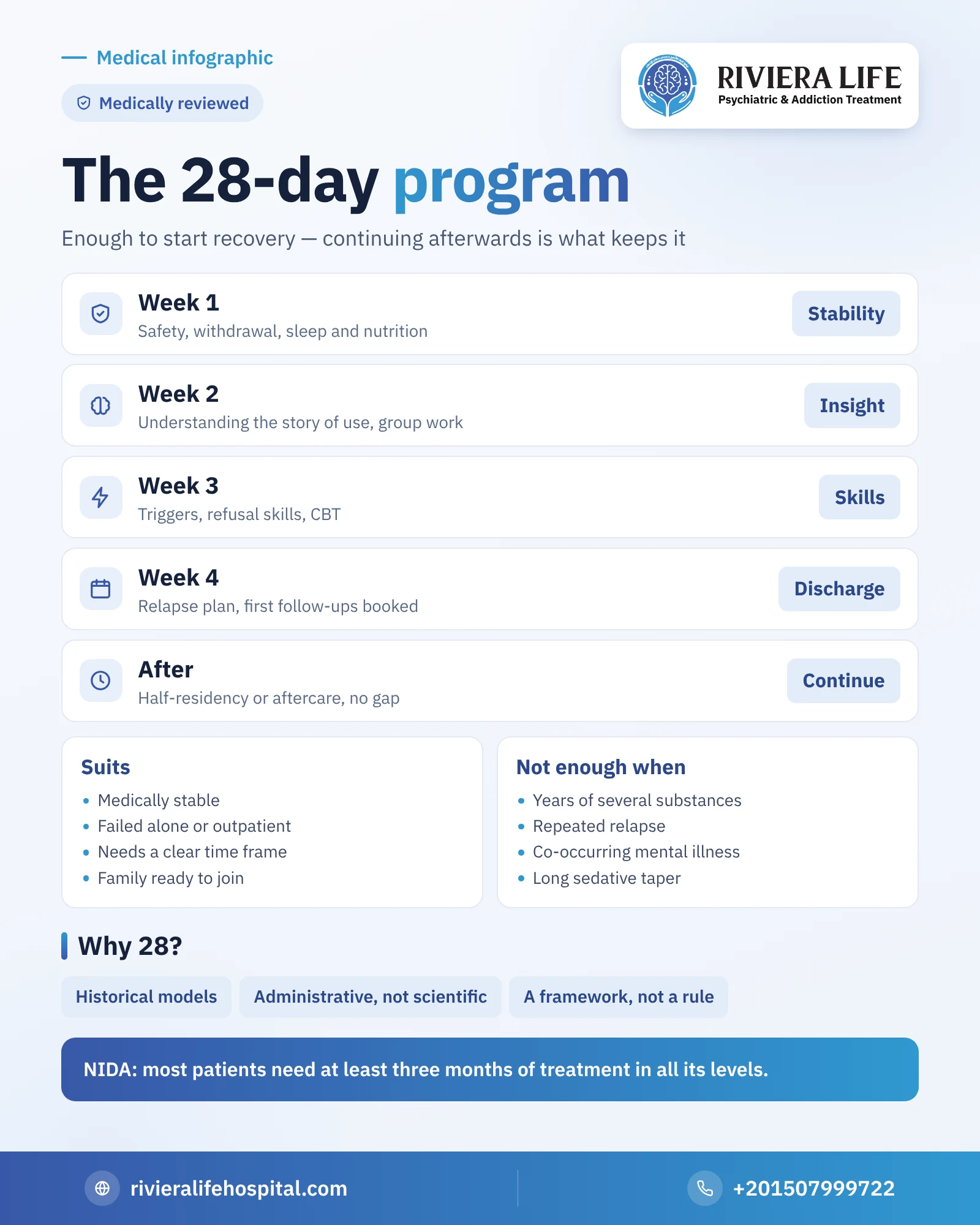
This number has historically been linked to old treatment models and to administrative and insurance arrangements in some countries, not to a scientific discovery saying four weeks is the ideal duration for everyone. Its practical advantage is that it is long enough to get through withdrawal and seriously start psychotherapy, and short enough for a hesitant patient or an employer to accept. But it remains a framework that can be adjusted, not a rule.
Is the 28-day program enough for recovery? A frank answer
Addiction is a chronic condition whose course resembles illnesses such as diabetes and high blood pressure: it needs continuous management, and relapse is possible. The principles of the US National Institute on Drug Abuse indicate that most patients need at least about three months of treatment, at all its levels, for use to fall or stop clearly, and that better outcomes are linked to longer periods.
This means the 28 days are part of this period, not a substitute for it. A patient who leaves after them and cuts contact with treatment loses much of what they built, while one who moves straight on to regular follow-up builds on a solid foundation. In short: the program is enough to start recovery, and continuing afterwards is what keeps it.
Who does the program suit?
- Those who need a temporary break from the using environment but are medically stable.
- Those who have tried stopping alone or with outpatient treatment and didn’t succeed.
- Those who want intensive treatment with a clear time frame around which they can arrange work or study.
- Those with a family ready to take part in sessions and in the post-discharge plan.
And when are four weeks not enough?
The doctor sometimes decides from the assessment that the case needs a longer or different path; among the best-known reasons:
- Using more than one substance for years, or repeated relapses after previous treatment; here the relapse treatment program helps.
- An accompanying psychiatric disorder that needs stabilizing, such as severe depression or bipolar disorder, handled by the dual diagnosis program.
- Withdrawal that needs a long gradual reduction, as with sedatives.
- An unsafe home the patient returns to without any protection.
Assessment before starting
The program isn’t built on its name but on its owner. That is why it starts with a review of the history of use and the substances used, a medical examination and tests, a psychological assessment, and a session with the family to understand the circumstances at home and work. From this assessment comes an individual plan that sets the goals of each week, and may also determine that the duration will need adjusting.
The four weeks: what happens each week?
Week one: safety and stability
Managing withdrawal if present, regulating sleep and nutrition, and introducing the patient to the team and the schedule. This week includes detox itself when needed, as the twenty-eight days start from admission, not after withdrawal ends.
Week two: understanding the addiction
Individual sessions to understand the story of use: when it started, what it gave the patient, and what it took from them. Group therapy begins, in which the patient discovers their experience isn’t an exception.
Week three: skills and relapse prevention
Identifying personal triggers, and practical training in refusing offers and dealing with craving and pressure, through methods such as cognitive behavioral therapy and motivational interviewing.
Week four: planning for discharge
Writing a relapse prevention plan, setting the first follow-up appointments before discharge, and sessions with the family to arrange the return home and to work.
How does it differ from detox? And can it be done at home?
Detox answers the question “how does the body stop safely?”, while the 28-day program answers “why was he using, and how does he not go back?”. The first is part of the second in many cases, not a substitute for it. And because the program rests on a temporary break from the environment and an intensive schedule, it is by nature a residential program; those whose circumstances don’t allow staying overnight discuss alternatives with the doctor, such as half-residency or the home addiction treatment program if their case is suitable.
What does a day inside the program look like?
The day starts with a quick medical check, then an educational session, then group therapy, and after lunch an individual session or physical or rehabilitation activity, ending with a review of what the patient learned that day. The schedule itself is part of the treatment: many patients have lost their sense of time and routine, and regaining it is early training for a life without drugs. The doctor may prescribe medicines when needed, to treat withdrawal symptoms or an accompanying disorder, or to reduce craving.
The family’s role during the four weeks
A family that waits until day twenty-eight to ask “what do we do now?” is very late. What is needed is that it attends its sessions, and learns how to support without smothering control, how to set realistic limits, and how to notice danger signs early. The family rehabilitation program provides this role in an organized way.
What comes after day twenty-eight?
This is where it is decided whether the program was a beginning or a separate episode. Depending on the patient’s condition, they may move to the half-residency program to apply what they learned while returning home in the evening, or directly to the aftercare program with individual and group sessions and medical follow-up. Most important is that no days pass without any treatment contact after discharge.
The right hospital for a 28-day program: how to choose
The right hospital for this program is the one that treats the twenty-eight days as the start of a plan, not as a package that ends with discharge. Ask:
- Does the initial assessment set clear goals for each week?
- Do the days include detox when needed under continuous medical supervision?
- Does the schedule combine individual, group and family therapy?
- Is an accompanying psychiatric disorder assessed and treated?
- Can the duration be extended medically if the patient isn’t ready?
- Are aftercare appointments booked before discharge?
And beware of any place that presents the four weeks as a guaranteed cure or the “end” of addiction.
How Riviera Life meets these standards in the 28-day program
Riviera Life applies these criteria as follows:
- Official license: a hospital licensed by the Ministry of Health.
- An individual plan: consultants in psychiatry and addiction treatment set the goals of each week and adjust the duration when needed.
- Continuous care: round-the-clock medical supervision throughout the stay.
- Extended experience: fourteen years and thousands of recovered cases.
- The family as a partner: a family program accompanying the four weeks.
- Continuity: organized aftercare after discharge.
- Complete confidentiality: for the data of the patient and their family.
Are 28 days enough for your case? Ask our consultants in a free first session, or call +201507999722 at any hour. Our address is Sheikh Zayed, Giza.
Read also
- The 7-day detox program
- The full residential addiction treatment program
- The aftercare program after treatment
- The Matrix program for addiction treatment