Revia is a brand name for the medicine naltrexone, used to help people recovering from opioids and alcohol not to relapse. The question we often receive: does Revia itself cause addiction? The frank medical answer: no. Naltrexone causes no high, no tolerance and no physical dependence, and withdrawal symptoms don’t usually appear when it is stopped. But there are real dangerous situations linked to it, such as sudden withdrawal if it is taken while opioids are still in the body, or trying to override its effect with large doses of the drug. This article explains what the phrase “Revia addiction treatment” really means, and how to handle each situation safely.
What is Revia in brief?
Revia is an opioid receptor antagonist: it sits on the receptors that heroin, tramadol and morphine act on and closes them, so the person doesn’t feel the effect of these substances if they use them. It also reduces the craving for alcohol in some patients. We won’t repeat its uses, side effects and detailed warnings here, as they are on the naltrexone page.
Does Revia cause addiction?
No. This is an agreed point in medical references. The medicine doesn’t activate the brain’s reward centers, so it gives no pleasant feeling that pushes the person to repeat it, and the patient doesn’t need to increase the dose over time. That is why there is no such thing as “detox from Revia”, and stopping it doesn’t need a gradual reduction program like sedatives.
So why do people search for “Revia addiction treatment”? Usually for one of these reasons:
- The patient’s or family’s fear that staying on the medicine for months means they have “become addicted” to it.
- Side effects appearing such as nausea, headache and insomnia, and being wrongly interpreted as withdrawal.
- Experiencing violent withdrawal after taking the medicine too early, so the person thinks the medicine is the problem.
- The craving for the drug or alcohol returning after stopping it, which is actually the return of the original illness.
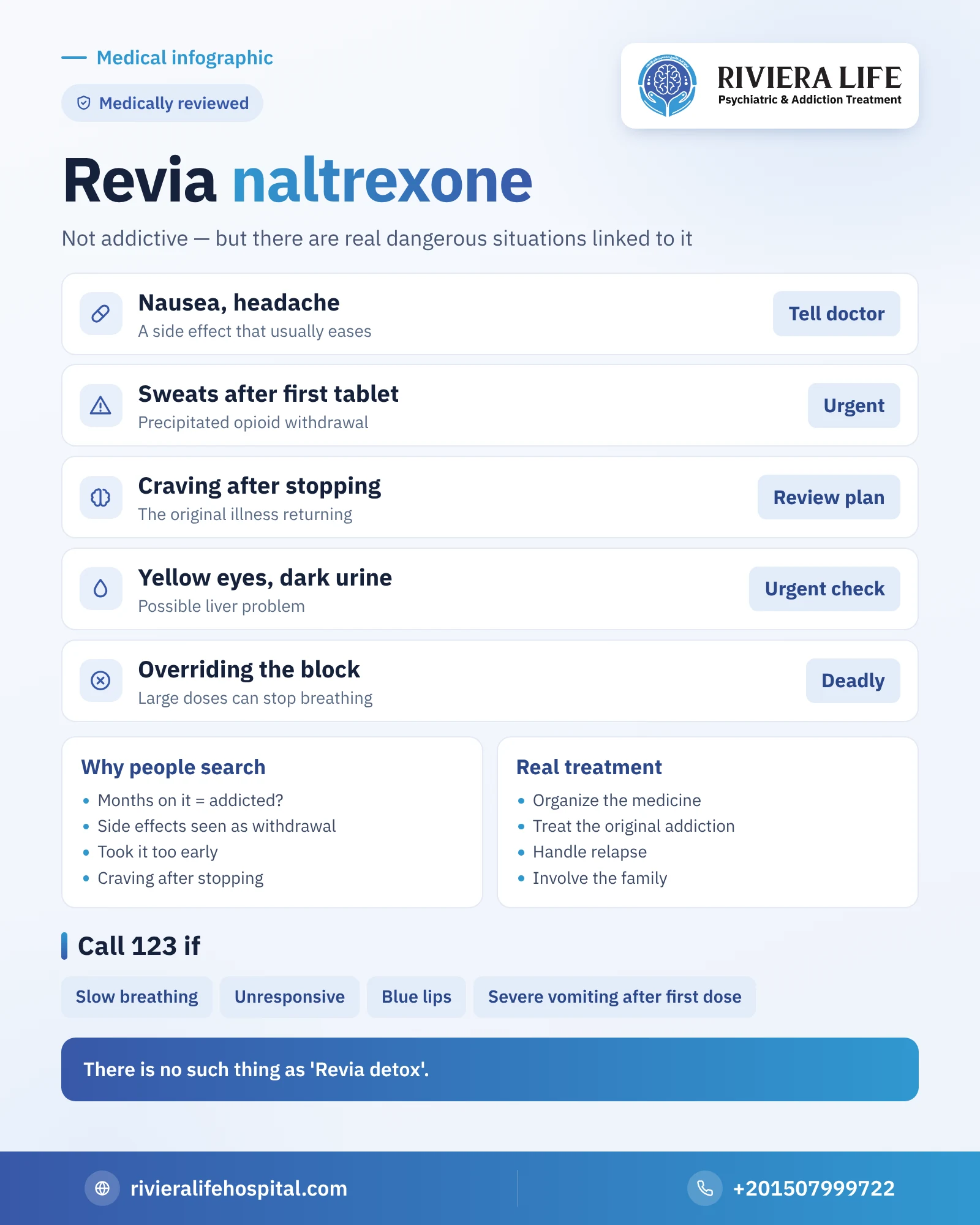
Addiction, side effect or something else?
| What the patient notices | The most likely explanation | What to do |
|---|---|---|
| Nausea, headache and dizziness in the first days | A side effect that usually eases with time | Tell the doctor and don’t stop the medicine yourself |
| Sweating, tremor, diarrhea and pain an hour after the first tablet | Precipitated opioid withdrawal | Contact the doctor or emergency department immediately |
| Strong craving for the drug after stopping Revia | The original illness returning | Review the main addiction treatment plan |
| Yellow eyes, dark urine or upper abdominal pain | A possible liver problem | Urgent medical examination |
Precipitated withdrawal: the most common mistake
If a person takes Revia while opioids are still in their body, the medicine pushes them off the receptors all at once, and they enter acute withdrawal within a short time: vomiting, diarrhea, heavy sweating, tremor, cramps and severe anxiety. That is why doctors require the body to be free of opioids for a sufficient period before the first dose, and this period is longer with long-acting medicines such as methadone and buprenorphine. Tests and medical assessment determine when starting is safe, not the patient’s wish to hurry. To understand the nature of this withdrawal you can read opioid withdrawal symptoms.
The most dangerous situation: trying to override Revia’s effect
Some patients discover that heroin or tramadol “doesn’t work” while they are on Revia, so they take larger amounts to get past the barrier. This may end in a fatal overdose, because the amount that breaks the barrier may be enough to stop breathing, especially when the medicine’s effect weakens before the next dose is due.
The second danger comes after stopping Revia: the body’s tolerance to opioids has fallen a lot, so if the person goes back to the amount they were used to before treatment, it may be more than they can bear.
Call an ambulance on 123 immediately if you see
For anyone using opioids during Revia treatment or after stopping it, or who took it with opioids in their body, call an ambulance immediately if you see:
- Very slow, irregular or stopped breathing
- Severe drowsiness or no response to calling
- Blue lips or nails
- Very constricted pupils with loss of consciousness
- Severe continuous vomiting with dehydration after the first dose of Revia
So what does “Revia addiction treatment” mean?
Since the medicine itself isn’t addictive, real treatment goes in one of three directions:
Organizing the use of the medicine
Reviewing the dose and timing, dealing with side effects, checking liver function when needed, and making sure the patient takes it from a reliable source and with a prescription.
Treating the original illness
Revia is a tool for preventing relapse, not a complete treatment. Someone who takes it without psychological and behavioral treatment and follow-up is more likely to stop it and go back to using. The full picture of its use within a treatment plan is in the naltrexone addiction treatment program.
Dealing with relapse
If the patient goes back to using during or after treatment, the priority is their safety first, then reassessment: do they need a new detox? Is naltrexone still the right choice, or would another medicine suit them? The details are in the relapse treatment program.
Can Revia be stopped suddenly?
Physically, stopping it doesn’t usually cause withdrawal. But the decision to stop itself should be made with the doctor, because it removes protection from relapse at what may be a sensitive time, and because lower tolerance makes any return to opioids more dangerous. Planned stopping usually comes after a period of stability, with a clear follow-up plan.
The family’s role
The family can be reassured that Revia isn’t a “substitute addiction”, and can support commitment to it without suffocating supervision. It is useful for them to know the signs of overdose, and to ask the doctor about having naloxone available for emergencies; you will find it explained in naloxone.
The right hospital for help with Revia: how to choose
The right hospital for someone searching for Revia addiction treatment is the one that tells them the truth first, that the medicine isn’t addictive, then treats what actually needs treatment: the original addiction and the risks of relapse. Ask:
- Does the team make sure the body is free of opioids before starting naltrexone?
- Does it follow liver function and side effects regularly?
- Does it combine the medicine with psychological and behavioral treatment and follow-up, not just a tablet?
- Does it have a plan for dealing with relapse and the risk of overdose after stopping?
- Does it involve the family and teach them how to act in emergencies?
And beware of any party that sells a “Revia withdrawal program” or promises a guaranteed cure in days.
How Riviera Life meets these standards with Revia
At Riviera Life these criteria take the following form:
- Ministry of Health license: a hospital licensed for psychiatry and addiction treatment.
- Addiction consultants: who determine the safe time to start naltrexone and follow the dose.
- Round-the-clock medical supervision: for detox before starting and for any precipitated withdrawal.
- Integrated treatment: medicine with psychological and behavioral treatment and relapse prevention.
- Fourteen years of clinical work: during which thousands of patients recovered from addiction to opioids, alcohol and other substances.
- Complete confidentiality: for everything related to the patient and their treatment.
- A family program and aftercare: including an emergency plan after discharge.
About Revia and your case, your first consultation is free on +201507999722, and we answer all day from our base in Sheikh Zayed, Giza.
Read also
- Naltrexone: uses and warnings
- Opioid addiction treatment
- Alcohol addiction treatment
- Naloxone and rescue from overdose
Questions many people ask
No. Revia is an opioid receptor antagonist, meaning it closes the receptors instead of activating them, and doesn't cause a high or sedation. That is why it is used to prevent relapse, not as a substitute for the drug.
Usually not, as naltrexone doesn't usually cause withdrawal. These symptoms may be the return of anxiety or craving that existed before treatment, and need assessment with the doctor.
You usually won't feel the substance's effect, and trying to get past this with larger amounts may cause a fatal overdose. Tell your doctor about any use immediately to adjust the plan.
Revia itself doesn't need admission. Admission may be needed for detox from opioids or alcohol before starting it, or with a severe relapse or an unstable psychiatric disorder.
Look for a team that starts naltrexone at a safe time after checking the body is free of opioids, follows the liver and side effects, combines medicine with psychotherapy, plans for relapse and trains the family. Riviera Life in Sheikh Zayed meets these criteria.