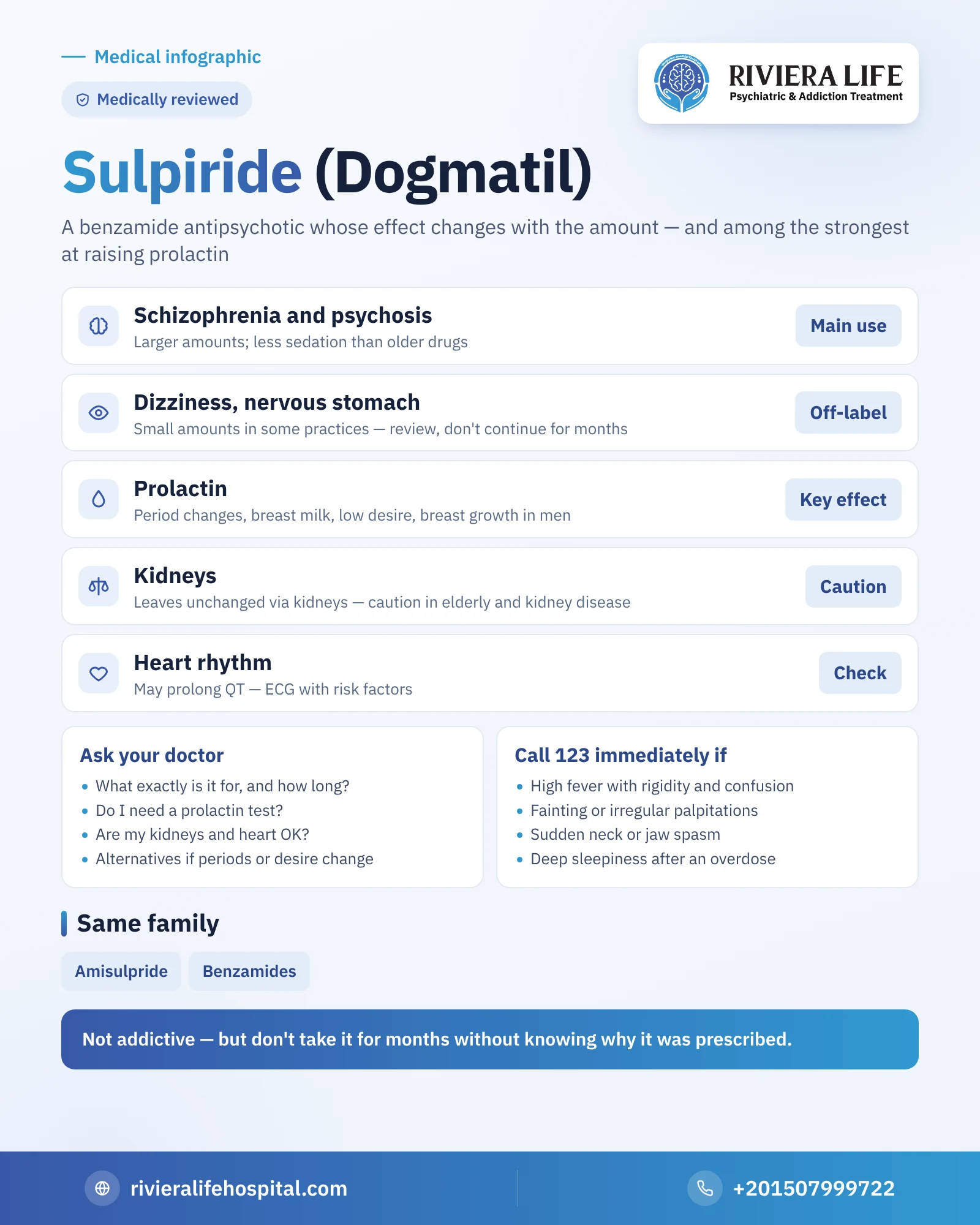
Sulpiride is an antipsychotic, known as Dogmatil and by other equivalent names in Egyptian pharmacies. It differs from others in that its use isn’t limited to psychosis: a doctor may prescribe it in relatively large amounts for schizophrenia, and in very small amounts for other purposes such as dizziness, some functional digestive disorders, or mild anxiety and depression in some practices. It is also one of the medicines that most raise the hormone prolactin, and it leaves the body through the kidneys. This is an introductory article without doses: starting, adjusting and stopping the medicine is the decision of the doctor who prescribed it.
What is sulpiride?
It belongs to a group called substituted benzamides, which selectively block type 2 and type 3 dopamine receptors. It is important to know that its effect changes with the amount: a small amount strengthens dopamine activity in some pathways, while a large amount blocks it. This explains its use for quite different purposes. It isn’t approved in the United States, so you won’t find a page on it in American references, but it is used in Europe, Asia and Africa, including Egypt. To understand where it sits among other medicines, see our article on antipsychotics.
What is sulpiride used for?
Schizophrenia and psychosis
It is prescribed to ease hallucinations and delusions and to treat negative symptoms in some patients, usually with less sedation than older medicines and a lighter movement effect than haloperidol, bearing in mind that prolactin is its weak point. Our overall view of the illness is in our article on schizophrenia treatment.
Dizziness and functional digestive disorders
In practice, prescriptions of sulpiride in small amounts are seen for dizziness or stress-related stomach upset. No one should start it on their own for this purpose or continue it for months without review, because even a small amount can raise prolactin in some people.
Mild anxiety and depression
Some doctors in some countries prescribe it for mild cases, but this use varies from one doctor to another, and it doesn’t replace psychotherapy and approved antidepressants when they are needed. You can read about the main options in our article on antidepressants.
Prolactin: sulpiride’s most distinctive feature
Sulpiride raises the hormone prolactin significantly in most people who take it, even at small amounts. This may never be noticed, or it may appear as:
- Irregular or absent periods in women.
- Milk coming from the breast without pregnancy or breastfeeding.
- Weak desire and erections, and breast enlargement in men.
- Difficulty getting pregnant, and in the long term weaker bones.
These are symptoms to discuss frankly with the doctor, because there are solutions, from a prolactin test to adjusting the plan or switching to another medicine. Many women have the cause of missed periods diagnosed months late because no one asked about the medicine. Our article on risperidone compares it with another medicine that shares this feature.
The kidneys: what does depending on them mean?
Sulpiride leaves the body through the kidneys almost unchanged, so if the kidneys are weak the medicine stays longer and its level rises. That is why caution is needed in older people and kidney patients, and the doctor may lower the amount or avoid the medicine. It is useful to check kidney function before starting it and when there are accompanying illnesses.
The heart and its rhythm
Sulpiride may prolong the QT interval, and in rare cases lead to a dangerous rhythm disturbance. The risk is higher if the patient has heart disease or unexplained fainting, low potassium, or is taking other medicines with the same effect. Ask your doctor for an ECG if any of these factors apply.
A quick comparison with amisulpride
Sulpiride resembles amisulpride in its chemical family, its reliance on the kidneys and its raising of prolactin, since both belong to the benzamide group. The practical difference is that amisulpride is stronger and more selective in psychosis, while sulpiride remains more flexible in its other uses. The doctor chooses between them based on symptoms and tests.
Why does its use vary from one doctor to another?
Because the medicine works differently depending on the amount, and because some medical practices inherited it from past decades, you’ll find many prescriptions for it in pharmacies that don’t always agree with each other. This doesn’t necessarily mean one of them is wrong, but it does mean that anyone taking sulpiride deserves to know why: is it for psychosis, dizziness, or a nervous stomach? Each purpose has a different duration and follow-up. If you don’t know why it was prescribed for you, ask. And if you’ve been on it a long time without review, ask for a new assessment that includes prolactin.
When does it start working?
In psychosis, symptoms settle gradually over weeks, and negative symptoms more slowly. In milder uses the patient may notice a difference within days, but no difference in the first week doesn’t mean the medicine has failed, nor does it justify increasing it on your own. Write down what changes in sleep, mood, stomach and periods; these notes help the doctor in one visit more than any general talk.
Other side effects and warnings
- Movement: restlessness, stiffness or tremor, usually milder than with the strong older medicines, with the possibility of tardive dyskinesia with long use.
- Sleep: it may cause sleepiness or insomnia depending on the person.
- Weight: a slight to moderate gain in some patients.
- Prolactin-secreting pituitary tumor: the medicine doesn’t suit someone who has a tumor of this type.
- Older people with dementia: an official warning of an increased risk of death and stroke when antipsychotics are used for dementia-related behavior.
- Pregnancy and breastfeeding: a shared decision with the doctor; the medicine passes into breast milk.
Among the rare, serious effects is a reaction combining fever, rigidity and altered consciousness, the subject of our article on neuroleptic malignant syndrome.
Call an ambulance on 123 immediately if you see
Or go to the nearest emergency department if someone taking sulpiride develops:
- A high temperature with severe muscle rigidity and confusion
- Fainting or a severe, irregular heartbeat
- A sudden spasm of the neck or jaw, or difficulty swallowing or breathing
- Deep sleepiness or slow breathing after taking too much
- Thoughts of harming oneself or others — for psychological support, the mental health hotline 16328
Does sulpiride help with sleep?
Sulpiride isn’t a sleeping medicine and isn’t prescribed to treat insomnia. But some people who take it feel sleepy, especially at the start, while others feel the opposite: restlessness and difficulty relaxing. If your sleep improves on it, it’s usually because the anxiety or stomach upset that kept you awake has settled, not because the medicine makes you sleep.
It shouldn’t be used for sleep without a prescription; insomnia has more suitable treatments that the doctor determines, the first being cognitive behavioral therapy for insomnia.
Is sulpiride addictive?
It isn’t considered an addictive medicine, and it doesn’t produce craving. At the same time, the feeling that it “calms the stomach and nerves” may push some people to keep taking it without need. Stopping it after long use for a psychotic condition risks relapse, so tapering according to the doctor’s plan is safest. For those using small amounts for passing symptoms, the doctor decides when to stop.
Patients’ experiences with sulpiride: what do most people notice?
When someone searches for “my experience with sulpiride”, they usually want to know what they will actually feel. The picture that recurs in medical references and in what patients report is similar, though the details differ from person to person:
- The first days: some patients notice relative calm or improvement in stress-related stomach symptoms and dizziness, while others complain of sleepiness, or of restlessness and difficulty sitting still; the latter is worth reporting to the doctor.
- The following weeks: some patients develop the effects of raised prolactin, such as irregular periods in women, breast pain and enlargement, nipple discharge, or weak sexual desire in both sexes.
- Increased appetite and weight are among the most often mentioned with extended use.
- Improvement in mood and anxiety, when that is the reason for the prescription, doesn’t appear in a day or two, but takes time, as we explained in the section on when it starts working.
Written experiences of sulpiride conflict because people take it for different reasons and in different amounts, so what someone who took it for a stomach upset describes doesn’t apply to someone prescribed it by a psychiatrist. So don’t measure your experience against someone else’s, and tell your doctor about any change in periods, breasts or weight instead of stopping the medicine on your own.
Questions to ask your doctor
- For what purpose exactly did you prescribe sulpiride, and for how long?
- Do I need a prolactin test, and how often?
- Is my kidney function suitable? Do I have a risk factor for the heart?
- What are the alternatives if my periods become irregular or my desire weakens?
- Does it affect my plans for pregnancy or breastfeeding?
How can Riviera Life help you?
Many people take sulpiride for months without a clear purpose, or suffer an effect they haven’t linked to the medicine. At Riviera Life in Sheikh Zayed, a consultant psychiatrist reviews the prescription and tests and decides whether the medicine is still suitable, in complete confidentiality and with round-the-clock medical supervision. The first consultation is free.
More from our psychiatric medicines guide
- Antipsychotics: first and second generation, side effects and monitoring
- Amisulpride
- Psychiatric medicines: types and uses
- Schizophrenia: the complete guide
Questions many people ask
A brand name for sulpiride, an antipsychotic, which in some practices is also prescribed for other conditions at the doctor's discretion.
Yes. It can raise prolactin, so periods become irregular or stop, and milk may come from the breast. Tell the doctor so the hormone can be tested and the plan adjusted.
Some doctors prescribe it in small amounts for dizziness or stress-related stomach upset, and it shouldn't be continued without review because it can raise prolactin.
Because it leaves the body through the kidneys, so if they are weak it stays in the body longer and its level rises.
It isn't considered addictive, but continuing it without need or follow-up isn't appropriate, and stopping after treatment for psychosis follows the doctor's plan.