Selective mutism is an anxiety disorder in children in which the child speaks fluently at home with their family, then is completely or almost completely unable to speak in certain places and situations, the best known being school. It isn’t stubbornness, rudeness or ordinary shyness, but a temporary paralysis of the voice caused by intense fear, as if the words “get stuck” in the throat. Many parents can’t believe that their chatterbox at home doesn’t utter a word in front of the teacher. Here we explain its signs and causes and how it is treated gradually, and what those around the child unintentionally get wrong.
What is selective mutism?
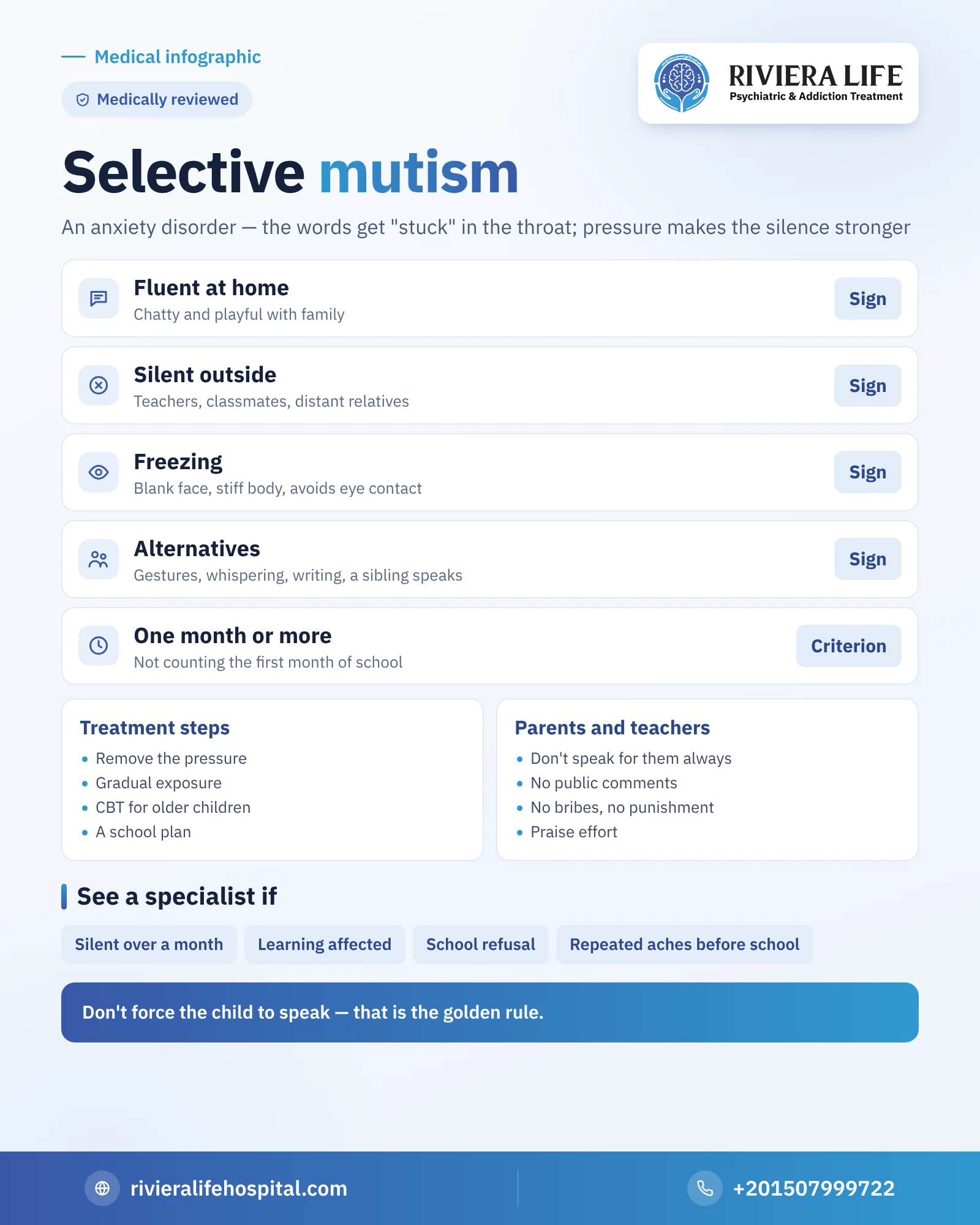
The diagnostic manual classifies this condition among the anxiety disorders. Its main conditions are: a consistent inability to speak in specific social situations where speaking is expected, while being able to in other situations; this lasting at least a month (the first month of school isn’t counted); its affecting education or social communication; and it not being caused by not knowing the language used or by another communication disorder such as stuttering.
The condition usually begins between the ages of two and five, but isn’t noticed until the child enters nursery or school. It is relatively rare, affects girls slightly more, and may continue untreated for years if it is put down to shyness.
What does it look like in daily life?
- The child speaks freely at home, and may be talkative and playful, then falls completely silent in front of teachers, classmates and more distant relatives.
- They seem frozen: an expressionless face and a stiff body, and they may avoid eye contact.
- They communicate by gesture, whispering or writing, or turn to a sibling to speak for them.
- They don’t ask to go to the toilet or ask for help at school.
- They may talk with a close friend in a low voice outside the classroom, then fall silent if someone approaches.
These children are often described as stubborn, arrogant or slow to understand, while in fact they hear what is said to them well and are hurt by what is attributed to them.
Selective mutism, shyness or stubbornness?
| Point of comparison | Ordinary shyness | Selective mutism | Stubbornness |
|---|---|---|---|
| Speaking outside the home | Speaks after a while of getting to know people | Doesn’t speak, or whispers, for months and years | Speaks when they want to |
| The body | Hesitation and bashfulness | Freezing and clear tension | Visible defiance |
| The motive | Social caution | Intense anxiety about speaking itself | Deliberate refusal of the request |
| The impact | Mild | Disrupts learning and friendship | A behavior problem |
For a comparison between social anxiety and shyness in adults see our article on social phobia symptoms, as many children with selective mutism carry severe social anxiety. Defiant stubbornness differs from it somewhat, as seen in oppositional defiant disorder.
Why does it happen?
Doctors don’t know a single cause. What is known is that affected children usually have a predisposition to anxiety and a reserved temperament that dislikes new situations, and that a family history of anxiety or severe shyness is common. Some cases may be linked to difficulties with sensory or language processing, which is why assessment is needed to clarify the picture. Trauma and poor parenting aren’t considered the most likely cause, although stress may make the condition worse.
It is important that parents aren’t burdened with guilt; in most cases the child isn’t silent because someone hurt them, but because their alarm system considers speaking in front of strangers a danger.
When the child is learning a new language
A child who emigrates or moves to an international school with a new language may be silent for months; this is called the silent period, and it is usually normal and temporary, and they speak afterwards as their language grows. But if the child also doesn’t speak with children who share their language at school, or the silence lasts more than six months without progress, selective mutism may lie behind it and deserves assessment.
How is it diagnosed?
Diagnosis is made through an interview with the parents, observations from the school, and usually an audio or video clip recorded by the parents at home to prove the child can speak. The specialist examines speech, language and hearing, and rules out communication disorders and the autism spectrum, as the silence may look similar on the surface, but they differ in that a child with selective mutism communicates socially normally in their safe places.
Treatment: small steps without pressure
The golden rule in treatment: don’t force the child to speak. Pressure raises anxiety and entrenches the silence. Treatment is based on gradually removing the fear of speaking:
- Removing pressure: the adults agree not to ask the child direct questions that require an answer, and to accept gestures, drawing and writing as acceptable means at first.
- Gradual exposure: very small steps, such as the child speaking with a familiar person in an empty room, then a second person quietly entering, then the situation gradually moving to a wider place. Techniques such as “sliding in” others and “stimulus fading” are applied by a specialist.
- Cognitive behavioral therapy: for older children, to learn to face the fear and think about it. Its principles resemble what is explained in cognitive behavioral therapy.
- A school plan: the teacher takes part in the plan, and celebrates small progress without an embarrassing public celebration.
- Medicine when needed: a child psychiatrist may decide on a medicine from the antidepressant class in severe cases or in older children alongside behavioral therapy, and it isn’t started or stopped except under their supervision.
Improvement usually comes gradually and steadily, and starting early is better, as silence that continues for years may become a habit that is hard to change and turn into social anxiety in adolescence.
What do parents and teachers do?
- Don’t always speak for them: give them a chance to communicate in their own way.
- Don’t comment on their silence in front of people: the phrase “why don’t you say hello?” embarrasses them and raises their anxiety.
- Don’t promise rewards or punish: “I’ll buy you a toy if you speak” or punishing silence both increase the pressure.
- Start from their safe place: arrange meetings at home with one classmate before large gatherings.
- Praise effort: “I liked that you took part with a gesture” is better than focusing on the audible word.
- Tell everyone: so relatives and teachers understand it isn’t an act.
A scene from the classroom
On the first day of the year the teacher asks each child their name. When it is Salma’s turn, she looks at the floor and doesn’t speak. The teacher gently repeats the question, so Salma freezes more and her ears turn red. The teacher thinks she is shy and moves on to someone else. After two weeks she decides Salma “doesn’t want to talk”, and complains to her mother. In the evening Salma tells her mother loudly about everything that happened at school, imitating the teacher and singing. This very contradiction is what leads to the diagnosis, and what the mother needs to explain calmly to the teacher, together with an audio recording proving the child can speak.
What eases things for Salma in class is being given alternative ways to take part, such as raising a card, nodding or writing on a small board, sitting next to a friend she trusts, and knowing in advance the question she will be asked so she isn’t taken by surprise.
When should you ask for specialist help?
Take your child to a psychologist or child psychiatrist if their silence at school continues for more than a month, their studies and friendships are affected, or you notice anxiety along with it, refusal to go to school, or repeated physical aches before school. Read also our article on mental illness in children. Because diagnosis requires a comprehensive assessment, don’t rely on waiting. At Riviera Life you can book a free first consultation in complete confidentiality to find out the right step for your child.
More from our guide to anxiety in children
- Anxiety: the complete guide
- Social phobia symptoms
- Mental illness in children
- Types of anxiety: 7 main disorders
- Bullying: its forms, signs and how parents and schools should act
Questions many people ask
No. Shyness is hesitation that fades with familiarity, while selective mutism is an anxiety disorder that prevents the child from speaking in specific situations despite being able to in others.
No, they freeze out of fear of speaking, not defiance, which is why punishment and pressure make the condition worse.
By reducing pressure and accepting alternative ways of communicating, then gradually exposing the child to speaking situations, with cognitive behavioral therapy and a school plan; medicine may be added for severe cases under the doctor's supervision.
Some children may improve, but untreated it may continue or turn into social anxiety, which is why early intervention is advised.
If the silence lasts at least a month beyond the first month of school, or affects learning and friendships, or is accompanied by anxiety and refusing school.