Psychological changes in adolescence aren’t an illness or rebellion without a cause, but a complete rebuilding of the brain, identity and relationships that happens in a few years. That is why mood swings, sleep gets longer, friends’ opinions become more important than home’s, and a sudden sensitivity to looks and words appears. Most of these changes are normal and pass with time. But some may be a signal of anxiety, depression or another problem that needs attention. This article helps parents and teenagers tell the two apart, without replacing a psychiatrist’s assessment.
What happens inside a teenager’s brain?
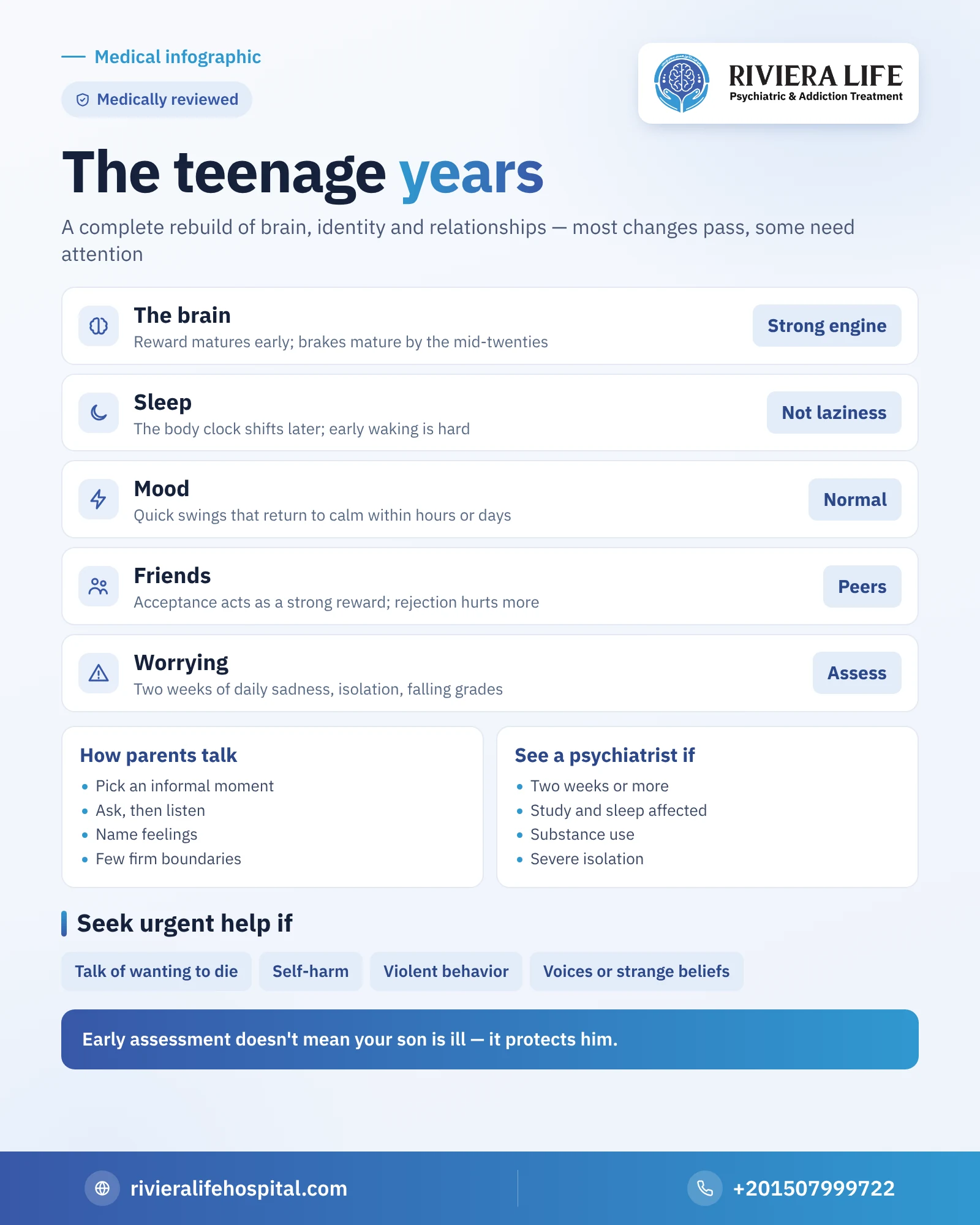
At this stage the brain goes through wide pruning and reorganization. The areas of reward and emotion mature early, while the frontal lobes responsible for planning, restraining impulses and judging consequences lag behind, and their maturation may continue until roughly the mid-twenties. The result is that the teenager feels strongly and gets excited quickly, but his brakes are weaker than his engine.
Hormones change too, and so does the body clock, so sleep tends to shift later and waking early becomes difficult. Much of the morning clash in Egyptian homes is caused by this later rhythm more than by the laziness or stubbornness parents assume.
Emotional changes: which are normal?
- Quick mood swings: laughing in the morning and upset in the evening without a clear reason, then returning to usual within hours or a few days.
- Sensitivity to criticism: a passing word in front of friends is felt as a big insult.
- The need for privacy: closing the door, hiding the phone, and talking little about details.
- Preoccupation with appearance: standing a long time in front of the mirror and comparing with others.
- Strong feelings without vocabulary: he says “I feel suffocated” or “I don’t know” because he doesn’t yet have precise words for what he feels.
Identity and independence: who am I outside the home?
The teenager’s biggest psychological task is to know who he is, not as his parents see him, but as he chooses. That is why he tries different styles of dress, music and opinions, and may oppose what he accepted yesterday. This opposition isn’t so much a rejection of the family as an exercise in independence.
The danger appears when independence turns into a complete break from the family, or when the teenager is pushed into independence before he is ready, so he looks for belonging in any group that accepts him, which may be a group that smokes or uses drugs. We have explained the risks of this in our article on teen addiction.
Friends and acceptance: why does outside opinion matter so much?
Acceptance by peers works in a teenager’s brain as a strong reward, and rejection hurts more than adults expect. That is why a teenager may put up with things he doesn’t like so as not to be excluded. Good friendships protect him and teach him social skills, while pressuring friendships push him toward risky behavior.
If you notice your son has suddenly lost his old friends and avoids every gathering, ask calmly about the reason. It may be bullying, it may be social anxiety (see social phobia symptoms), or it may be an ordinary disagreement that will end.
The body and self-image
Rapid physical changes make a teenager watch himself anxiously: a sudden growth spurt, acne, a changing voice, and features he isn’t used to. This preoccupation is common. But if the conviction that there is a flaw in his appearance takes over his day and stops him going out, it may be more than ordinary sensitivity, and here it helps to read our article on body dysmorphic disorder.
Screens and sleep
For a teenager the phone isn’t just a tool, but a social arena. So banning it completely doesn’t solve the problem, as it isolates the teenager from his friends. But excess at night steals sleep, and little sleep increases irritability and difficulty concentrating and weakens mood. Our article on social media addiction details when use becomes a problem. Screen rules work better when they are agreed with the teenager and the adults keep them too.
Normal and worrying: a comparison table
| Aspect | Usually normal | Calls for attention |
|---|---|---|
| Mood | Quick swings then a return to calm | Daily sadness or irritability for more than two weeks |
| Relationships | Changing friends and some distance from the family | Almost complete isolation and loss of all interest |
| Study | Fluctuating performance | A sharp, continuous drop with absence or dropping out |
| Sleep | Staying up late and difficulty waking early | Severe insomnia or sleeping all day |
| Eating | Appetite varying with growth | A sharp, noticeable change in eating or weight |
| Behavior | Arguing, stubbornness and experimenting | Repeated lying, stealing, violence or self-harm |
And if the symptoms resemble what is described in teen depression, it is better to take the matter to a specialist instead of waiting. For questions about drug use specifically, our article on how to know if my son is addicted explains the differences between adolescent changes and signs of use.
Seek urgent help immediately if you see
Some signs can't be postponed and aren't counted among the swings of adolescence.
- The teenager talking about wanting to die or being a burden on others
- Self-harm or marks of new wounds
- Violent behavior that threatens himself or others
- Hearing voices or strange beliefs that suddenly change his personality
- Using a drug with a sharp change in consciousness or behavior
Call an ambulance on 123 or go to the nearest emergency department, or call the mental health hotline on 16328. And don’t leave the teenager alone at that moment. For more on dealing calmly with self-harm, see self-harm: how to help someone you love.
How do parents talk with a teenager?
- Choose the time: talking during a car ride or while doing something together is easier than a direct confrontation at the table.
- Ask, then listen: a sentence starting with “why did you do that?” opens a defense, while “what happened?” opens a dialogue.
- Name feelings instead of judging them: “you seem upset” is better than “there’s no need to be upset”.
- Fewer orders and more choices: a teenager accepts a decision when he takes part in making it.
- Set a few firm boundaries: safety, sleep, study and respect, and leave the rest to negotiation.
- Watch yourself: parents’ shouting raises the temperature of the whole house, and calm is contagious too.
What changes in early, middle and late adolescence?
Adolescence isn’t one stage. At its start (roughly ten to fourteen) preoccupation with the body, shyness and sensitivity to comparison dominate. In the middle, friends’ influence intensifies and impulsivity and trying forbidden things appear. At its end, thinking turns toward the future, study, work and serious relationships, and anxiety about choices increases. Knowing where your son stands on this map makes your expectations more realistic.
What does the teenager himself do?
If you are a teenager and reading this, know that what you feel is common and that many others feel it and don’t say so. Try to identify an adult you trust, in your family or at school. Sleep as regularly as you can, move every day, and compare yourself less with what you see on the screen. And if you feel your sadness or anxiety is heavier than you can bear, asking for help is strength, not weakness.
When should you consult a psychiatrist?
Consult a specialist if symptoms last two weeks or more, affect study, relationships and sleep, or if substance use, self-harm or severe isolation appears. Early assessment doesn’t mean your son is ill; it means you are protecting him from a treatable distress turning into a chronic problem. You can read mental illness in children and when to see a psychiatrist to learn what parents can expect at the first visit.
How can Riviera Life help you?
At Riviera Life, a psychiatry and addiction hospital in Sheikh Zayed, Giza, psychiatry consultants assess the teenager’s condition in complete confidentiality, explain to the family what is happening and the right next step, and the family can take part in our family program. The first consultation is free; contact us on +201507999722.
More from our teen mental health guide
Questions many people ask
Usually yes, if they are quick and return to calm within hours or days. But daily sadness or irritability for two weeks or more needs attention.
It is part of building identity and independence, helped by the fact that the frontal lobes responsible for restraining impulses haven't matured yet. Calm dialogue and clear boundaries are better than confrontation.
When symptoms last two weeks or more, affect study, sleep and relationships, or severe isolation, substance use or self-harm appears.
A body clock that shifts later in adolescence is common. But very long sleep with loss of interest and sadness may be a sign of depression.
Choose an informal time such as a car ride, ask open questions, listen without judging or lecturing, and name the feelings you notice.