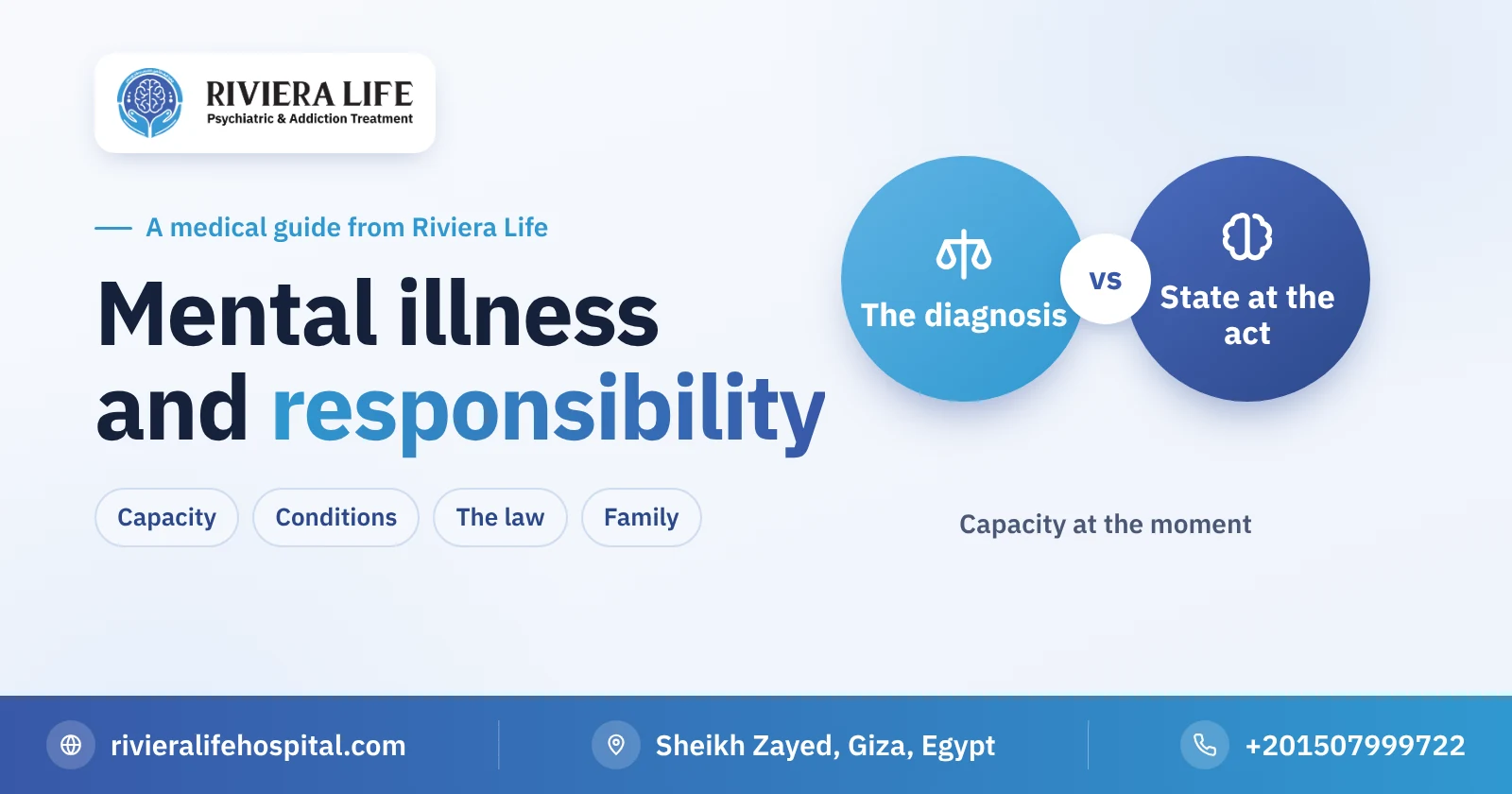
Is a mentally ill person responsible for their actions? The short answer: not every mentally ill person is not responsible, and not every mentally ill person is fully responsible. Responsibility isn’t linked to the name of the illness but to the person’s state at the time of the act: were they able to understand what they were doing, distinguish right from wrong and control their will?
The great majority of those living with depression, anxiety, OCD or even bipolar disorder in its stable periods bear responsibility for their actions like anyone else. On the other hand, a person in a severe psychotic episode may lose the ability to judge reality. Here we explain the idea with simple examples, how medicine and law look at it, and what the family does, with a note: this article is general information and not legal advice.
What does “responsibility” mean here?
We use the word in different senses, and confusing them causes much of the argument:
- Moral and social responsibility: is the person blamed for their behavior, and must they apologize and repair the damage?
- Legal responsibility: does the court hold them accountable criminally or civilly?
- Responsibility for treatment: the patient’s responsibility to follow their treatment as far as they can, and the family’s responsibility to support and protect them.
A person may not be legally culpable at a certain moment, but remains responsible for their treatment after they improve, and their family remains responsible for protecting them and protecting others. The two don’t conflict.
Is a mentally ill person responsible for their actions? Capacity at the time of the act
Forensic psychiatry usually asks two questions: at the time of the act, was the person able to perceive the nature of their act and its consequences? And were they able to control their behavior? What is meant is the person’s state at the moment of the act, not their general diagnosis or their medical record alone. Someone may suffer from schizophrenia for years and make a mistake in a stable period while fully aware, and the situation may be completely different if the act happened at the height of a psychotic episode in which they heard voices commanding them.
This resembles what we do with any patient: we don’t say “a diabetic is banned from driving”, but look at their condition at the moment and their ability.
Conditions that may weaken awareness or will
Among the conditions that may affect capacity, depending on their severity and timing:
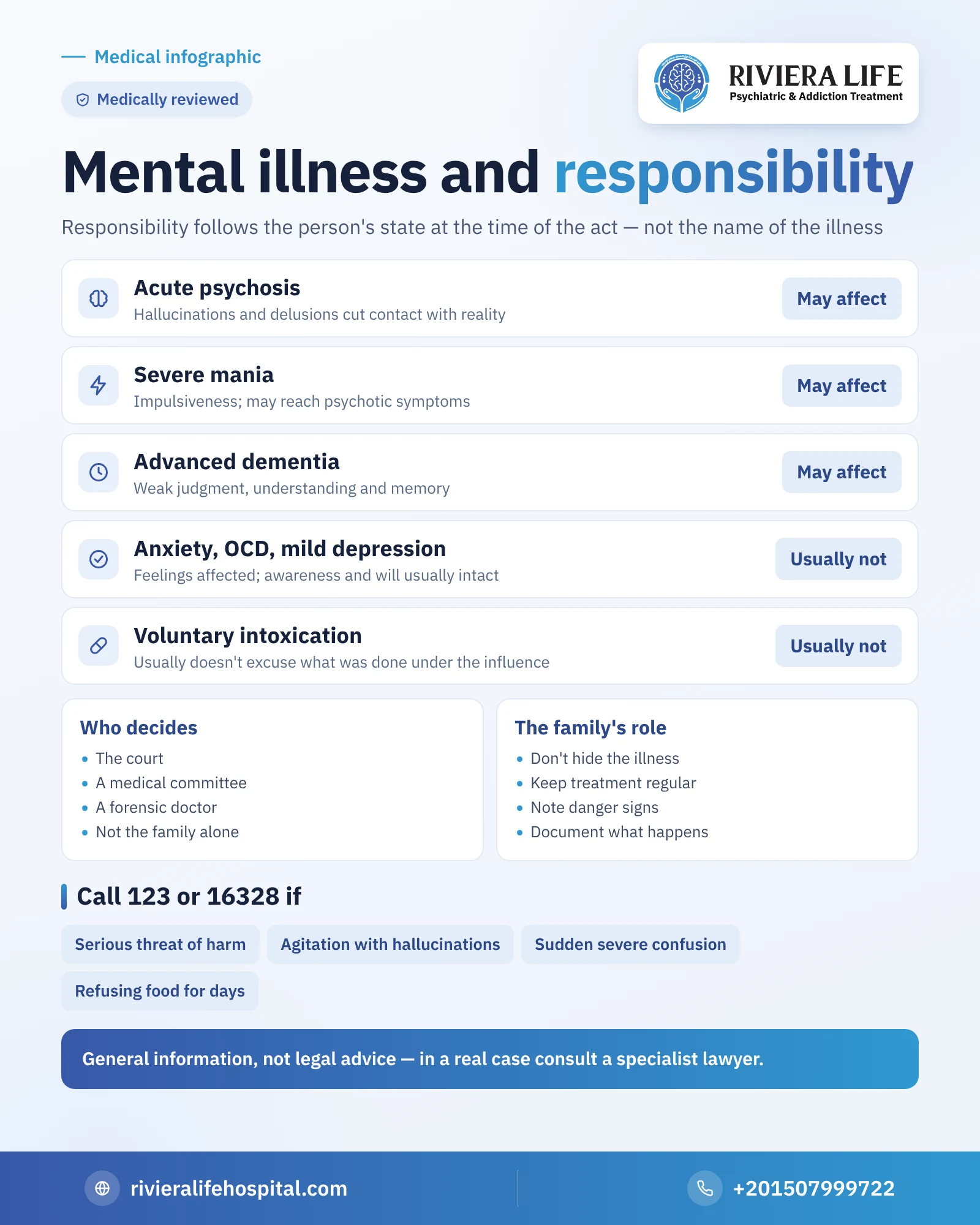
- Acute psychosis: hallucinations and delusions that cut contact with reality, as in some episodes of schizophrenia. See also hallucination symptoms.
- A severe manic episode: impulsiveness and a disturbed assessment of risks, which may reach psychotic symptoms.
- Psychotic depression: when depression is accompanied by severe delusions, as in psychotic depression.
- Advanced dementia and delirium: weakened judgment, understanding and memory; see caring for a person with dementia.
- Severe intellectual disability.
- Drug-induced psychosis: a special case that needs detail, which we explained in drug-induced psychosis.
These are severe conditions, they don’t apply to everyone, and they don’t mean everyone with this diagnosis has always lost awareness.
Conditions that don’t usually remove responsibility
Disorders such as generalized anxiety, mild to moderate depression, OCD, panic attacks and PTSD affect feelings and behavior, but they mostly don’t cancel awareness and will. The person understands what they are doing and can choose, even if that is hard and exhausting. Likewise, intense anger alone, a difficult personality, or narcissistic traits don’t justify harm. A psychological explanation of a behavior is one thing and justifying it is another; we can understand why an act happened without saying it is acceptable.
What about substance use and intoxication?
The general rule in many legal systems is that someone who takes an intoxicant or drug by their own will isn’t usually excused from responsibility for what they do under its influence, because using was their choice. The details differ from country to country and relate to the circumstances of each incident; if a long psychosis or a persistent condition arises after the substance’s effect has worn off, it may be viewed differently, and all of this is assessed by forensic medicine and the courts.
That is why it is wrong for a user to think addiction is “an illness that justifies everything”. Addiction is an illness that deserves treatment, and recovery is the person’s responsibility with their family’s support. For the general legal side and asking for treatment see the law and addicts in Egypt.
How do law and jurisprudence see it?
Penal codes in many countries, including Egypt in general terms, provide that someone who loses awareness or will at the time of the act because of a mental illness isn’t punished as a responsible person, and therapeutic measures such as placement in a mental health hospital may be taken instead. This isn’t decided by the treating doctor or the family, but by the court based on the report of a medical committee or a forensic doctor who examines the case. Islamic jurisprudence also regards reason as the basis of legal obligation; the hadith “The pen has been lifted from three” is often cited, including “the insane until he regains his reason”, with scholars giving detail on the degrees of insanity and the rulings.
It isn’t right to make a definitive judgment online about a particular case. If you are a party to an actual case, consult a specialist lawyer, and contact a forensic psychiatrist through the official bodies.
Belief and reality: is a mentally ill person dangerous?
One common myth is that mental illness means violence. Research indicates that the great majority of those affected harm no one, and that they are more likely to be victims of violence or exploitation. The risk increases when factors come together such as untreated psychosis with substance use, trauma and interrupted treatment, not because of the diagnosis alone. That is why regular treatment is the most important protection for the patient and those around them. For more on mistaken beliefs read myths about mental illness.
What is the family’s role in practice?
- Don’t hide the illness: hiding delays treatment and increases risk.
- Make sure treatment and follow-up are regular, and learn the signs of early relapse.
- Don’t overlook danger signals: talk of harming others or oneself, intense suspicion, or a sharp drop in sleep with agitation.
- Document what happens with dates, to make it easier for the doctor to assess the case.
- Set clear limits without humiliation: understanding doesn’t mean allowing harm.
- Request compulsory treatment or admission when there is a serious danger, according to the regulated procedures and with the doctor’s guidance.
If your relative refuses treatment despite serious deterioration, you may find it useful to read our article on compulsory treatment and when it is justified, which explains the principle in the context of addiction.
Call an ambulance on 123 immediately if you see
If there is an imminent danger to the patient or to others, don't wait for a consultation and don't try to confront it alone. Call an ambulance on 123 or the mental health hotline on 16328, and remove any tools that could harm.
- A serious threat to harm oneself or others
- Severe agitation with hallucinations or dominating suspicions
- Sudden severe confusion with failure to recognize people
- Refusing to eat and drink for several days
What about the patient themselves?
Many patients fear that all their actions will be read through the illness, so they feel they don’t own their decisions. The truth is that recovery means regaining the ability to choose. Accepting the illness and committing to treatment are part of taking responsibility, and they are the strongest protection against repeating mistakes. If you harmed someone during a period of illness, apologizing and repairing what you can helps others and helps you. And in all this, don’t carry the shame alone; ask a specialist for help.
How can Riviera Life help you?
You can get a free first consultation with a consultant psychiatrist at Riviera Life in Sheikh Zayed, Giza, to assess a patient’s condition or set a treatment plan and involve the family, in complete confidentiality. The hospital doesn’t provide legal advice; for judicial matters refer to the competent bodies and specialists. Call +201507999722.
Read also
- Myths about mental illness
- When do you need a psychiatrist?
- Schizophrenia treatment
- Mental illnesses: symptoms, types and treatment
Questions many people ask
No. Most people with anxiety, depression, OCD and other conditions bear responsibility for their actions; the standard is the person's state at the time of the act, not the name of the illness.
When awareness or will is lost at the time of the act because of a severe condition such as acute psychosis, severe mania or advanced dementia; this is assessed by forensic medicine and the courts.
The court decides, based on the report of a medical committee or forensic doctor, not the family nor the treating doctor alone.
Usually someone who used a substance by their own will isn't excused from what they did under its influence, but the details depend on each incident and are assessed by the courts.
No; the majority harm no one, and the risk rises with untreated psychosis and substance use. Regular treatment protects everyone.