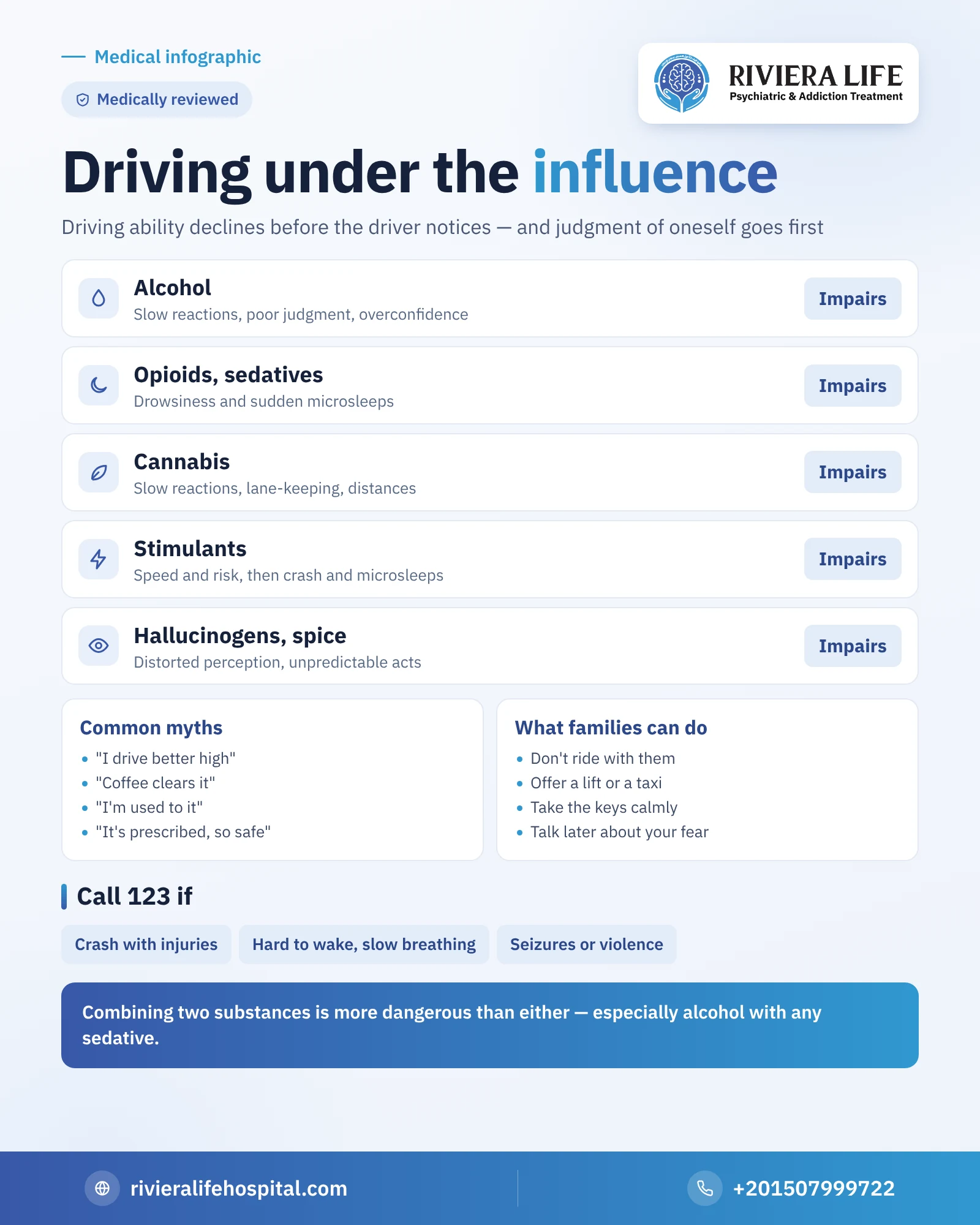
Driving under the influence of drugs is a danger to the driver and to everyone on the road, because it slows reaction and distorts the judgment of distance and speed, and may drop the driver into a brief sleep or a false confidence that pushes them to take risks. This includes banned substances, prescribed medicines, alcohol and combinations of them. Egypt’s traffic law generally criminalizes driving under the influence of a narcotic or intoxicating substance. Here we explain what happens to the driver and how substances vary in their danger, when a prescribed medicine is dangerous too, and what the family can do before an accident happens.
Why does driving under the influence of drugs weaken it so much?
Driving is a task that consumes attention, coordination and judgment at the same time: you watch the mirror, the lane and pedestrians, judge distance, and decide within fractions of a second. Substances that affect the brain hit all these functions, in different ways. And because driving abilities decline before the person feels it, they think they are fine while their judgment of themselves weakens first.
What does each family of substances do?
| Family | Its effect on driving |
|---|---|
| Alcohol | Slow reactions, poor judgment, imbalance and excessive boldness |
| Opioids (tramadol, codeine) | Drowsiness, slowing and poor concentration, and a sudden microsleep may happen |
| Sedatives and benzodiazepines | Lethargy, poor coordination and short-term memory loss |
| Hashish and marijuana | Slow reactions and difficulty keeping in lane and judging distances |
| Stimulants (ice, Captagon, cocaine) | Overconfidence, speed and impulsiveness, then severe tiredness and microsleeps as the effect wears off |
| Hallucinogens, spice and “chemical” | Distorted perception, hallucinations, confusion and unpredictable behavior |
Combining two substances is more dangerous than either alone, especially alcohol with any sedative.
And what about prescribed medicines?
Not all driving risks come from street drugs. Medicines such as tramadol, pregabalin, gabapentin, sedatives, some sleeping pills and drowsy antihistamines may weaken alertness, even if taken as prescribed. Regulators such as the US Food and Drug Administration warn that the effect of some sleeping pills may persist into the next morning and impair driving. If you take a medicine of this kind, ask your doctor or pharmacist clearly: can I drive? And when? And read the enclosed leaflet.
Don’t decide yourself that the medicine “doesn’t affect you”, as getting used to it may hide the feeling of drowsiness but doesn’t fully restore reaction speed. The details of dependence on these medicines are in prescription drug addiction and sleeping pill addiction.
The microsleep: moments enough for a disaster
The most dangerous thing about painkillers and sedatives is that they may put the driver into a microsleep lasting a few seconds without them noticing. At highway speed, the car covers a long distance in those seconds without a conscious driver. And it can’t be predicted: the driver may or may not feel drowsy. That is why the rule some follow, “I’ll pull over if I get sleepy”, doesn’t help, because the person affected may not get the warning.
Common illusions among drivers
- “I drive better when I’m high”: confidence is one of the symptoms of impairment, not evidence of safety.
- “A cup of coffee and the effect goes”: coffee may reduce the feeling of drowsiness, but doesn’t restore judgment and reaction speed.
- “I’m used to it”: tolerance hides the symptoms and doesn’t prevent real impairment.
- “It’s a short drive”: one accident is enough at any distance, even a few minutes.
- “Hashish doesn’t affect driving”: research indicates it affects reaction time and lane-keeping.
- “The medicine is prescribed, so it’s safe for driving”: a prescription proves medical use, not driving safety.
Signs that a driver is impaired
- The car weaving or drifting within the lane, or sudden braking for no reason.
- Slow response to signals, or running them.
- Slurred speech, inappropriate laughter or quick temper.
- Red eyes, dilated pupils or drooping eyelids.
- The smell of alcohol or smoke, or trembling hands and heavy sweating.
The appearance of some of these doesn’t prove use on its own, as they may result from illness or exhaustion, but it is enough for a passenger to refuse to take the risk.
The law and driving in Egypt: a general picture
In general, Egypt’s traffic law prohibits driving under the influence of alcohol or narcotic substances, and road campaigns are carried out to detect it; penalties may include a fine and withdrawal of the license, and may become heavier if the incident results in an accident or injuries. The details and penalties change, so consult a lawyer for actual cases. The general picture of how the law relates to seeking treatment is in the law and addicts in Egypt.
In practice, a professional driver usually loses their job if use is proven, which is an additional reason to seek help before the incident, not after it.
Taxi, transport and delivery drivers
A professional driver spends long hours on the road, and some resort to stimulants to stay awake or painkillers to bear the fatigue. This is a dangerous trick: the stimulant hides exhaustion without removing it, then a sharp crash follows, and staying awake turns into a risk to passengers. If you are a driver and find yourself needing a substance to finish your work, this is a sign that deserves medical advice, and articles such as dealing with someone addicted to Captagon may help you understand the pattern of staying up and crashing.
What can the family do?
- Don’t ride with a driver you think is impaired, and don’t let your children do so.
- Offer to drive them, call a taxi, or ask them to stay the night.
- Take the car keys calmly if the situation is clear, without arguing or challenging them in front of others.
- Talk with them when they are sober about your fear, not about their “disgrace”: “I could have lost you, or someone else.”
- If it recurs, it is a sign the problem goes beyond habit, and advice may not be enough (see the importance of early addiction treatment).
And if the person refuses all help and has become a danger to themselves and others, read about involuntary addiction treatment and its legal limits.
Call an ambulance on 123 immediately in these cases
After an accident, or if the driver seems to be in medical danger.
- An accident with injuries or loss of consciousness
- Difficulty waking the person, or very slow breathing
- Seizures, severe hallucinations or violence
- Chest pain, severe palpitations or a clearly raised temperature
Driving during treatment and recovery
In the first days of stopping, driving may also be impaired because of insomnia, tremor, absent-mindedness and supporting medicines. The practical rule is for the patient to ask their medical team when to return to driving, and not to decide alone. Many medicines used in treatment may cause drowsiness at first, and the doctor sets the right time according to the case.
And if you are a passenger and feel the driver isn’t safe, don’t be embarrassed to get out. Your safety matters more than awkwardness, and you can simply say you prefer to continue the journey another way. And if you are the driver and feel that the medicine you take is making your head heavy, stop the car in a safe place and ask someone to pick you up, then talk to the doctor the same day.
How can Riviera Life help you?
If you drive and fear that your substance use or medicine has become dangerous, the first consultation at Riviera Life is free and confidential. Consultants in psychiatry and addiction treatment assess your case and set a safe plan that includes round-the-clock medical supervision, a family program and follow-up after discharge. Call +201507999722; we are in Sheikh Zayed, Giza.
Read also
- Drug overdose: the signs and what to do
- Tramadol addiction symptoms
- The characteristics of a drug user
- Drug addiction: causes, symptoms and treatment
Questions many people ask
No, cannabis slows reaction, weakens lane-keeping and distance judgment, and there is no time that can be declared safe for everyone.
It depends on the medicine; some painkillers, sedatives and sleeping pills cause drowsiness, so ask the doctor or pharmacist and read the leaflet.
The law generally prohibits driving under the influence of an intoxicant or narcotic, and penalties vary depending on the incident; for details, consult a lawyer.
No, it may reduce the feeling of drowsiness, but it doesn't restore reaction speed or sound judgment.
Calmly prevent the driving, drive them or call an alternative, talk to them later about your worry, and seek an assessment if it recurs.