The short answer
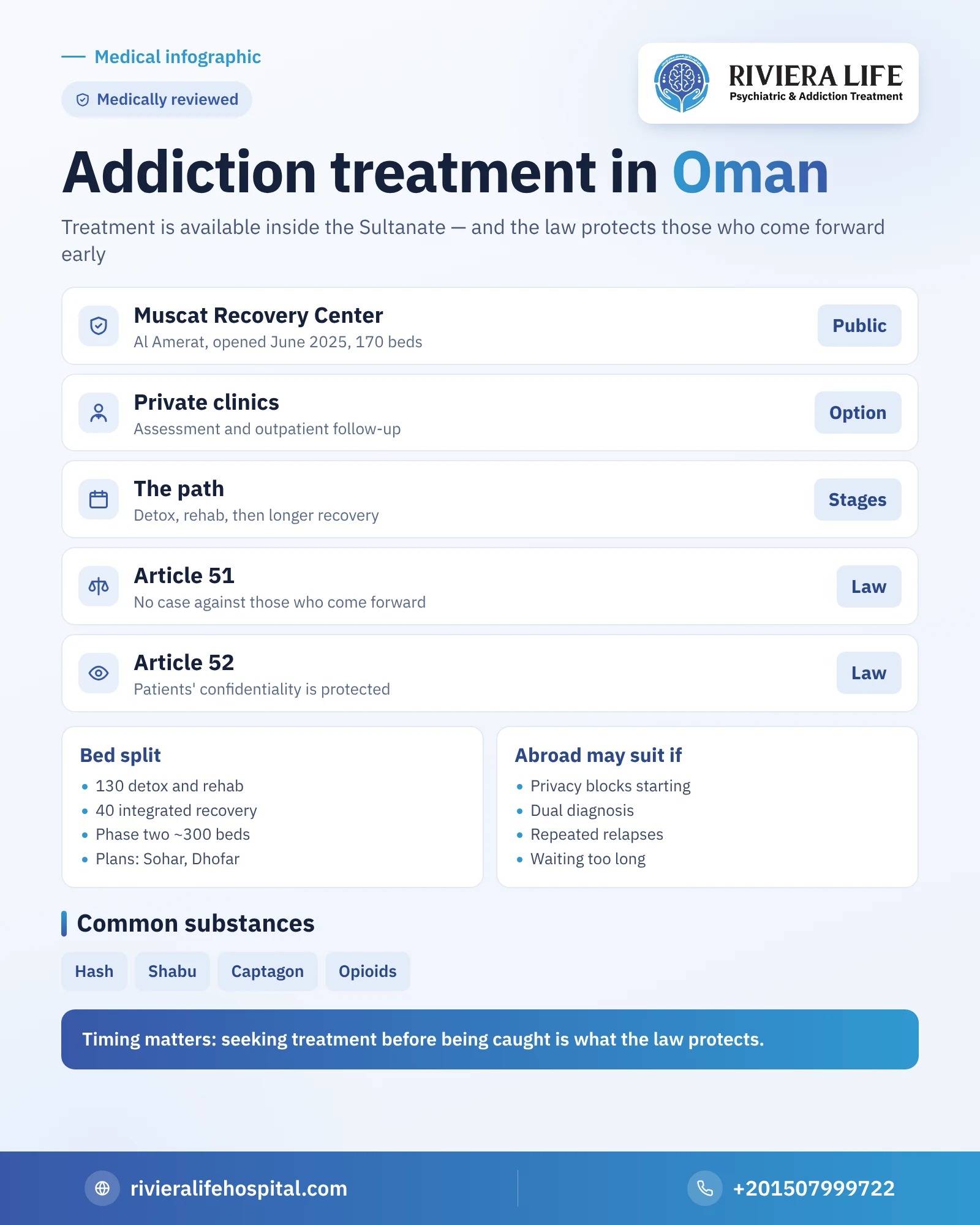
Addiction treatment in Oman is available inside the country through the Ministry of Health. The most prominent announced service is the Muscat Recovery Center in the Wilayat of Al Amerat, opened in June 2025 with 170 beds: 130 for detox and medical and psychological rehabilitation, and 40 for integrated recovery. It brought together under one roof what Al Masarra Hospital and the recovery houses used to provide. Treatment progresses from detox to rehabilitation and then longer recovery programs. The Omani narcotics law provides that no criminal case is brought against a user who comes forward for treatment of their own accord or at the request of their spouse or a relative, and for the confidentiality of patients’ data. Treatment outside Oman is worth considering in specific cases, such as wanting more privacy or having an accompanying psychiatric disorder that needs an integrated program.
- The public routeThe Ministry of Health’s Muscat Recovery Center
- Treatment stagesDetox, then rehabilitation, then extended recovery
- When to travel?More privacy or a complex case
Many Omani families search for “addiction treatment centers in Oman” while torn between shame at anyone finding out, fear of accountability, and questions about the quality of the treatment available. This guide gathers what has been officially announced about addiction treatment services in the Sultanate, explains how the treatment journey goes, when travelling abroad is an option worth considering, and when local treatment is the most suitable.
Addiction treatment hospitals and centers in Oman
The Muscat Recovery Center
According to Oman Daily, the Ministry of Health opened the Muscat Recovery Center in the Wilayat of Al Amerat on 30 June 2025, and it is presented as the first specialized government center for addiction treatment, rehabilitation and recovery in the Sultanate. It has 170 beds, of which 130 are for detox and medical and psychological rehabilitation and 40 for integrated recovery, and work is under way on a second phase of about 300 beds. The center treats drug addiction specifically, and alongside medical treatment provides psychological, social and behavioral support, with spaces for hobbies and a library for patients. Its construction was funded by Petroleum Development Oman and the Bridge Charity Foundation, and plans were announced for two more centers in Sohar and Dhofar.
Al Masarra Hospital and the recovery houses
Before the new center, Al Masarra Hospital provided detox and short-term rehabilitation, then referred patients to the recovery houses in Al Amerat. The program was described as lasting at least 21 days: a detox stage of 7 to 10 days, then short rehabilitation of two weeks to a month or more, with the possibility of an advanced rehabilitation program of six months or more. Reports indicate these services moved to the new center.
Private psychiatric clinics
There are private psychiatric clinics in Muscat and other cities, with which you can start assessment and outpatient follow-up. But detox from dangerous substances such as alcohol, sedatives and opioids needs a facility with round-the-clock medical supervision. Before starting, make sure the clinic is licensed by the Ministry of Health.
How do you start?
The patient or their family can go to the Muscat Recovery Center or the nearest government health institution to request assessment and referral, or start with a psychiatrist who determines the appropriate level of care. Seeking treatment voluntarily before any prosecution protects the patient legally, as the law section below explains.
How does the treatment journey usually go?
- Assessment: the nature of the substance, the duration of use, and the physical and psychological condition.
- Detox under medical supervision, with a duration that varies by substance.
- Individual and group psychological rehabilitation, and family therapy.
- A longer recovery program for those who need it, then regular follow-up after discharge.
The expected durations of each stage are detailed in the article on how long addiction treatment takes.
The most common substances and what they mean for treatment
Names such as hash, shabu or crystal, Captagon, opioids and some misused medicines recur in public talk about addiction in the Gulf. Each has a different plan: shabu and Captagon may cause psychosis that needs close psychiatric follow-up, opioids may need substitute medicines under supervision, and sedatives are withdrawn slowly. That is why it matters that the place can deal with the specific substance your son uses. Read about shabu addiction treatment and Captagon addiction treatment.
What does Omani law say about voluntary treatment and confidentiality?
Drugs in the Sultanate are governed by the Narcotic Drugs and Psychotropic Substances Law issued by Royal Decree No. 17/99 and its amendments. It contains two articles that matter to every family:
- Article 51: no criminal case is brought against a user who comes forward to the public authorities for treatment in the clinic, of their own accord or at the request of their spouse or a relative up to the second degree. This doesn’t cover someone caught using, or someone against whom a criminal case for this offence has already been initiated.
- Article 52: confidentiality is observed regarding patients treated for addiction and those who come forward for treatment voluntarily, and anyone who discloses a secret learned through their work is punished with imprisonment of up to one year and a fine of up to 500 rials.
The 2023 amendment by Royal Decree No. 24/2023 was limited to Articles 5 and 6 concerning the National Committee for Narcotics Affairs, and didn’t touch these two articles. The practical meaning is that timing is decisive: whoever seeks treatment before being caught is protected by the law. For the details of a specific case, consult an Omani lawyer.
When is treatment outside Oman a suitable option?
- If social privacy is a worry that stops the patient from starting at all.
- If there is an accompanying psychiatric disorder, such as severe depression, psychosis or a personality disorder, that needs an integrated dual diagnosis program.
- If relapses recur after local treatment, and the patient needs a completely different environment for a while.
- If the wait is long and the case can’t tolerate postponement.
On the other hand, treatment close to home remains better for many patients, because the family takes part in it and follow-up afterwards is easier. If you choose to travel, the plan must include from the start how follow-up will continue after returning.
If you decide on treatment in Egypt
The first step usually begins with a remote consultation that the doctor conducts with the family, then the program and duration are set before travel, who will accompany the patient is agreed, and remote follow-up after returning is arranged. The practical details are in addiction treatment in Egypt for Gulf patients, and the selection criteria in how to choose an addiction hospital.
How can Riviera Life help you?
Riviera Life receives patients from the Gulf states, and starts with a confidential remote consultation that helps the family assess the situation, whether the decision is treatment inside Oman or in Egypt, with dual diagnosis programs and remote follow-up after returning home. The first consultation is free and confidential on +201507999722.
Read also
- Addiction treatment in Saudi Arabia
- Addiction treatment in Kuwait
- Drug street names in Saudi Arabia and the Gulf
- Online addiction treatment
- Addiction treatment in Egypt for Arab patients: a guide by country
Questions many people ask
Yes, the Ministry of Health opened the Muscat Recovery Center in the Wilayat of Al Amerat in June 2025, offering detox, rehabilitation and recovery under one roof.
The recovery houses program was described as lasting at least 21 days, starting with 7 to 10 days of detox then short rehabilitation, with the possibility of an advanced program of six months or more.
According to what was published at its opening, the center specializes in drug addiction, and doesn't cover behavioral or internet addiction.
Yes, and treatment close to home is better for many patients. You can also start with a remote consultation to assess the case before any decision.
It is usually preferable for a family member to accompany them at the start, especially if the case is severe, and the family's participation in the treatment program improves outcomes.