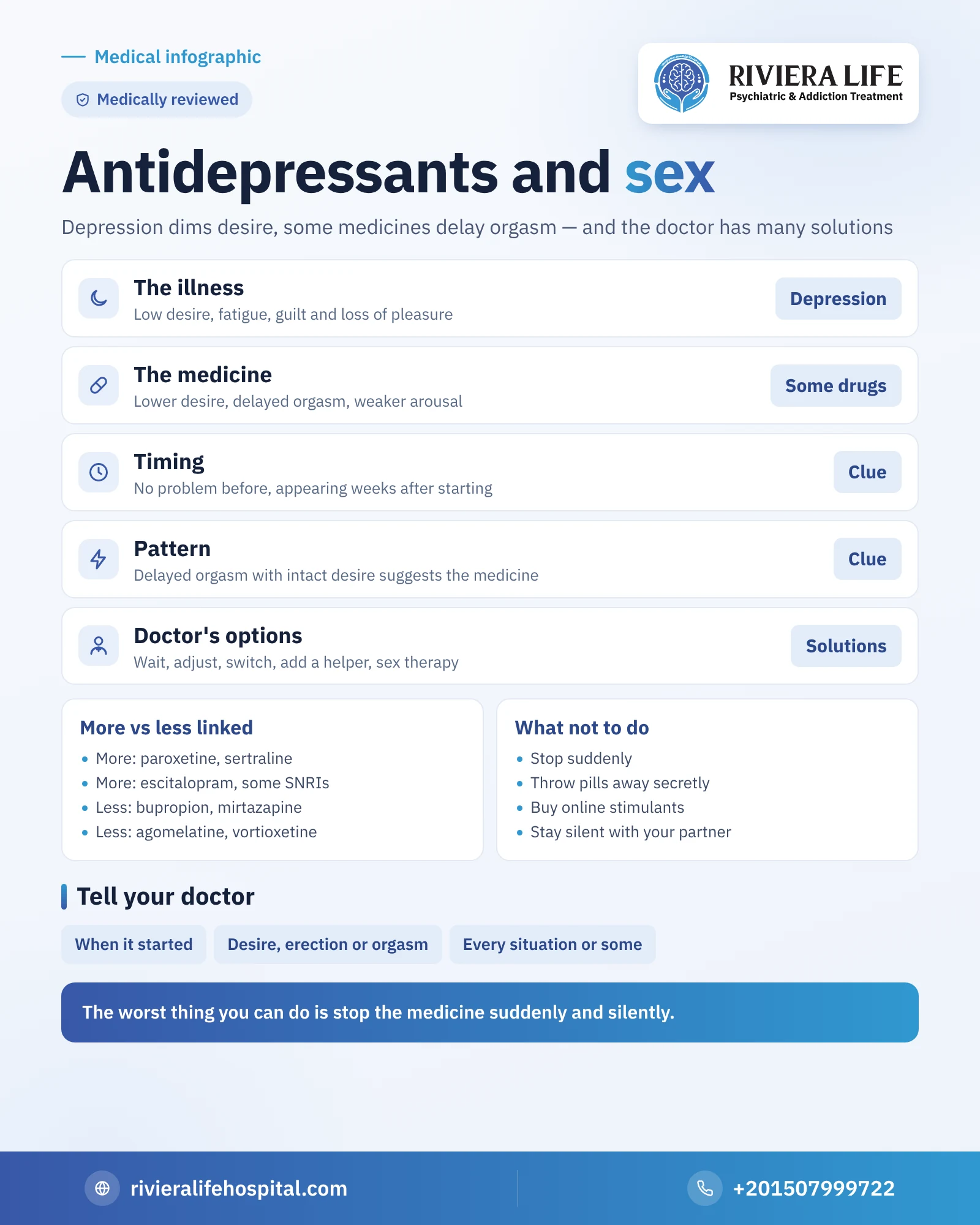
Antidepressants and sex is a relationship that puzzles many patients: depression itself affects sexual life, and some medicines do too, so the patient asks whether the cause is the medicine or the illness. The truth is that the two may come together. Depression dims desire and reduces energy and pleasure, and some antidepressants delay orgasm and weaken desire, erection and lubrication. The good news is that this problem has many solutions in the doctor’s hands, and the worst thing you can do is stop the medicine suddenly and silently. Here we distinguish the effect of the illness from the effect of the medicine, and set out what can be discussed with the doctor.
Depression itself affects sex
Before any medicine, depression changes the brain chemistry responsible for drive and pleasure, so the patient feels that things he used to love have lost their taste, including intimacy. The difficulties appear in different forms:
- Low or absent desire for months.
- Tiredness and exhaustion that make the very idea draining.
- Difficulty with erection in men, or with arousal and lubrication in women.
- Difficulty reaching orgasm, or no pleasure in it.
- A feeling of guilt or worthlessness that stops one approaching the partner.
- Constant mental preoccupation and negative thinking that break the moment.
These symptoms improve in many patients when the depression itself improves. For the core symptoms of the illness, see depression symptoms.
Antidepressants and sex: how do they affect the sexual response?
The sexual response is a chain: desire, then arousal, then orgasm. Some antidepressants interfere with more than one link, especially medicines that raise serotonin. The most common effects include:
- Weaker desire: the absence of a drive that used to be there.
- Delayed orgasm and ejaculation: reaching it takes longer, and may sometimes be difficult.
- Weaker arousal: difficulty with erection or less lubrication.
- Dulled pleasure: orgasm is weaker than it was.
- Tingling or numbness in the genital area: less common, and sometimes reported.
Estimates of how widespread these effects are vary greatly depending on the medicine and how the patient is asked, but they are common enough for doctors to count them among the most important reasons for leaving treatment. That is why they should be asked about frankly, and the patient shouldn’t be embarrassed to mention them.
Which antidepressants have more effect, and which less?
The medicines aren’t equal in this effect:
- More linked to the problem: selective serotonin reuptake inhibitors, such as paroxetine, sertraline and escitalopram, and some serotonin-norepinephrine reuptake inhibitors. Paroxetine is known as one of the strongest in delaying ejaculation.
- Less linked to it: medicines such as bupropion, mirtazapine, agomelatine and vortioxetine, according to what studies report.
This doesn’t mean the less-affecting one is better for every patient, as the one with less sexual effect may not suit your other symptoms, such as severe anxiety or insomnia. The choice is the doctor’s responsibility, balancing the medicine’s effectiveness for your depression against its effect on your life. Antidepressants explains all the classes.
Is the problem from the medicine or the illness?
The patient can’t be certain, but there are clues the doctor uses:
- Timing: if you had no problem before starting the medicine and it appeared weeks after, the medicine is more suspect.
- Previous record: if desire was weak before treatment because of depression, the illness is a likely cause.
- Pattern of the problem: delayed orgasm with desire intact suggests the medicine’s effect, while a general lack of interest in everything suggests the illness.
- General improvement: improved mood, sleep and energy with the sexual problem continuing favors the medicine’s effect.
- Different situations: being able to get an erection or be aroused in certain situations usually means the body is sound and the factor is psychological or medicinal.
There may be other causes such as diabetes, heart disease, hormones, smoking, alcohol and other medicines, so the doctor may request tests. Alcohol and sex explains one of these common causes.
What can the doctor do?
The doctor has several options, and doesn’t resort to stopping first:
- Waiting and watching: the effects may ease in some patients during the first weeks.
- Adjusting the timing or plan: the doctor sometimes changes the time or frequency of the medicine depending on its type.
- Switching to another medicine: one with less sexual effect, with a considered transition plan.
- Adding a helping medicine: used in specific cases at the doctor’s discretion, not without a prescription.
- Treating the erection problem: the doctor can prescribe a suitable medicine if there are no cardiac contraindications.
- Psychosexual and couples therapy: treats performance anxiety and distance between the partners.
None of these options is tried by personal experiment. “Stimulant” supplements and erection medicines of unknown origin may interact with the psychiatric medicine or the heart.
What not to do
- Stopping the medicine suddenly: causes discontinuation symptoms and the depression may relapse; details are in antidepressant withdrawal symptoms.
- Getting rid of the medicine secretly: the doctor loses the ability to adjust, and the patient loses protection from relapse.
- Buying stimulants online: their cardiac risks and interactions are known.
- Silence with the partner: misunderstanding doubles the distance and delays the solution.
- Using alcohol to break the barrier: worsens the weakness and conflicts with treatment.
How do you talk to your doctor?
Many stay silent out of embarrassment, and doctors themselves may forget to ask. It is enough to say: “I’ve noticed a change in my intimate life since I started the medicine”. It helps to prepare three pieces of information: when the change started, what exactly it is (desire, erection or orgasm), and whether it happens in every situation. Women have the same right to raise the matter, as these symptoms are often neglected in women more than in men. And it is advisable for the husband or wife to attend if the patient wishes, because the partner’s understanding eases the pressure.
Does the problem continue after stopping?
Mostly, the sexual effects go away within days or weeks after a planned stop following the doctor’s plan. Very rare cases have been described in which symptoms persist after the medicine is stopped, and doctors are still researching their causes and frequency, and these cases shouldn’t cause alarm. If the problem continues a long time after stopping, a comprehensive assessment of other causes is needed. You will find an example of a medicine known for its sexual effect in our article on paroxetine.
Men and women: different pictures of the same problem
In men the patient usually notices delayed ejaculation or difficulty reaching orgasm, and erection may decline. In women desire may decrease, lubrication weaken and orgasm be delayed, and these symptoms are often neglected because the woman doesn’t mention them or isn’t asked. In both cases a general emotional flatness may occur covering joy and sadness alike, so the patient feels “emotionally flattened”. This flatness is different from depression itself, and deserves to be mentioned to the doctor in the same words.
The effect on the marital relationship
A sexual problem during depression doesn’t harm its owner alone, as the partner may interpret the coldness as rejection or loss of love, so the gap widens. It eases this for both partners to know that the cause is an illness and a medicine, not a lack of feeling. Among general practical tips: frank talk away from the moment of intimacy, keeping emotional and physical closeness without performance pressure, and involving the doctor in the solution instead of keeping it hidden. Balance usually returns as the depression improves and treatment is adjusted.
How can Riviera Life help you?
At Riviera Life, licensed by the Ministry of Health, psychiatry consultants listen to your questions about treatment and intimate life in complete confidentiality, and adjust the treatment plan without you losing the benefit of treatment. The first consultation is free on +201507999722.
More from our psychiatric medicines guide
- Psychiatric medicines: their types and what each family treats
- Escitalopram (Cipralex)
- Mirtazapine
- Depression treatment
- Depression: the complete guide
Questions many people ask
They may in some users, especially serotonin reuptake inhibitors, but depression itself weakens desire, and the two often come together.
Studies report that medicines such as bupropion and mirtazapine are less linked to the problem, but the choice belongs to the doctor according to your condition.
No, stopping suddenly causes discontinuation symptoms and relapse; it is more correct to tell the doctor so he can adjust the plan.
They usually improve after a planned stop, and cases where they persist are rare and still being researched, and need a comprehensive assessment.
Often it can, by adjusting the plan, switching the medicine, a helping treatment or psychosexual therapy, all by the doctor's decision.