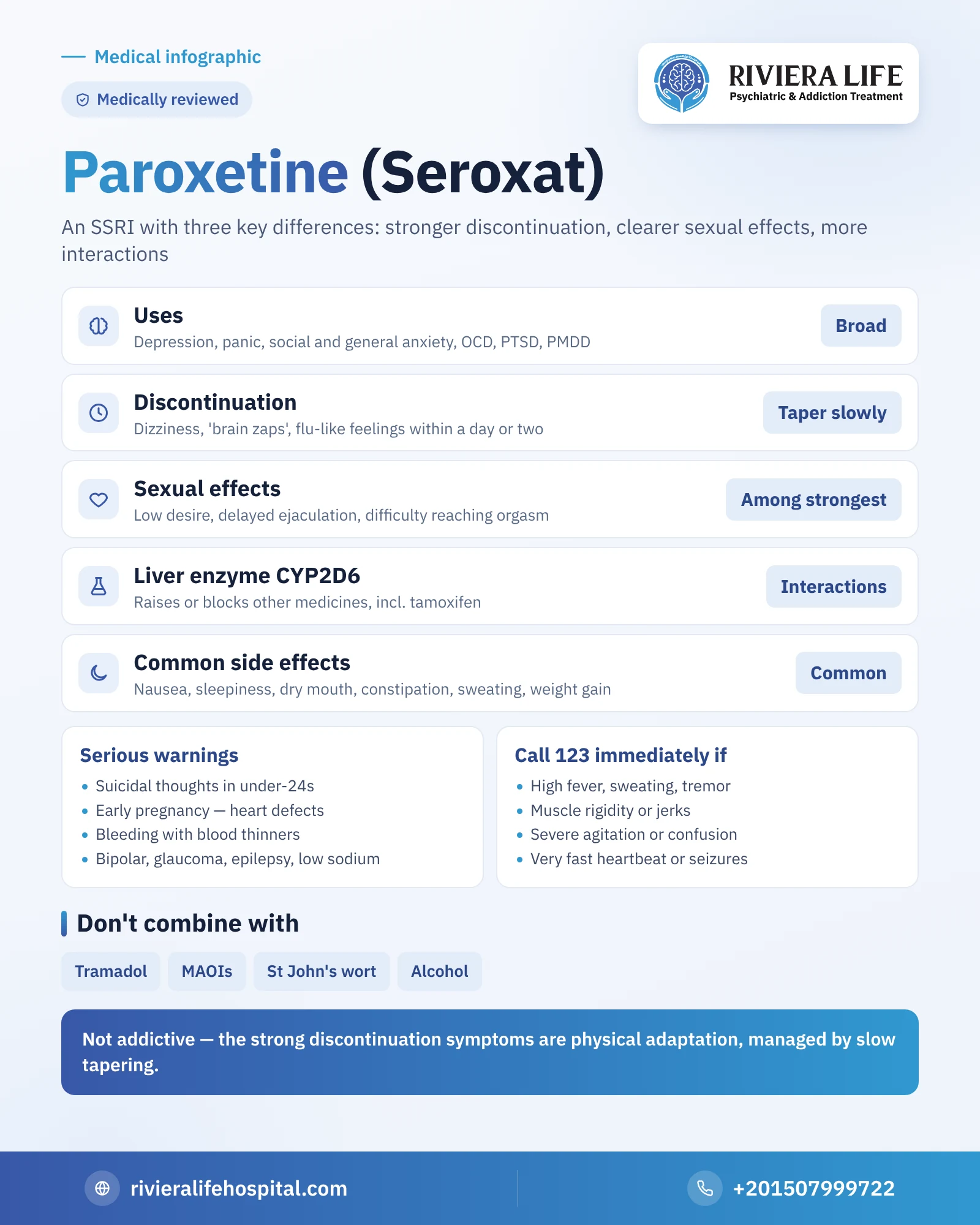
Paroxetine is an antidepressant from the selective serotonin reuptake inhibitor (SSRI) class, known in Egypt by its original name Seroxat and by equivalent names. A doctor prescribes it for depression and a large number of anxiety disorders. But it differs from its siblings in three points that everyone who takes it should know: discontinuation symptoms with it are stronger and appear faster, its sexual side effects are among the clearest in its class, and it has more interactions with other medicines. In this article we explain these differences, and cautiously address its use outside its original indications for premature ejaculation. You won’t find doses or instructions for use; starting, adjusting and stopping are with the psychiatrist only.
What is paroxetine?
Paroxetine was one of the first medicines in the SSRI class, and spread quickly because it is effective across a wide range of anxiety disorders. Like the rest of the class, it works by increasing the availability of serotonin, but it has some additional properties: a mild anticholinergic effect resembling older medicines, a short life in the blood, and a strong ability to block a liver enzyme that breaks down many medicines. These three properties are the key to understanding its side effects and warnings. Our article on antidepressants places it in the context of the other classes.
Brand names of paroxetine in Egypt
The original name used in Egypt and Europe is Seroxat, which has an extended-release form marked CR. In the United States it is known as Paxil. Egyptian pharmacies also have equivalent names containing the same substance, including Paxetin and Paroxedep. The regular and extended-release forms aren’t easily interchangeable, so don’t switch between them or between names without the doctor.
What is paroxetine used for?
- Depression: moderate and severe episodes, along with psychotherapy.
- Panic disorder: sudden episodes of fear and palpitations, as we describe in our article on panic attacks.
- Social anxiety and generalized anxiety.
- Obsessive-compulsive disorder and post-traumatic stress disorder.
- Premenstrual dysphoric disorder.
- Hot flushes at menopause: in a special formulation in some countries, a non-psychiatric use.
How does paroxetine work, and why is it different from its siblings?
Paroxetine closes the serotonin reuptake pump, so the neurotransmitter stays available for longer, and over the weeks the mood and fear circuits adapt. Up to this point it is like sertraline and escitalopram. The difference is that its effect on acetylcholine receptors makes it more likely to cause dry mouth, constipation and sleepiness, and that its rapid exit from the body, without long-acting intermediate substances, makes the brain feel its absence quickly when it is forgotten or stopped. Its blocking of the liver enzyme known as CYP2D6 raises the level of other medicines or cancels their effect.
When does paroxetine start working?
It usually needs several weeks before a clear improvement in depression or anxiety appears, and sleep and tension may improve before mood. In OCD the time is longer. A patient with panic disorder may notice a temporary increase in tension at the start, which is worth telling the doctor about rather than stopping the medicine.
Common side effects
- Nausea and headache in the first days.
- Sleepiness or insomnia, and a feeling of tiredness.
- Dry mouth, constipation and excess sweating.
- Dizziness and mild tremor.
- Weight gain with long-term use, which is clearer with it than with some members of its class.
Paroxetine and sex
All the medicines in its class can affect sexual function, but paroxetine is one of the most associated with these effects: weak desire, delayed or absent ejaculation in men, difficulty reaching orgasm in men and women, and sometimes weak erections. These effects don’t always ease with time, and they are among the most common reasons for secretly stopping the medicine. The solution isn’t stopping suddenly, which brings strong discontinuation symptoms, but a frank conversation with the doctor, who has options such as reviewing the timing, changing the medicine or adding a suitable treatment.
Paroxetine and premature ejaculation: a use outside the original indications
Because delaying ejaculation is one of paroxetine’s known effects, researchers have studied it for treating premature ejaculation, and some doctors use it for this purpose outside its approved indications. But this doesn’t make it a delay pill bought on a friend’s advice. Premature ejaculation has psychological and physical causes that need assessment first, and the medicine carries the same effects and warnings, including weak desire, strong discontinuation symptoms and drug interactions. The biggest danger in Egypt is combining it with tramadol, which some young men do seeking a greater delay, raising the likelihood of serotonin syndrome and seizures, as we explain in our article on tramadol and sex. The decision here belongs to a psychiatrist or andrologist who knows your history.
Why is stopping paroxetine harder?
Medical references note that discontinuation symptoms with paroxetine are more common and more severe than with the rest of its class, because it leaves the body quickly. Symptoms may begin within a day or two of forgetting or stopping it, and include:
- Dizziness and a feeling of imbalance.
- A sensation like tingling or electric shocks in the head.
- Nausea, headache and flu-like symptoms.
- Irritability, anxiety, mood swings and tearfulness.
- Insomnia and disturbing dreams.
That is why the doctor reduces it very slowly, and the reduction may extend over weeks or months; sometimes the patient is moved to a longer-acting medicine before stopping. Don’t stop it suddenly, and don’t leave it for days and then go back to it. How to tell these symptoms apart from the illness returning is explained in our article on antidepressant withdrawal symptoms.
Serious warnings you should know
- Suicidal thoughts in young people: an official warning covering antidepressants for those under about twenty-four. Any worrying change calls for the doctor immediately, the mental health hotline on 16328, or an ambulance on 123.
- Pregnancy: studies have linked its use in the first months of pregnancy to a higher likelihood of heart defects in the baby, so doctors usually avoid it for women planning pregnancy. If pregnancy happens during treatment, don’t stop it suddenly; contact your doctor to decide.
- Drug interactions: it may cancel the effect of tamoxifen, used to treat breast cancer, and raises the level of some heart medicines and antipsychotics.
- Bleeding: its likelihood rises with blood thinners, aspirin and anti-inflammatory painkillers.
- Other conditions: bipolar disorder, narrow-angle glaucoma, epilepsy, and low sodium in older people.
Call an ambulance on 123 immediately if you see
After taking too much paroxetine, or when combining it with tramadol or another medicine that raises serotonin:
- A high temperature with heavy sweating and tremor
- Muscle rigidity or repeated involuntary jerks
- Severe agitation, confusion or hallucinations
- A very fast or irregular heartbeat
- Seizures or loss of consciousness
Paroxetine, alcohol and drugs
Alcohol increases sleepiness and dizziness and weakens the effect of treatment, so it is better avoided. Tramadol, as mentioned, is a dangerous combination because of serotonin and seizures. Sedatives, pregabalin and opioids increase sleepiness and poor concentration. Stimulants raise blood pressure and serotonin together. Paroxetine isn’t combined with monoamine oxidase inhibitors, or with St John’s wort. The details of the signs of serotonin toxicity are in our article on serotonin syndrome.
Is paroxetine addictive?
It isn’t addictive in the medical sense: there is no high, no compulsive craving, and no seeking to increase the amount for a pleasurable effect. But the strength of the discontinuation symptoms makes some patients think they are addicted to it. The difference matters: these are symptoms of physical adaptation managed by slow reduction, not an addiction that needs withdrawal treatment. If you have been taking it for years and are afraid to stop, book your free first consultation with a consultant psychiatrist at Riviera Life, and we’ll set a comfortable reduction plan with you in complete confidentiality.
More from our psychiatric medicines guide
- Psychiatric medicines: the complete guide
- Antidepressants: the types and how they work
- Antidepressant withdrawal symptoms
- Anafranil (clomipramine): uses and warnings
- Prozac vs Lustral: how long they last, effects and interactions
- Fluoxetine (Prozac): uses, side effects and interactions
Questions many people ask
Both contain paroxetine; the difference is the manufacturer. Don't combine them or switch between them, especially between the regular and extended-release forms, except on the doctor's decision.
Yes. Discontinuation symptoms can appear quickly with paroxetine because it leaves the body fast. Don't make up with a double amount, and ask your doctor how to return to your plan.
In most patients sexual function improves after an organized stop or a change of medicine. If the problem continues, tell your doctor so they can assess other causes.
The doctor may combine them in certain cases after assessing the heart and other medicines, but don't do it on your own. Most important is telling your doctor frankly about the problem.
Doctors are cautious with it in older people because of its anticholinergic effect, interactions and possible low sodium, and may prefer another medicine. The decision depends on the case.