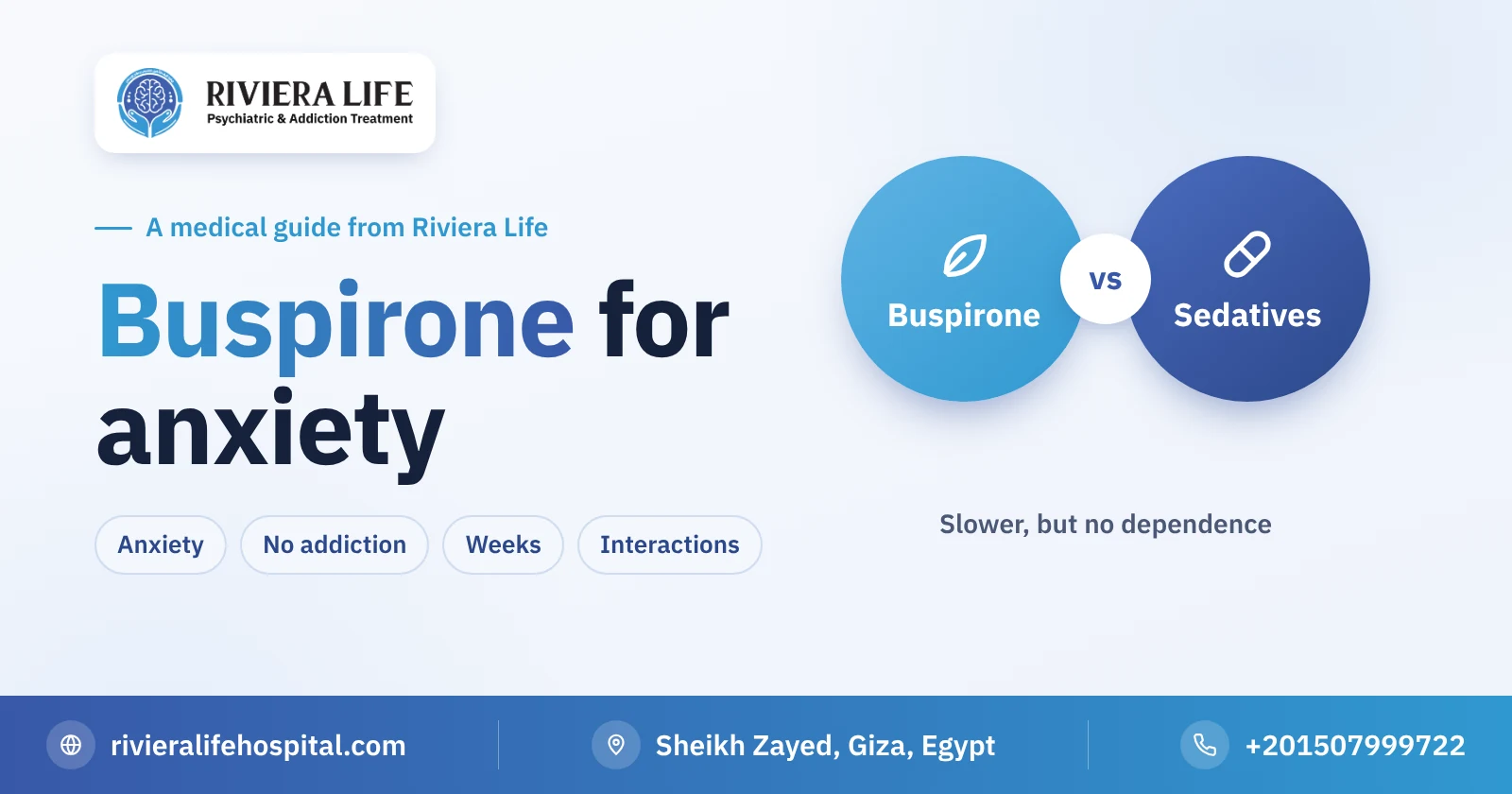
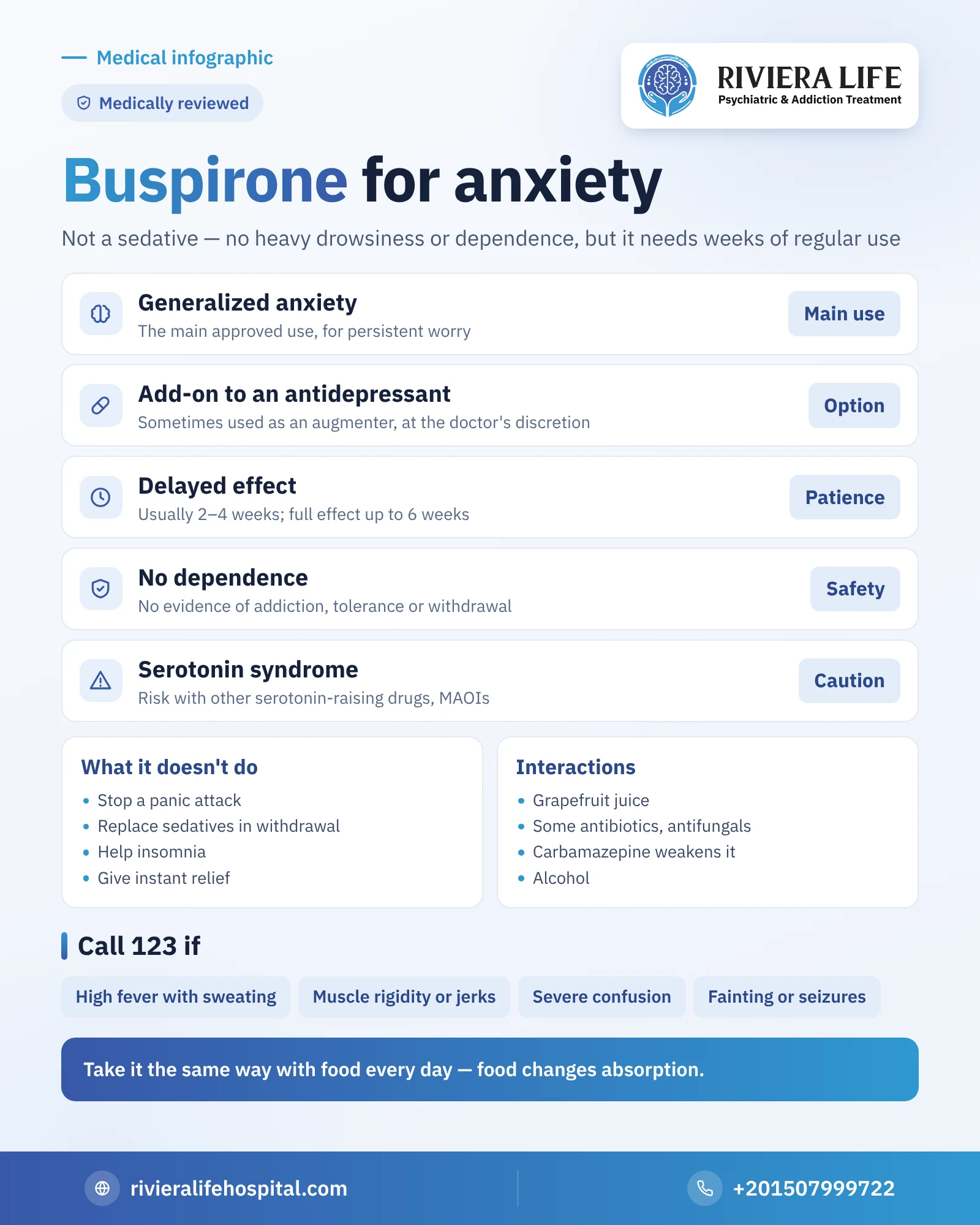
Buspirone, whose brand names include Buspar, is a treatment for generalized anxiety that is unlike the well-known sedatives such as Valium, Xanax and Rivotril. It doesn’t cause heavy drowsiness, doesn’t lead to physical dependence or addiction, and has no withdrawal symptoms like those known to people accustomed to benzodiazepines. On the other hand, it doesn’t work in an hour or a day; it needs weeks, and it isn’t suitable for rescuing a panic attack. Here we explain who it is prescribed for, who it doesn’t suit and what the patient can expect, without mentioning doses, as every step with it is taken with the doctor.
What is buspirone?
Buspirone belongs to the “azapirone” class, a group separate from benzodiazepines and antidepressants. It acts on serotonin 5-HT1A receptors as a partial agonist, and also has a slight effect on dopamine receptors. It doesn’t act on GABA receptors, which is the secret behind the absence of sedation and habituation. It is dispensed as tablets usually taken two or three times a day according to the plan. International guidelines don’t classify it as a narcotic substance, but it is dispensed on a doctor’s prescription. As for what is available in Egypt and its brand names, ask the pharmacist, as it may differ between the original and alternatives.
Who is buspirone prescribed for?
- Generalized anxiety disorder: the main approved use, when anxiety about many things continues for weeks and months.
- As an add-on to an antidepressant: some doctors turn to it as an augmenter when an antidepressant alone isn’t enough for anxiety or depression, a use at the doctor’s discretion.
- Someone who wants a medicine without habituation: especially someone with a history with sedatives or alcohol, so the doctor prefers an option that doesn’t carry a dependence risk.
- Older people: because it doesn’t cause drowsiness and falls as sedatives do, though caution remains necessary.
Why is its effect delayed?
This is what disappoints those expecting an immediate result. Buspirone relies on gradual changes in the response of serotonin receptors, so it usually needs two to four weeks before the patient notices a difference, and it may take up to six weeks before its full effect becomes clear. The most dangerous thing about this delay is the patient stopping after a week because it “did nothing”. Stick to the medicine as the doctor prescribes it, and record your symptoms on a scale of one to ten each week, which helps judge the effect objectively. After a suitable period, the doctor assesses the result and decides whether to continue or change.
What doesn’t buspirone do?
- It doesn’t stop a panic attack in the moment: it isn’t an as-needed medicine. To understand panic attacks and what helps during them, read panic attacks.
- It doesn’t replace sedatives when stopping them: a patient stopping a benzodiazepine won’t find in buspirone a substitute that prevents withdrawal symptoms, because its mechanism is different. That is why it isn’t given for this purpose, and withdrawing benzodiazepines has its own plan, as in our article on Rivotril withdrawal symptoms.
- It doesn’t necessarily treat social anxiety or OCD: its evidence is weaker in these conditions.
- It doesn’t make you sleep: so it isn’t used for insomnia.
- It doesn’t give a “high” or instant relief: so it doesn’t attract those seeking a direct effect, which is one of its strengths in terms of safety.
Common side effects
- Dizziness and light-headedness.
- Nausea and stomach discomfort.
- Headache.
- Nervousness or a feeling of tension, especially at first.
- Insomnia or vivid dreams in some people.
- Mild drowsiness in a few people.
These symptoms usually ease with time. It is advisable to take it in a consistent way in relation to food (always with food or always without), because food changes its absorption. If the dizziness doesn’t improve or the headache intensifies, tell the doctor. And before driving, make sure you know how it affects you.
Serotonin syndrome: when is it a risk?
Combining buspirone with other medicines that raise serotonin may increase the risk of serotonin syndrome, a rare but serious condition. These medicines include some antidepressants, including sertraline, monoamine oxidase inhibitors (MAOIs), some strong painkillers such as tramadol, some migraine medicines, and supplements containing St John’s wort. Many patients combine buspirone with an antidepressant safely under the doctor’s supervision, but unmonitored combining or combining with other substances is the danger. With MAOIs specifically, combining is prohibited except with careful arrangement and a time gap set by the doctor.
Foods and medicines that change its effect
- Grapefruit juice: raises the level of the medicine in the blood and increases side effects, so avoid it as your doctor advises.
- Some antibiotics and antifungals: may raise its level.
- Medicines that speed up liver breakdown, such as carbamazepine: may weaken it; read about it in our article on carbamazepine.
- Alcohol: isn’t advisable with it because it increases dizziness, weakens concentration and undermines anxiety treatment in the first place.
Does it cause addiction?
No. There is no evidence that it causes physical dependence, compulsive craving or tolerance that pushes the patient to increase the amount, a fundamental difference between it and benzodiazepines, and between it and pregabalin, which carries a risk of dependence for some people. Even so, a medicine remains a medicine: it isn’t taken without a prescription, and isn’t stopped without consultation, because stopping suddenly may bring anxiety back and make assessment difficult. And if you suffer from anxiety and turned to sedatives until you became dependent on them, there is treatment for that, which we discuss in our article on anxiety treatment.
How does medicine work together with psychotherapy?
Medicine alone is rarely the whole plan. Chronic anxiety is fed by habits of thinking and avoidance, which is why cognitive behavioral therapy helps, with or without medicine. Buspirone can ease the intensity of physical tension, making it easier for the patient to practise facing situations instead of escaping them. Organizing sleep, reducing caffeine and exercising also help. Over time the doctor may decide to reduce the medicine gradually when things are stable, a shared decision not taken suddenly.
Pregnancy and breastfeeding
Data on buspirone in pregnancy are limited, so the doctor decides after weighing the risk of untreated anxiety against the risk of the medicine. The medicine isn’t stopped suddenly on discovering a pregnancy; the plan is discussed with the doctor. Likewise in breastfeeding, the doctor or pharmacist is asked.
When should you see the doctor without delay?
- If anxiety hasn’t improved after a sufficient period as set by the doctor.
- If severe dizziness, nervousness or insomnia that weighs on you appears.
- If you have started a new medicine or herbal supplement.
- If depression or harmful thoughts appear.
- If you feel you need stronger sedatives to get through your day.
Common mistakes
- Stopping after a week because it hasn’t worked yet.
- Using it as needed as if it were a sedative, which doesn’t help.
- Combining it with antidepressants or strong painkillers without the doctor’s knowledge.
- Changing how it is taken in relation to food from day to day.
- Thinking it treats withdrawal from benzodiazepines.
Call an ambulance on 123 immediately if you see
After taking buspirone with other medicines, or after an excessive amount:
- High fever with heavy sweating and shivering
- Muscle rigidity or involuntary jerks
- Severe confusion or agitation
- A very fast heartbeat
- Severe diarrhea with continuous vomiting
- Fainting or seizures
How can Riviera Life help you?
If anxiety dominates your days or you rely on sedatives to calm down, a full assessment is best to determine whether buspirone, psychotherapy or another plan suits you. The consultants in psychiatry and addiction treatment at Riviera Life provide this in complete confidentiality, and the first consultation is free on +201507999722.
More from our anxiety guide
- Anxiety: the complete guide
- Anxiety treatment
- The best medication for depression and anxiety
- GABA and anxiety
Questions many people ask
There is no evidence that it causes dependence or withdrawal symptoms like benzodiazepines. It remains a prescription medicine and isn't stopped without consultation.
Usually two to four weeks, and the full effect may take up to six weeks. So it shouldn't be judged after a few days.
No, it isn't an as-needed medicine and doesn't stop the attack at the moment. Its benefit comes from regular use.
No, its mechanism is different and it doesn't prevent withdrawal symptoms. Withdrawing benzodiazepines needs a special medical plan.
Usually yes, because it raises the level of the medicine in the blood and increases dizziness and nausea. Ask your doctor or pharmacist.