Conversion disorder, also called functional neurological disorder today, is a condition in which real neurological symptoms appear, such as weakness in an arm or leg, tremor, seizure-like attacks, or loss of voice or sight, without medical examination finding a physical disease to explain them. The patient isn’t acting or faking; the symptoms really exist and are distressing, but the fault is in how the nervous system works, not in its structure. Here we explain its symptoms, how doctors distinguish it from physical neurological diseases, its link to psychological stress, and how it is treated.
What is conversion disorder?
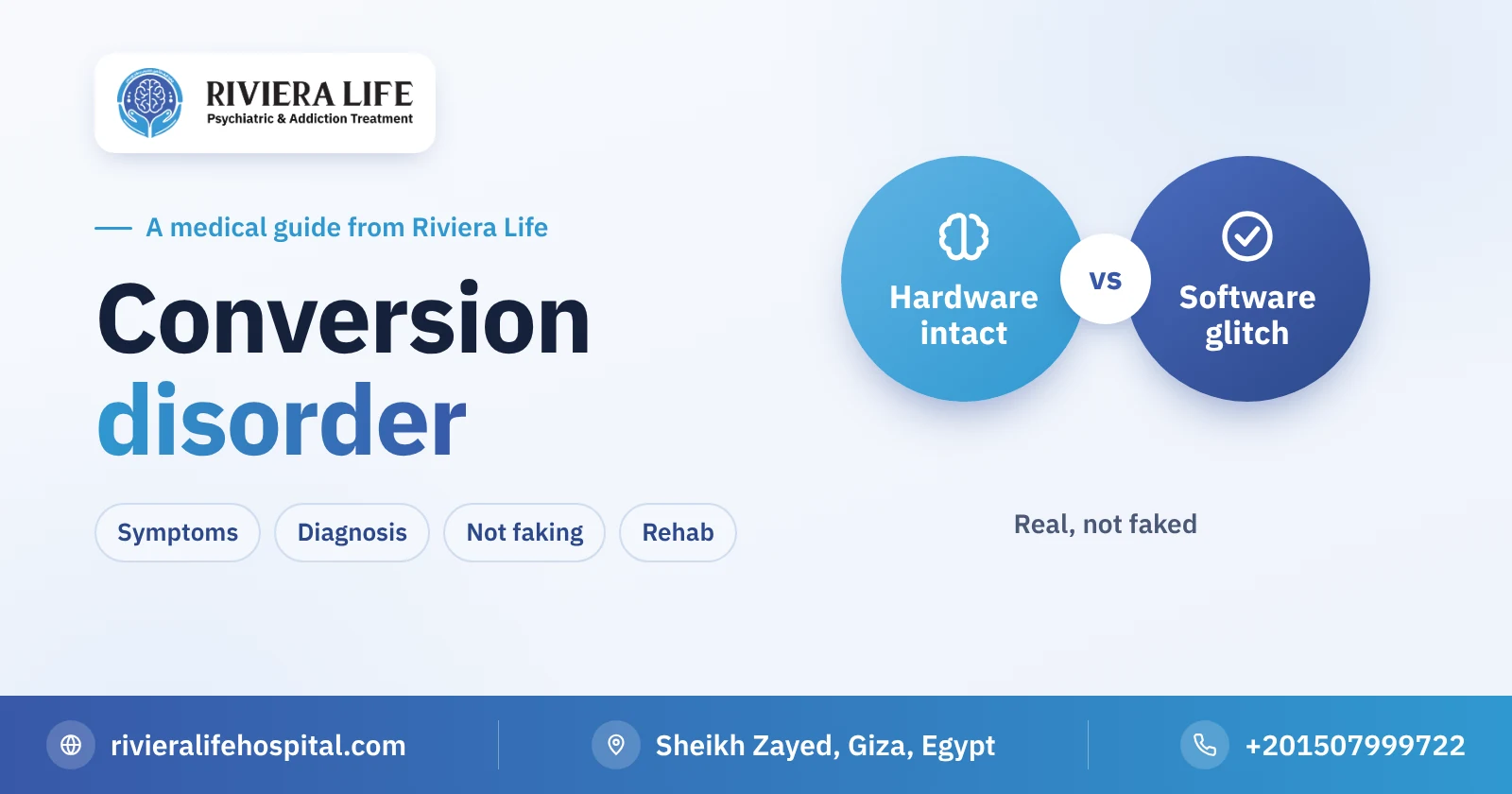
The old name “conversion” came from the idea that psychological conflict is “converted” into a physical symptom. Doctors no longer rely on this theory fully, so in the diagnostic manual it was replaced with the name “functional neurological symptom disorder”. The word “functional” means the function is disturbed, like a computer whose hardware is intact but whose software runs incorrectly.
The disorder usually begins between adolescence and middle age; it is diagnosed more often in women, and affects men too. It is one of the most common reasons for visiting neurology clinics, more than people think, but many don’t hear its name until after rounds of tests.
Common symptoms
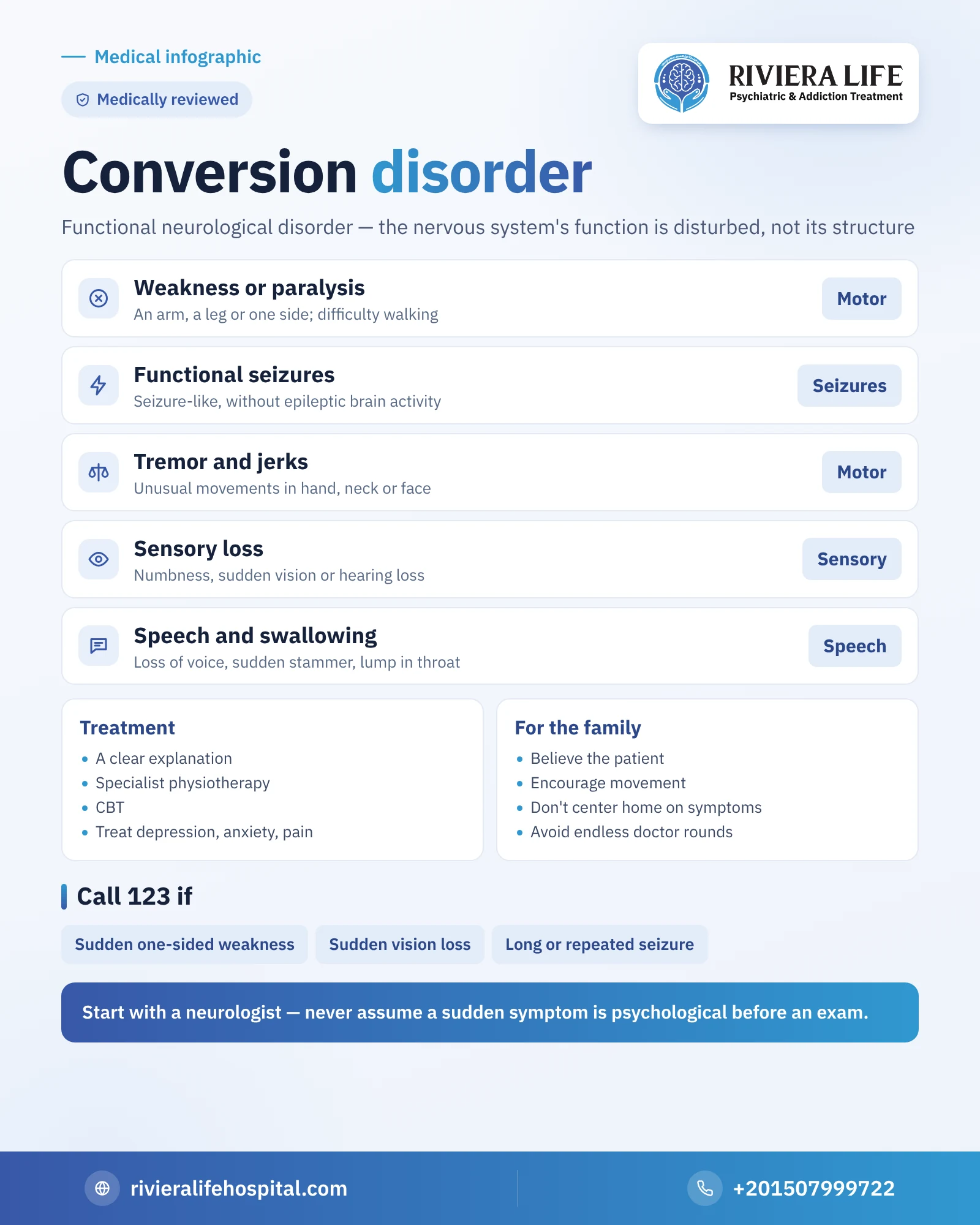
- Weakness or paralysis: in an arm, a leg or a whole side of the body, or difficulty walking as if the legs won’t carry their owner.
- Involuntary movements: tremor, jerks or unusual movements in the hand, neck or face.
- Seizure-like attacks: convulsions or falling with partial loss of consciousness without epileptic electrical activity in the brain, called psychogenic non-epileptic or functional seizures.
- Sensory symptoms: numbness or loss of sensation in part of the body, or sudden weakness in vision or hearing.
- Disturbed speech and swallowing: loss of voice, a sudden stammer, or a feeling of a lump in the throat.
The symptoms usually come suddenly, and may improve and worsen with attention and distraction, easing when the person is occupied with something else and intensifying when they focus on them. This fluctuation is part of their nature and isn’t evidence of pretending.
How does the doctor know the symptoms are functional?
The doctor doesn’t just say “nothing showed in the tests”. Modern diagnosis is positive: the neurologist looks for signs on clinical examination that indicate a functional pattern, such as leg strength returning when tested indirectly while weakening when tested directly, or a tremor shifting to the rhythm of a requested movement, among others. He may request tests, scans and an EEG to rule out diseases such as multiple sclerosis, epilepsy, strokes and brain tumors.
That is why the patient should start with a neurologist, rather than every sudden symptom being attributed to the psyche without examination. A functional disorder may also coexist with a physical disease in the same person, so follow-up remains important.
What is its link to psychological stress and trauma?
In many patients the disorder is preceded by stress, trauma or loss, but not in all. In some it starts after a physical illness, an accident, an injury or an operation, and others develop it with no apparent cause. That is why the patient shouldn’t be pressed with “what happened to you? There must be trauma!” If there is a psychological cause it will emerge with treatment, and if there isn’t, the diagnosis remains correct.
The likelihood increases with anxiety, depression, personality disorders and a history of abuse, but the great majority of people with these don’t develop functional symptoms.
Is it acting or “hysteria”?
This is what hurts patients most. The word “hysteria” was inherited by popular culture from old medicine, and came to mean drama and exaggeration, which is unfair. There is an important difference between three things:
| Condition | Are the symptoms deliberate? | Is there an external gain? |
|---|---|---|
| Conversion disorder | No, the patient doesn’t control them | No |
| Malingering | Yes | Yes, such as avoiding work or getting compensation |
| Factitious disorder | Yes | No, the motive is the patient role itself |
Histrionic personality is a personality pattern characterized by seeking attention and exaggerated emotion, and it isn’t conversion disorder. They may meet in one person, but most people with conversion symptoms don’t have a personality disorder. And the difference from psychosomatic disorders is that the symptoms here are specifically functional neurological ones.
Treating conversion disorder
The most important step is the explanation. When the patient hears from their doctor that their symptoms are real and have a name and a treatment, half the road is covered. After that the treatment plan varies according to the type of symptoms:
- Movement rehabilitation: physiotherapy specialized in functional disorder that retrains movement and walking by directing attention away from the limb; it is one of the most useful means for weakness and tremor.
- Psychotherapy: cognitive behavioral therapy helps understand the role of attention, anxiety and avoidance in maintaining the symptoms, and other sessions help when trauma lies behind them.
- Treating accompanying conditions: depression, anxiety, chronic pain and sleep disorders; the doctor may prescribe medicine for them, which isn’t adjusted or stopped except under his supervision. There is no medicine that cures the functional symptoms themselves.
- Educating the family: how to help without turning into a permanent “servant” that prolongs the disability.
Many patients improve, especially those diagnosed and treated early, and symptoms may return under stress, at which point what they learned is put to use. Someone whose diagnosis was delayed for years may need more patience, but hope remains.
Common mistakes on the road to diagnosis
The story often follows the same path: a young man wakes up unable to move his leg, is taken to the emergency department, and many scans and tests are done, all normal. He goes home without an explanation, so his fear grows, and he starts a journey between clinics, doctors, sheikhs and medicines without result. With each round his conviction strengthens that “the doctors didn’t understand” or that a serious illness is hiding in his body.
- Unnecessarily repeated tests: repeating the same scans adds nothing new and may increase anxiety.
- Telling the patient “it’s all in your head”: a phrase that wounds and breaks trust; the right thing is to explain that the symptoms are real and that their treatment goes through the nervous system itself.
- Long bed rest: it weakens the muscles and entrenches disability instead of solving the problem.
- Relying on sedatives: they may relieve for hours but don’t treat functional symptoms, and may add a dependence problem.
How does the family deal with it?
- Believe the patient and don’t say “you’re acting” or “there’s nothing wrong with you”.
- Help them move and rely on themselves as far as they can, as long rest and permanent disability entrench the symptoms.
- Don’t make the home revolve around the symptoms; care for them calmly without magnifying every attack.
- Avoid continuous rounds between doctors looking for the “real diagnosis” after the necessary tests have been done.
Call an ambulance on 123 immediately if you see
Don't assume a sudden symptom is psychological before a doctor has examined it; some neurological symptoms mean a stroke, bleeding or a real epileptic seizure.
- Sudden weakness in one side of the face, arm or leg, or difficulty speaking
- Sudden loss of vision or a sudden, unusual severe headache
- A long or repeated seizure, or one with injury or difficulty breathing
When should you see a psychiatrist?
After the neurologist has ruled out physical causes, a psychiatric assessment is advised if the symptoms persist or disrupt work, study and daily life, or are accompanied by intense sadness, anxiety and thoughts of self-harm. Read also when do you need a psychiatrist. At Riviera Life, consultant psychiatrists work with the family in complete confidentiality to set a plan that treats what lies behind the symptoms, and the first consultation is free.
More from our guide to psychological physical symptoms
- Psychosomatic disorders: when the body speaks the language of anxiety
- Histrionic personality: the signs and the difference from hysteria
- Illness anxiety: when worry about health becomes a disorder
- Anxiety: the complete guide
- Difficulty expressing emotions: alexithymia and how to deal with it
- Psychogenic urticaria: when stress triggers hives and how it is treated
Questions many people ask
No. The patient doesn't control the symptoms or produce them deliberately; they are real and distressing, but the fault is in how the nervous system works, not in its structure.
No. Histrionic personality is a personality pattern, and conversion is a disorder of neurological symptoms; most people with conversion disorder don't have a personality disorder.
No. Stress or trauma precedes it in many people, but it may start after an illness or injury or without a clear reason.
Yes, many patients improve with movement rehabilitation and psychotherapy, especially with early diagnosis.
Functional seizures aren't accompanied by epileptic electrical activity in the brain; telling them apart needs a neurologist's assessment and may require video EEG.