Defense mechanisms are ways the mind turns to, without deciding to, to ease a pain, fear or guilt it can’t bear in the moment. When you tell yourself “nothing happened”, get angry at a colleague because of a disagreement with someone else, or bury yourself in work so as not to think about a painful loss, you are using a defense mechanism. Most of us do this daily, and some of them really do protect us. The problem starts when the mechanism alone becomes a way of life, preventing a person from seeing their problem and from seeking help. Here we explain the best-known mechanisms and their examples, how to recognize them, and how they turn into barriers in relationships, addiction and treatment.
What exactly are defense mechanisms?
The concept emerged in psychoanalysis with Sigmund Freud, then was expanded by his daughter Anna Freud and those who came after her. The basic idea is that the mind protects the person from heavy feelings by changing the way they see or feel reality, and that this happens automatically without planning. That is why it isn’t right to say someone is “lying” when they deny; they usually don’t see the truth the way we do.
Medical references usually classify these mechanisms from the simplest and most primitive to the most mature. Some studies suggest that the mechanisms a teenager relies on may give an early signal of their later personality pattern, but these are only indicators, not verdicts.
The best-known defense mechanisms, with examples
| Mechanism | What does it do? | A real-life example |
|---|---|---|
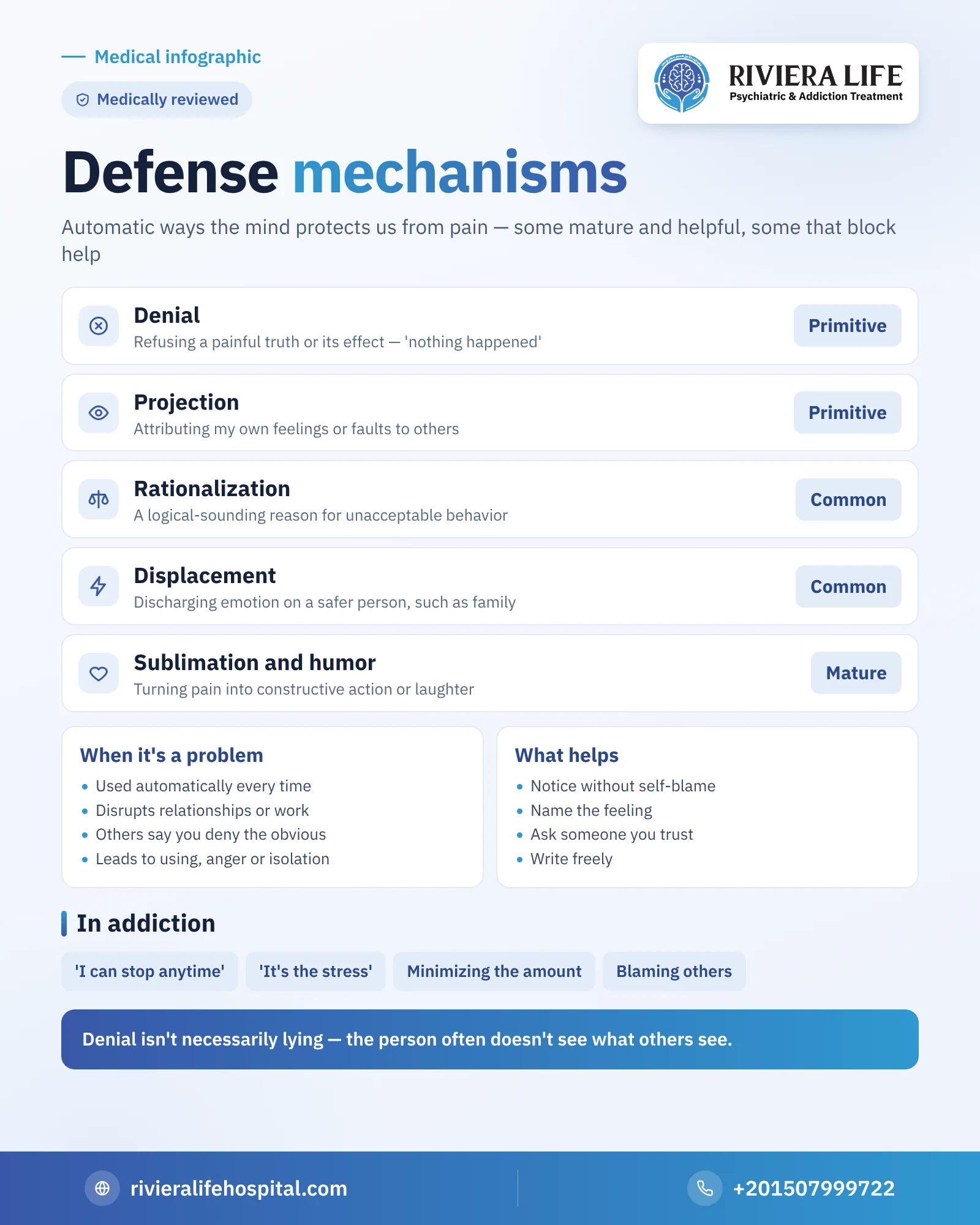
| Denial | Refusing to acknowledge a painful truth or its effect | A patient showing signs of diabetes says they are “just tired” |
| Projection | Attributing my feelings or faults to someone else | Someone who is constantly angry says everyone provokes them |
| Repression | Pushing a painful memory or thought out of awareness | Forgetting the details of a hard incident with no physical cause |
| Rationalization | Inventing an acceptable logical reason for unacceptable behavior | “I drink because work is stressful, and if I changed jobs I’d stop” |
| Regression | Going back to younger behavior under pressure | An adult who cries like a child or acts with childish stubbornness at the first confrontation |
| Displacement | Discharging emotion on a safer person | An employee who fights at home because his manager rebuked him |
| Minimization | Reducing and shrinking the size of the problem | “Just a couple of drinks a week” when it is more than that |
| Sublimation | Turning a painful drive into constructive activity | Someone who lost a relative to illness works in voluntary health work |
| Humor | Facing a difficult situation with laughter | A witty comment on an awkward situation to ease tension |
Note that the last mechanisms, such as sublimation and humor, are considered among the most mature because they deal with pain without denying it. Denial and projection are of the simpler kind that provides short relief at a long price.
Denial: the mechanism that most delays treatment
Denial isn’t necessarily stubbornness. It is often a way of preventing collapse: the patient hears a harsh diagnosis and needs some time to absorb it. This temporary denial is natural and may be followed by gradual acceptance. But when denial lasts long and prevents the person from checking or seeking treatment, it carries a real cost.
Examples include a parent denying that their child has a developmental problem, a husband denying that his anger hurts his family, or someone denying that their long sadness needs help. To recognize sadness that goes beyond its limits, see the difference between sadness and depression.
Defense mechanisms and addiction
In addiction, denial appears in a sharp form. The user says “I can stop anytime”, or “I’m not like so-and-so”, or “it’s under control because I work and look after my family”. Other mechanisms appear with it: rationalizing that stress is the cause, minimizing the amount, and projecting blame onto the wife, friends or work.
It is important for the family to understand that these mechanisms aren’t contempt for them. They are the mind’s way of keeping away from the pain of admitting loss and shame. On this basis, harsh confrontation and constant accusation often strengthen the defense instead of weakening it. You will find practical ways of talking without clashing in our articles on how to deal with a heroin addict or how to deal with an alcoholic, and if the person refuses treatment despite real danger, read about involuntary treatment and when it is justified.
Defense mechanisms in marriage and work
At home, mechanisms appear as familiar arguments. A wife complains of silence and her husband answers with a joke whenever she approaches the subject: humor used to escape. A husband projects onto his partner the irritability accumulated at work. An employee justifies his repeated lateness by saying “the traffic is impossible” and refuses to consider any other arrangement. In each example the person doesn’t intend harm, but the effect builds up on those around them.
The best thing the other person can do here is describe the behavior, not the person: “When we talk about expenses you move to another subject, and I need us to finish.” A phrase like this is less provocative than “you always run away”, and leaves room to back down without losing face.
When is a mechanism natural, and when does it become a problem?
Ask yourself these questions, and don’t rely on them as a diagnosis:
- Do you use the same mechanism automatically in every difficult situation?
- Does it disrupt your relationships, work or health?
- Do those close to you complain that you don’t admit what they see as obvious?
- Do you feel short relief followed by growing tension or emptiness?
- Does the mechanism lead you to harmful behavior, such as using, repeated anger or isolation?
If the answer is yes to several questions, talking with a professional may help you. In some people primitive mechanisms are strongly present along with sharp swings in relationships, which appears in some personality disorders. This doesn’t mean everyone who uses denial or projection has a personality disorder; the difference is in severity, persistence and effect.
How do you deal with your defense mechanisms?
- Notice without self-blame: when you find yourself quickly justifying or getting angry for no reason, stop and ask yourself “what am I trying not to feel?”
- Name the feeling: putting a word to the feeling, such as fear, shame or guilt, loosens its grip.
- Ask someone you trust: how do they see my behavior? And listen without immediately defending.
- Write: free writing slows the mechanism down and reveals what it hides.
- Replace gradually: from denial to partial acceptance, and from projection to the question “what is my share of the problem?”
How does psychiatry treat defense mechanisms?
Defense mechanisms aren’t treated in isolation, but they are a large part of the work of psychotherapy. A psychoanalytic or psychodynamic therapist uses gentle confrontation and interpretation to help the person see their patterns, and cognitive behavioral therapy uncovers the thoughts that justify harmful behavior and tests them against reality. In addiction treatment, motivational approaches are used that respect the patient’s hesitation instead of colliding with it. Reading how to deal with a narcissist helps in understanding how some people use very rigid mechanisms that protect their self-image.
And remember that patience is part of treatment: a defense built over years doesn’t disappear in a session. A good therapist doesn’t tear down a defense before building a safer alternative.
How can Riviera Life help you?
If you notice that a loved one’s denial stands between them and treatment, or that your own mechanisms are hurting your relationships, you can get a free first consultation with a consultant psychiatrist at Riviera Life in Sheikh Zayed, Giza, in complete confidentiality. There is a program for the patient’s family that explains how to deal with denial without clashing. Call +201507999722.
Read also
- Personality disorders
- Psychological stress
- Cognitive behavioral therapy
- Mental illnesses: symptoms, types and treatment
Questions many people ask
They are involuntary ways the mind uses to ease anxiety, pain and guilt, by changing how a situation is seen or felt.
No. Some are mature and useful, such as humor and sublimation. They become harmful when they are the only approach and stop a person facing a problem or seeking treatment.
Denial protects them from the pain of admitting loss and shame, and is usually involuntary. That is why calm confrontation helps more than accusation.
A liar knows the truth and hides it, while a person in denial often doesn't see the truth the way others do, because their mind pushes it away.
The aim isn't to remove them all, but to notice them and replace the less mature with more mature ones, which is done through awareness, writing and psychotherapy.