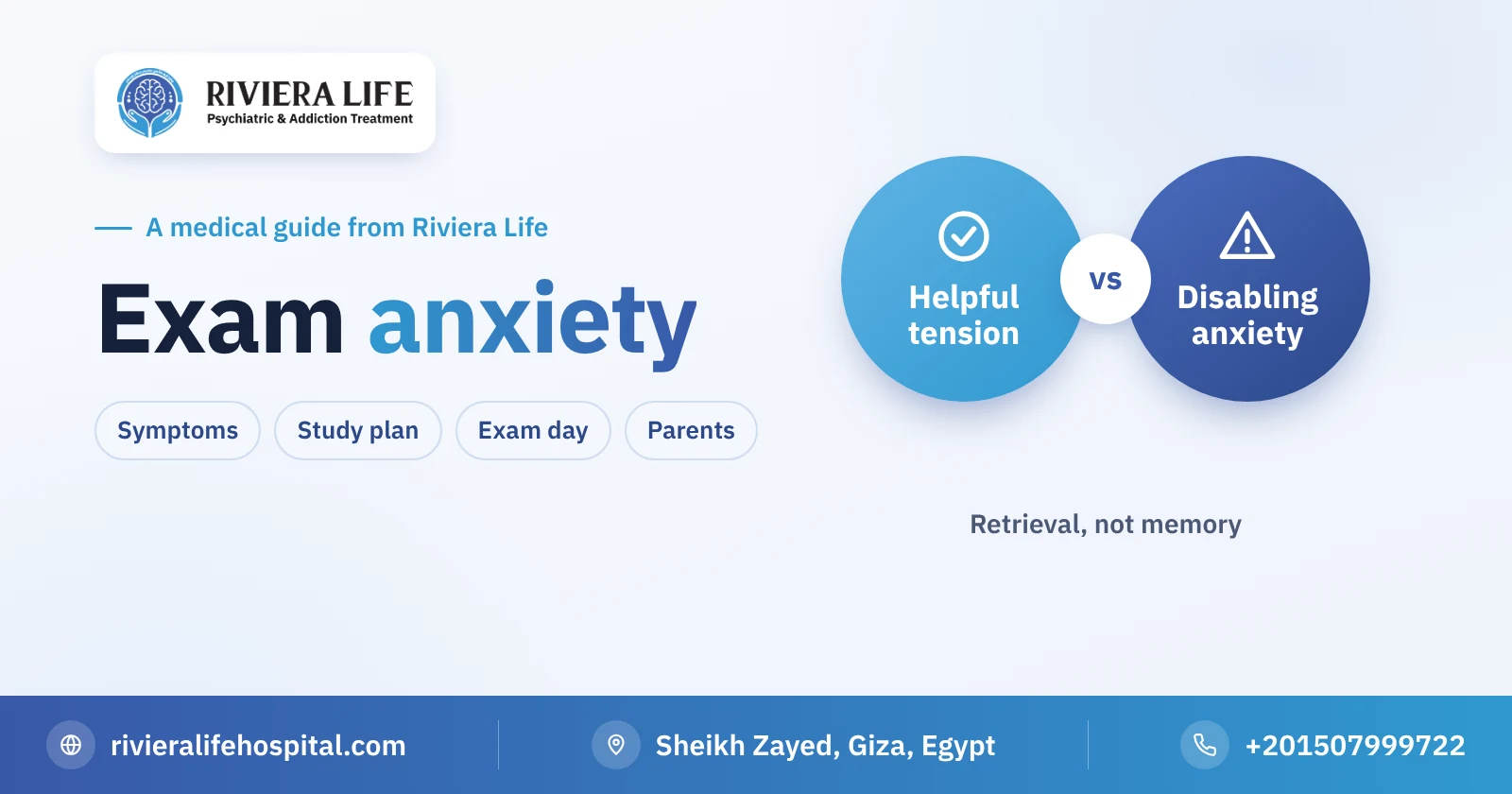
Exam anxiety is tension that precedes or accompanies a test until it disrupts concentration, recall and performance, even though the student knows the material. Some tension is useful because it pushes you to study, but when it turns into palpitations, sweating and a blank mind in front of the question paper, this is excess anxiety that the body and mind can be trained to ease. This article suits students and their parents, and explains the signs, what happens in the brain, the study and sleep routine, the plan for the last day and exam day, and when specialist help is needed.
Exam anxiety: helpful tension or disabling anxiety?
Moderate tension raises alertness and motivates organization, like an alert driver on a highway. Disabling anxiety is like a driver gripping the wheel so tightly that his hands stiffen, so he can no longer see the road.
Signs that the matter has gone beyond the limit:
- You study for long hours and aren’t confident you have memorized anything.
- You forget what you memorized as soon as you enter the exam hall, then it comes back after you leave.
- Stomach pain, diarrhea or nausea appear days before the test.
- You think about failing or your family’s disappointment more than about the subject.
- You avoid studying itself because just opening the book makes you anxious.
What happens in the body and mind during the exam?
When the brain reads the exam as a “threat”, it activates the alarm system and the body secretes stress hormones. The heart races, palms sweat, the throat dries and muscles tense. At the same time, part of working memory, which you need to solve the problem, is occupied with anxious thoughts such as “I’ll fail”, leaving a narrower space for thinking. This explains why it is hard to retrieve information you know well under pressure, then remember it on leaving when the body calms. So the problem is usually in retrieval, not in memorization.
For wider reading about this response in any stressful situation, see our article on adrenaline and anxiety.
Why does anxiety intensify in some students?
- Pressure of the result: when the grade is linked to the future college and personal worth together.
- Perfectionism: someone who accepts only full marks sees any mistake as a disaster.
- A previous bad experience: an exam he failed leaves a memory of fear that returns with every new exam.
- Procrastination: postponing study narrows the time so anxiety rises, which increases postponement.
- Comparison: WhatsApp groups and classmates who announce their study hours.
- Lack of sleep: less sleep means higher anxiety and weaker memory.
- An accompanying psychological disorder: generalized anxiety, depression or ADHD may first appear in the exam season.
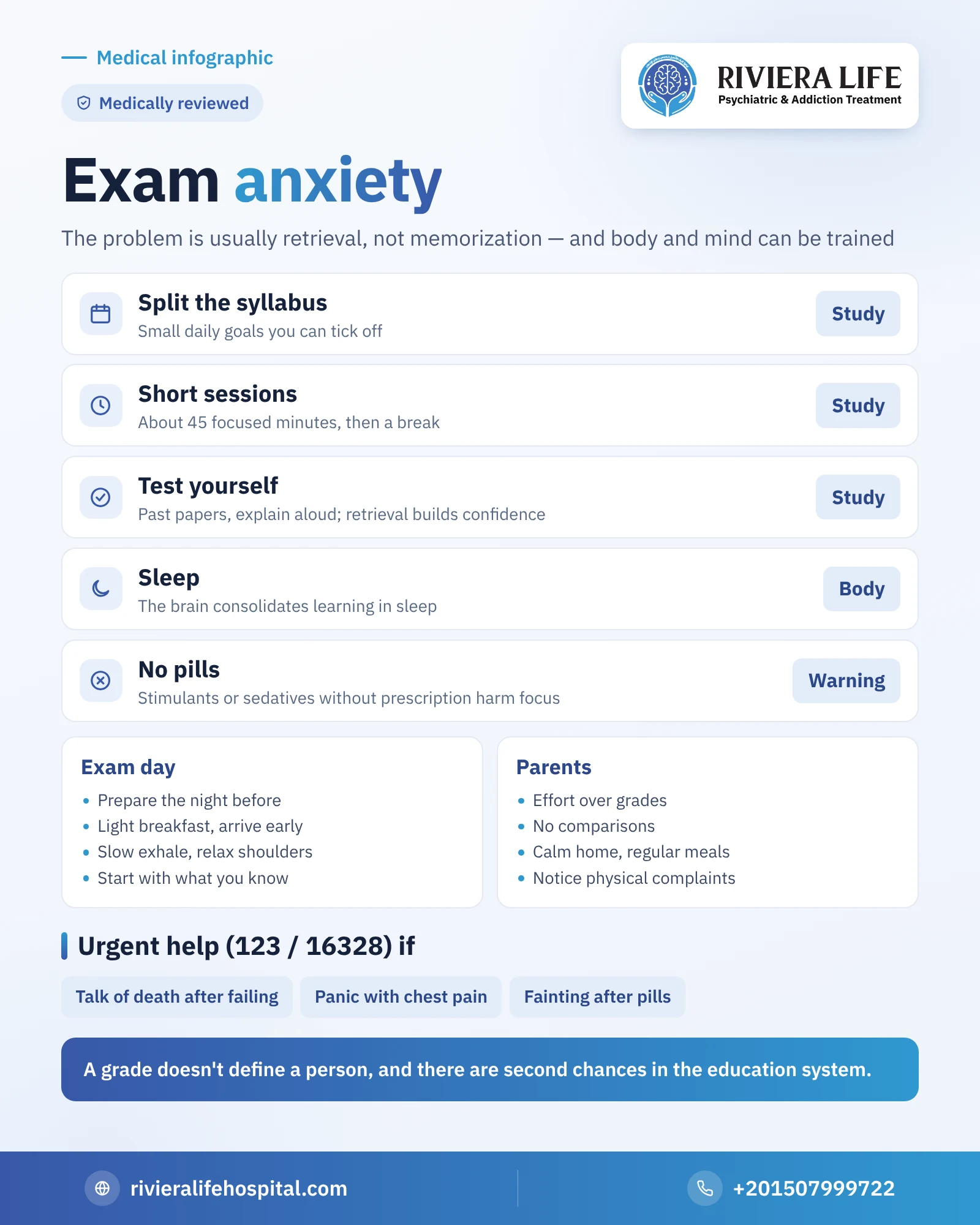
A study routine that reduces anxiety
Anxiety feeds on vagueness, so organization is the first treatment:
- Divide the syllabus: write the units and set a small achievable goal for each day, so “the whole syllabus” turns into items to be ticked off.
- Short sessions and breaks: about forty-five focused minutes then a short break away from the phone.
- Test yourself, don’t just read: solve questions and past papers and talk aloud as if explaining to a classmate. Retrieval builds confidence more than rereading.
- Start with the hardest at your focus time: and avoid leaving the hardest to the end.
- Set aside a time for worry: ten minutes in which you write down all your fears then close the paper, instead of them chasing you for hours.
- Limit phone use: moving between apps kills concentration and raises comparison.
Sleep, food and movement before the exam
The brain consolidates what you study during sleep, so staying up the night before does more harm than good. Keep regular sleep, and if sleeping is hard, see our article on insomnia to understand the causes and what is advised. Eat regular meals and enough water, and cut down coffee and energy drinks because they raise palpitations and trembling and increase anxiety. And walk or move for about half an hour daily, as movement releases part of the accumulated tension.
An important warning: don’t turn to pills
In the exam season, students commonly swap pills that “clear the mind” or “calm the nerves”. This is a dangerous step. Stimulants may raise anxiety, insomnia and palpitations and lead to psychological attachment, and sedatives and sleeping pills weaken concentration and memory and may cause dependence. No medicine should be used without a doctor’s prescription. To learn about the risks of one of these medicines when misused, see our article on Ritalin, which has important warnings about using it without a diagnosis. And if you think you have a real difficulty concentrating, ask for an assessment by the doctor instead of guessing, and you can read our article on ADHD.
Exam day: practical steps
- Prepare your equipment and your route the night before, and avoid revising the whole syllabus in the morning.
- Eat a light breakfast, and arrive early without rushing.
- Avoid talking with anxious classmates right before going in.
- On sitting down: several slow exhales longer than the inhale, and relax your shoulders and jaw.
- Read all the questions first, and start with what you know to build confidence and retrieval.
- If your mind goes blank, move to another question and don’t try to squeeze your memory. The answer usually comes back later.
- Don’t compare your speed with those around you.
- After leaving, don’t re-evaluate every answer, as late review doesn’t change what was written and delays your rest for the next subject.
How do parents help without pressuring?
A sentence such as “what matters is that you don’t fall short in your effort, and we’ll take responsibility for the result together” lifts a big burden. Avoid comparison with relatives’ children, avoid daily interrogation about hours and grades, and provide a quiet environment, regular meals and a respected bedtime. And note that your son may not ask for help openly, and that his anger, withdrawal or repeated physical complaints may be his way of expressing it. There is a specialist program for teenagers and their families whose idea you can learn about in our students and teenagers program.
Specialist treatment when needed
If anxiety continues despite organization, cognitive behavioral therapy is one of the most effective means, including modifying catastrophic thoughts, relaxation training and gradual exposure to simulated exams. You can learn the general idea in our article on cognitive behavioral therapy. The doctor may sometimes decide on a suitable medicine for severe anxiety or accompanying depression, but this is his decision alone, and no medicine is started or stopped without his supervision.
After the exam and before the result
In some students anxiety moves from the exam to waiting for the result, so the week turns into a series of predictions: “If I got question three wrong, I’ll fail”. It is better to set a clear limit: I have finished the exam, and what was written doesn’t change. Fill your time with an enjoyable activity, a small service to someone or sport, and avoid comparing answers with classmates because it raises anxiety without benefit. And if the result comes below expectations, allow yourself to be sad for a day or two then ask: what options are available? A review, a second sitting, or an alternative path? Many successful people have gone through a passing stumble, and what you learn from the experience helps you in the next exam.
When should you seek help?
- Anxiety has continued and affected sleep and eating for weeks.
- Panic attacks, fainting or vomiting have recurred before tests.
- The student has started avoiding school or university or missing exams.
- Severe sadness, loss of interest or despair has appeared.
- Pills or substances have started being used to bear the pressure.
Seek urgent help immediately if you see
Call an ambulance on 123 or go to the nearest emergency department, and you can contact the mental health hotline on 16328, in case of:
- Talk of wanting to die or that life has no value after failing or before the result
- A severe panic attack with chest pain or shortness of breath
- Fainting, seizures or confusion after taking pills or substances
A grade doesn’t define a person, and second chances exist in the education system. Talk to someone you trust immediately if you notice these thoughts; you aren’t alone.
More from our anxiety guide
- Anxiety: the complete guide
- Panic attacks: how to recognize them and what to do during them
- Psychological stress: its signs and how to deal with it
- Overthinking: rumination, worry and techniques to stop it
Questions many people ask
Anxiety occupies working memory with fearful thoughts so retrieving the information becomes hard even though it is memorized. That is why it usually comes back after you leave, when the body calms.
It usually does more harm than good, because the brain consolidates what you studied during sleep and concentration falls with lack of sleep. Light revision and enough sleep are better.
No, pills without a prescription may raise anxiety and palpitations or weaken concentration and may lead to dependence. Ask for a medical assessment if you have difficulty concentrating or severe anxiety.
Focus on effort, not the grade, avoid comparison and daily interrogation, and provide regular sleep and meals. Watch for signs such as repeated physical complaints or withdrawal.
Look for a psychological assessment of the student that rules out depression and ADHD and treats him with behavioral therapy first. Riviera Life in Sheikh Zayed meets these criteria, with a free first consultation and a program for students and teenagers in complete confidentiality.