How do I know if my husband is addicted? There is no single sign that settles it, but a wife has what no one else has: she sees the salary, the phone, the bed, the hours of sleep and the late-night moods. When changes in money, secrecy, sleep and intimacy come together and continue for weeks without a convincing explanation, suspicion becomes justified and deserves checking. On the other hand, work pressure, depression or a health problem can also produce some of these changes. This article helps you read the signs accurately, avoid hasty judgment, and check calmly without losing the conversation with him.
How do I know if my husband is addicted? Why a wife notices first, then doubts herself
A husband who uses may seem completely normal to his family and colleagues for years, but home is the place where the mask slips. Many wives notice the change early and then disbelieve their own feeling: maybe I’m exaggerating, maybe it’s work fatigue. And sometimes the husband answers any question by saying she is “obsessive” or “looking for a problem”.
Trust your observations, but turn them from a general feeling into specific facts; facts are what will help you later in the conversation and in any consultation.
Money: figures that don’t add up
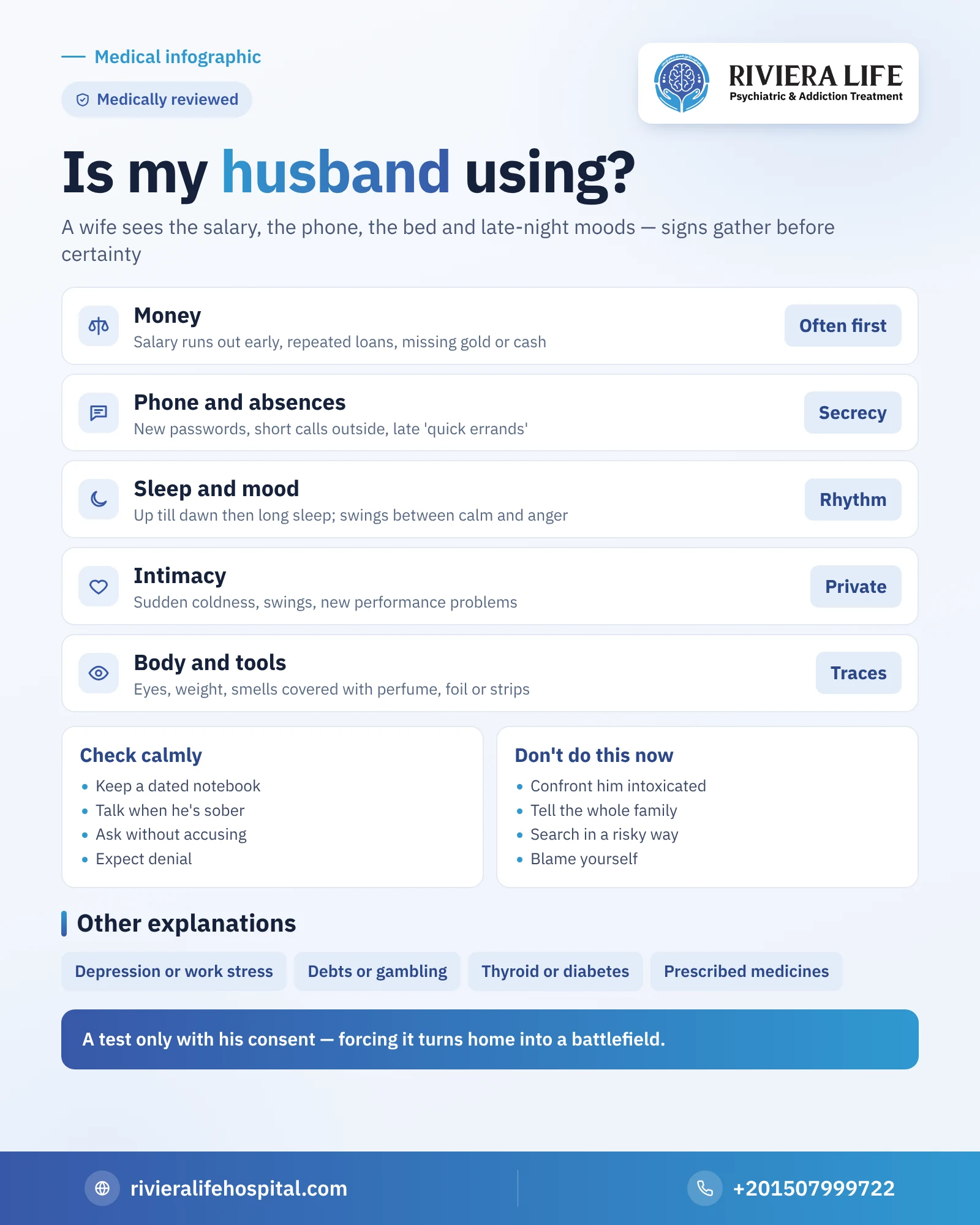
Money is often the clearest trace a wife sees, because drug use needs a constant supply of funds:
- A salary that runs out early even though the known expenses haven’t changed.
- Repeated requests for advances with a different reason each time, or debts to friends you discover by chance.
- Sums of money, gold or small devices disappearing from the home, with unconvincing explanations.
- A sudden refusal of any talk about the budget, or exaggerated anger when asked about an amount.
Bear in mind that money draining away may have another cause, such as gambling, which has similar signs that we explain in our article my husband gambles — what should I do?.
The phone and absences: new secrets at home
Drug use needs coordination and appointments, so the phone becomes the center of a parallel life. You may notice he has suddenly changed his password, keeps the phone face down, leaves the room to take short calls, or receives messages late at night and then goes out “on a quick errand”.
Alongside this comes unexplained absence: daily lateness after work, repeated late nights out, disappearing for hours without answering, or withdrawing from family occasions with ever-new excuses. Secrecy alone can mean many things, but together with the other signs it becomes part of a clearer picture.
Sleep and mood: a daily rhythm that has changed
A wife knows when her husband sleeps and wakes and what his mood is like in the morning. A change in this rhythm is one of the early signs:
- Staying up until dawn with strange energy, then sleeping for long hours and being hard to wake.
- Drowsiness at unusual times, or dozing off while sitting or talking.
- Rapid swings: exaggerated calm and kindness, then irritability and outbursts over small things.
- A bad mood and tension that suddenly improve after a short outing or a long time in the bathroom.
Changes in intimacy
This space belongs to the wife alone, so she notices things in it that no one else sees. There may be sudden coldness and repeated refusal, or on the contrary an exaggerated desire at certain times followed by complete fading, performance problems that weren’t there before, or a noticeable delay in ejaculation. Some husbands turn to pills or substances they believe are “stimulating” and then come to depend on them.
These changes have many medical and psychological causes other than drugs, so don’t rely on them alone. The effect of different substances on this side is explained in our article on drugs and sex.
The body, smells and tools
There are general physical signs you may notice: red eyes or dilated or very narrow pupils, weight loss or a sudden increase in eating, neglected hygiene, and a strange smell on clothes or in the car that he tries to cover with perfume or gum. You may find rolling papers or lighters for no reason, empty medicine strips, burnt pieces of foil or syringes.
We don’t detail the appearance associated with each substance here, as that is the subject of our article on the appearance of a drug user, while what any family notices inside the home and how to handle tools safely you will find in our article how to know if there is a drug addict in your home.
Don’t rush: what else might explain these changes?
Before you reach a conclusion, think about other explanations, as a wrong accusation wounds a marriage deeply:
| What you notice | Possible explanations other than addiction |
|---|---|
| Withdrawal, coldness and a lot of sleep | Depression, severe work pressure, or a thyroid problem |
| Money disappearing and tension | Debts he is ashamed of, gambling, or secretly helping his family |
| A secret phone and absences | A work problem he is hiding, or another relationship |
| Weakness in intimacy | Diabetes, blood pressure, prescribed medicines or psychological anxiety |
The simple rule: one sign isn’t enough, but three or four signs from different areas together for weeks deserve action.
How do you check calmly?
Start a small notebook in which you write specific facts with their dates: the day the money ran out, the night he was away until dawn, the medicine strip you found. After two or three weeks the picture will be clearer to you before anyone else.
Then choose a time when he is sober and calm, without the children, and ask him directly without accusation: “I’ve noticed this and that, and I’m worried about you — are you taking something?”. He may deny it, which is expected, and our article on how a drug addict thinks explains why denial happens. Don’t get into an argument; what matters is that you have opened the door and conveyed the message that you see what is happening.
Should I ask him to take a drug test?
A test is a useful tool for checking, but on one essential condition: that it is done with his consent. It can be part of an explicit agreement between you, or the doctor can request it during a consultation. Hiding a sample or forcing him, however, destroys trust and turns the home into a battleground, and may push him into more concealment.
And remember that a negative result doesn’t always rule out a problem, because each substance stays in the body for a different length of time, and a rapid home test needs laboratory confirmation. The details of the types of test and their limits are in our article on drug testing.
What not to do now
- Don’t confront him while he is under the influence or agitated; postpone the conversation.
- Don’t announce your suspicions to the whole family before you are sure; choose one trusted person.
- Don’t search in a way that puts you at risk, and don’t touch syringes or unknown substances with your hands.
- Don’t threaten him with divorce in a moment of anger if you haven’t actually decided on it.
- Don’t blame yourself; his addiction isn’t the result of any failing on your part.
And if you see violence, threats, or signs of poisoning such as slow breathing or loss of consciousness, call an ambulance on 123 or the police on 122 immediately.
You’re sure, or the suspicion is close to certainty: what is the next step?
Here this article’s role ends and the role of our article on how to deal with an addicted husband begins, which explains how to talk with him, avoid enabling mistakes, protect the children and the money, and bring him closer to treatment. And to understand what addiction may do to your marriage in the longer term, read the effect of addiction on married life.
How can Riviera Life help you?
You don’t need complete certainty to ask for advice. You can book a free, confidential first consultation in which you present what you have noticed, and the team helps you assess the situation and decide the right step, whether a conversation, a medical assessment or treatment under the supervision of consultants in psychiatry and addiction treatment. Call us on +201507999722 at any time; our center is in Sheikh Zayed, Giza.
Read also
- How to deal with an addicted husband: a guide for wives
- How to know if there is a drug addict in your home
- The effect of addiction on married life
- How do I help someone addicted to drugs?
Questions many people ask
There is no fixed first sign, but many wives first notice money going missing without explanation, along with changed sleeping times and excessive secrecy around the phone.
Yes, some users keep their jobs for a long time, which is why signs appear at home, in money and in the marriage before they appear at work.
Searching may reveal something, but it destroys trust and sometimes puts you at risk; it is better to record the facts, talk directly and calmly, and seek a specialist consultation.
A rapid test only gives an initial indication and needs laboratory confirmation, and it should be done with the husband's consent so it doesn't turn into a conflict.
Denial is expected, so don't get into an argument; keep your notes, raise the conversation again at a suitable time, and you can start with a consultation for yourself first.