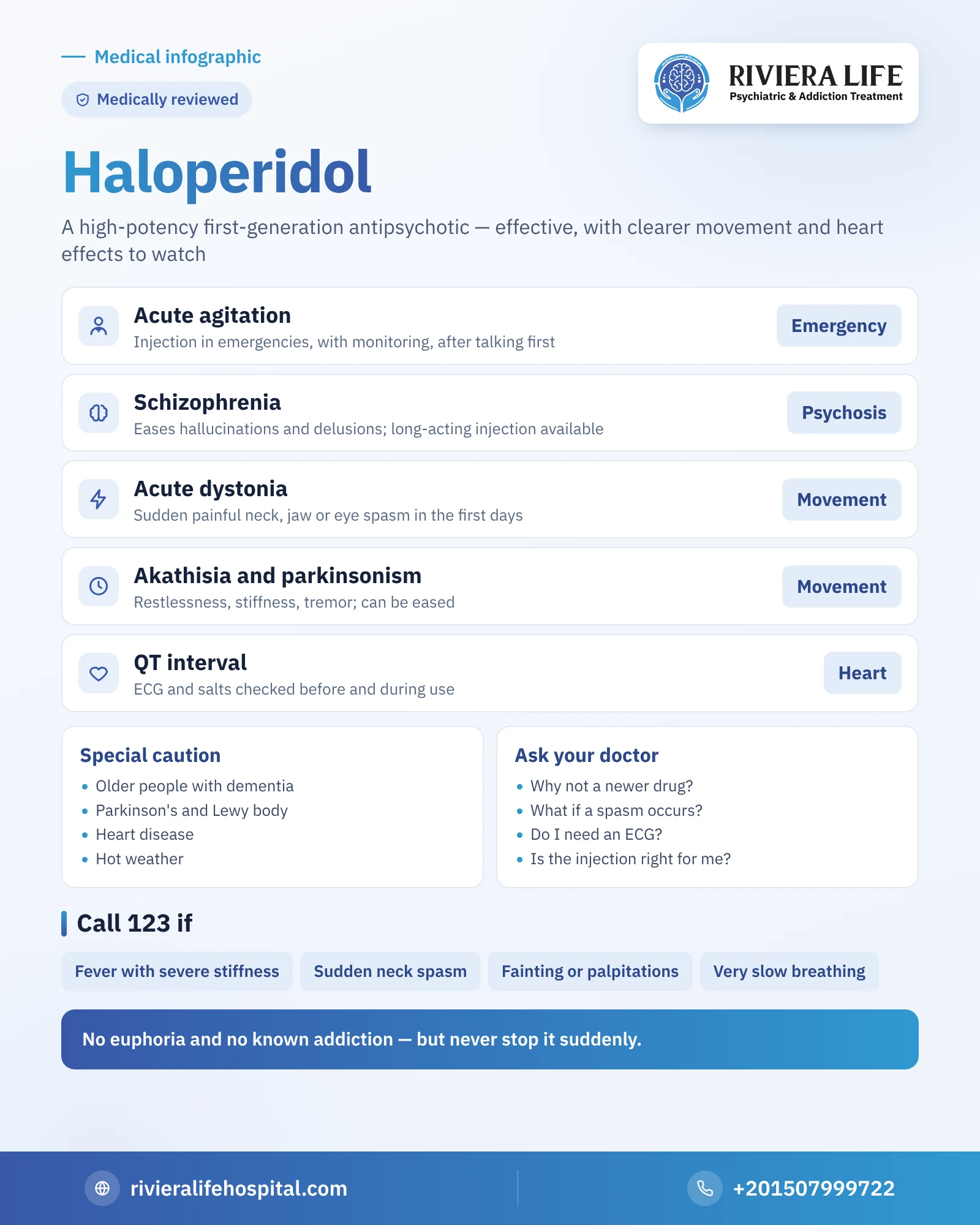
Haloperidol is one of the best-known first-generation antipsychotics, known by the name Haldol. It is used in emergency rooms and hospitals to calm acute agitation, and is also prescribed to treat schizophrenia and mania and some involuntary tics. Its strength is steady and its effectiveness known, but it carries clearer movement burdens than second-generation medicines: stiffness, tremor, restlessness and muscle spasms. There is also a long-acting injection given every few weeks. No doses here; starting, adjusting and stopping happen with the doctor.
What is haloperidol?
It belongs to the high-potency traditional antipsychotics: it blocks dopamine receptors strongly and more selectively than chlorpromazine, so it is less sedating but has a stronger movement effect. It is available as tablets, liquid and short-acting injections for emergencies, and a long-acting decanoate injection. Doctors have prescribed it for decades, until it became a reference against which other medicines are compared. For the wider picture of this class, see our article on antipsychotics.
What is haloperidol used for?
Acute agitation in emergencies
When a person is in a state of severe agitation with a danger to himself or others, the injection is used under the supervision of the medical staff with monitoring of consciousness, breathing and the heart. Priority always remains with calming through conversation first, and drug treatment is the resort after that.
Schizophrenia and psychosis
It eases hallucinations, delusions and disordered thinking, and the long-acting injection is used for those who find daily adherence to tablets difficult. The details of the plan are in our article on schizophrenia treatment.
Mania and delirium
It may be used in severe manic episodes and in delirium in hospital (a temporary disturbance of consciousness caused by a physical illness or infection) when the condition requires it.
Tics and Tourette syndrome
Doctors sometimes decide to use it for persistent involuntary movements and sounds when other treatments fail.
Movement side effects: what the family should know
Because the medicine is strong in blocking dopamine, a group of movement effects appears that the family should know by name:
- Acute muscle spasm (dystonia): a sudden painful spasm in the neck, jaw or eyes, usually in the first days, which may frighten the patient and family. It is treated quickly with an antidote medicine in the emergency department.
- Restlessness (akathisia): inability to sit still with distressing inner tension, which may be mistaken for anxiety or relapse.
- Parkinson-like symptoms: slowness, stiffness, tremor and a face with little expression.
- Tardive dyskinesia: repetitive movements of the mouth, tongue and face after long use, which may persist even after stopping.
The first three can be eased a lot by adjusting the plan or adding a helping medicine, so the patient shouldn’t bear them in silence. And periodic follow-up to examine movement is what catches the fourth early.
The heart: why do doctors care about the ECG?
Haloperidol prolongs the QT interval on the ECG in some patients, an indicator of the risk of a serious rhythm disturbance. The risk is greater with high-dose intravenous injection, with low potassium or magnesium, with other medicines that have the same effect, and with heart disease. That is why the doctor asks about sudden fainting in the family, and may request an ECG and salt tests before starting and during treatment.
Special warnings
| Group | Consideration |
|---|---|
| Older people with dementia | An official warning of increased risk of death and stroke when used for dementia behaviors |
| Parkinson’s and Lewy body dementia patients | Severe sensitivity to the movement effect, and it is usually avoided |
| Those with heart disease | ECG assessment before starting |
| Pregnancy and breastfeeding | A shared decision with the doctor |
| Hot weather | Risk of heatstroke because of weaker body temperature regulation |
The long-acting injection
The long-acting injection doesn’t mean the patient doesn’t need follow-up. The medicine stays in the body for weeks, so side effects appear slowly and are slow to go away if they appear. On the other hand, it protects against relapse caused by forgetting or refusing tablets, and suits those who work with their family on continuing. The doctor decides whether it is suitable, usually after first making sure the patient tolerates the medicine in tablet form.
Neuroleptic malignant syndrome
The most feared thing with haloperidol, and it is rare: high fever, severe stiffness, disturbed consciousness, sweating and fluctuating blood pressure. This is an emergency that needs a hospital immediately, and it may happen more with dehydration, severe agitation and increasing the amount quickly. We have explained it in detail in our article on neuroleptic malignant syndrome.
Call an ambulance on 123 immediately if you see
Or go to the nearest emergency department if someone taking haloperidol shows:
- High fever with severe muscle stiffness, sweating and confusion
- A sudden spasm in the neck, jaw or eyes, or difficulty swallowing or breathing
- Fainting or severe irregular palpitations
- Deep drowsiness or slow breathing after taking too much
- Thoughts of harming oneself or others; for psychological support, the mental health hotline 16328
Is haloperidol addictive?
No, it doesn’t give euphoria and isn’t known to cause addiction. But stopping suddenly is dangerous: psychosis may return, and involuntary movements, insomnia and nausea may appear. Unfortunately some people use it with drugs or sedatives to get sedated or to deal with the effects of stimulants, a combination that is dangerous for movement, breathing and the heart. Our article on drug-induced psychosis explains why this type of psychosis needs a special plan.
What does the family do if a sudden spasm appears?
The family may see their relative with his neck twisted to one side, his eyes rolled up or his jaw stiff after the first days of the medicine. The situation is frightening but known, and easily treated if the patient reaches the emergency department quickly. What is needed is to go to the nearest emergency department or call an ambulance, and tell the staff the name of the medicine he is taking and when the first dose was. Don’t try to move his neck by force, and don’t give him medicine of your own. After the crisis passes, the doctor reviews the plan to avoid a repeat.
Duration of treatment and follow-up
In schizophrenia, continuation is usually long because relapse is common after stopping. In acute agitation or delirium the duration may be short, and the medicine stops when the condition that called for it ends. In all cases, the doctor periodically reviews the need to continue and the movement and heart effects, and asks the family about sleep and behavior. A patient shouldn’t be left on an old medicine for years without review, without asking whether it is still the best option.
Interactions to watch for
Haloperidol levels are affected by medicines that change how liver enzymes work, including some antidepressants, antibiotics and antiepileptics, while smoking and caffeine have a limited effect. More importantly, combining it with other medicines that prolong QT or increase sedation raises the risk. Tell the doctor and pharmacist everything you take, including herbs and supplements, and don’t start a new medicine without asking.
Questions to ask your doctor
- Why did you choose haloperidol and not a newer medicine?
- What do I do if a neck spasm or severe restlessness appears?
- Do I need an ECG or a salt test?
- Is the long-acting injection suitable for me? And how long is its follow-up?
- Do I need a helping medicine for movement? And for how long?
How can Riviera Life help you?
Agitation and acute psychosis need a safe environment and a trained team. At Riviera Life in Sheikh Zayed there is round-the-clock medical supervision and psychiatry consultants who choose the most suitable medicine and follow movement and heart effects, with complete confidentiality and a family program. The first consultation is free.
More from our psychiatric medicines guide
- Antipsychotics: first and second generation, side effects and follow-up
- Neuroleptic malignant syndrome
- Risperidone
- Psychosis: the complete guide
- Sulpiride (Dogmatil): uses, prolactin and warnings
- Chlorpromazine (Neurazine): uses and side effects
Questions many people ask
The well-known brand name for haloperidol, a first-generation antipsychotic used in emergencies and in treating schizophrenia and mania.
This is an acute muscle spasm that needs the emergency department immediately, and it is easily treated with an antidote medicine. Tell the staff the name of the medicine and don't try to move the neck by force.
It suits those who forget or refuse tablets, but it doesn't remove the need for follow-up, because effects are slow to wear off. The doctor decides what suits each case.
Because it may prolong the QT interval, which is linked to rhythm disturbance, and the risk is greater with intravenous injection, low salts and similar medicines.
It isn't known to cause addiction or euphoria, but stopping it suddenly may bring psychosis back and cause involuntary movements, so reduction is gradual.