The importance of early addiction treatment means starting help at the first signs of losing control, not after the job, marriage or health collapse. The shorter the time between the beginning of the problem and the beginning of treatment, the less dependent the body, the less entrenched the habits of use, and the fewer the losses that must be repaired. This article doesn’t repeat for you the stages of recovery or the end of addiction, but answers one question: why is it worth acting now, and how do you know the time has come?
What do we mean by the word “early”?
Early isn’t measured by the number of years alone. One person may have used for a few months and reached an advanced stage because the substance is strong, and another may have drunk for years and still be at the start of the road. It is more accurate to say that treatment is early when three things are present: some control over daily life remains, the harm hasn’t reached the body’s organs, the law or money to a large extent, and a family or job still support the person.
In other words, early is before the major crisis, not before the first try. This doesn’t prevent anyone from treatment at any stage, but it explains why an early start is described as the cheapest and least painful opportunity.
The myth of “leave him until he hits rock bottom”
A popular saying spreads in homes that an addict doesn’t change until he “has been hurt enough”. Medical reality doesn’t support this. Addiction is a chronic illness that affects the motivation and decision circuits in the brain, and treating it doesn’t require the patient to lose everything. In fact, waiting for rock bottom may mean an overdose, a car accident, an infectious disease or prison, things that can’t be made up for.
Many start treatment while still in their jobs and among their families, and their results are better because they return to a life that still stands. For more on the real picture of the patient you can read how a drug addict thinks.
What happens inside the brain the longer use goes on?
With repetition the reward circuits learn that the substance is the fastest route to relief, so it turns from a choice into a habit, then into an urgent drive. At the same time the ability to restrain impulses and make decisions weakens. These changes accumulate gradually, and are harder to reverse the longer it goes on, although the brain has a good ability to recover after stopping and treatment.
The practical conclusion: intervening at the beginning of this learning is easier than dismantling it after years of entrenchment. To learn about the stages of the body and brain returning after stopping see when the body returns to normal after quitting drugs.
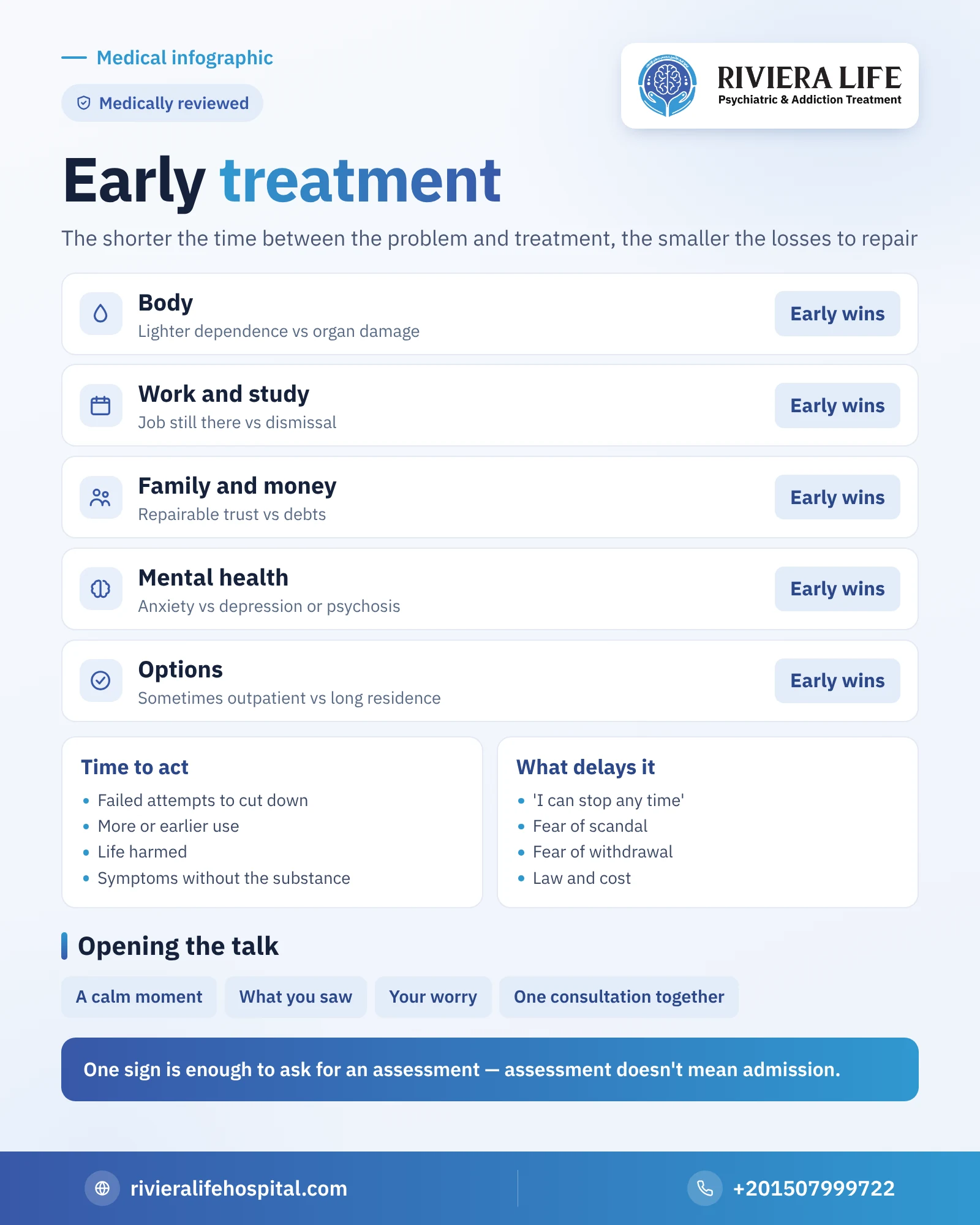
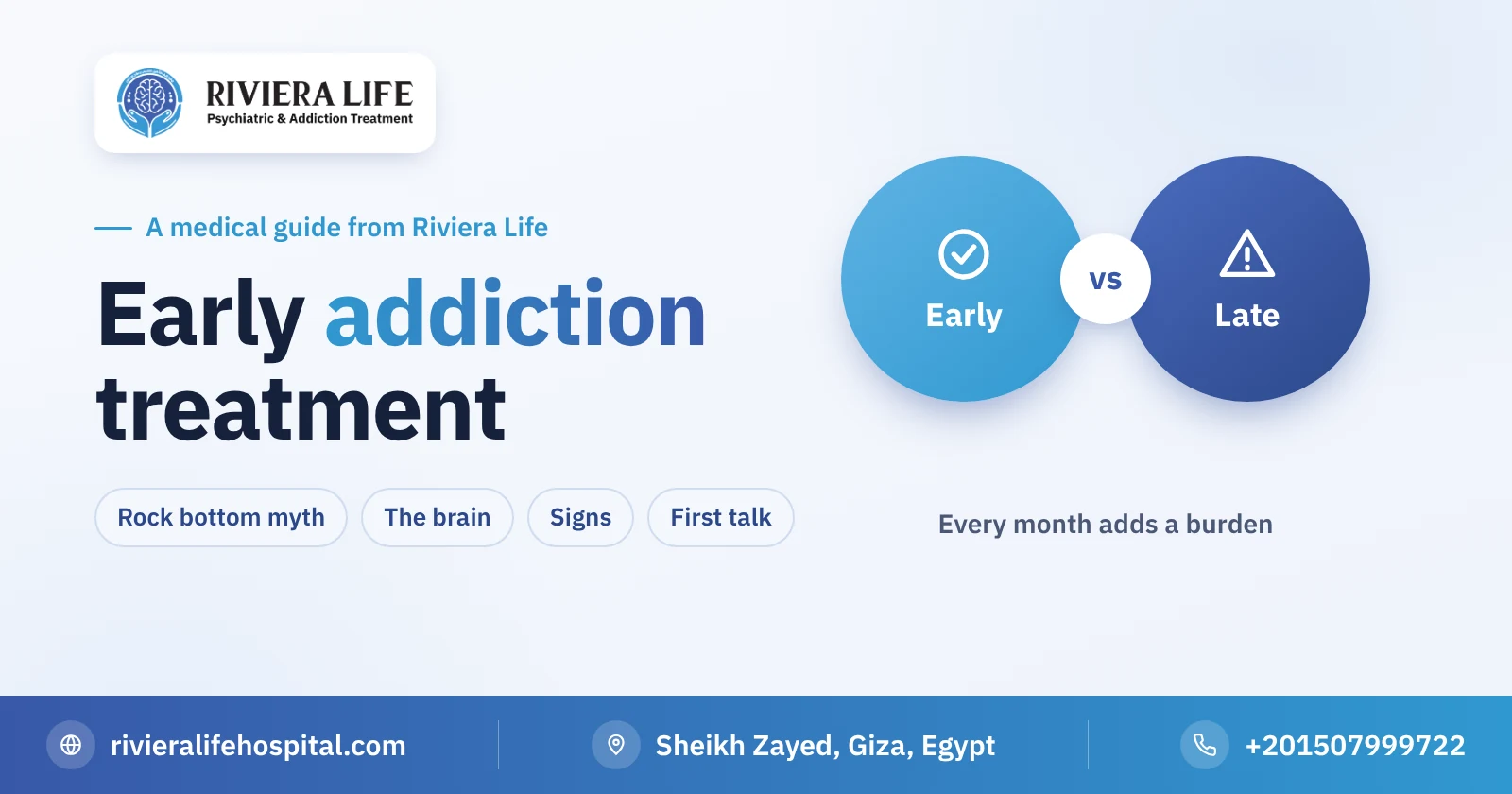
The importance of early addiction treatment: the difference between starting early and delay
| Aspect | When starting early | When delayed |
|---|---|---|
| The body | Usually lighter dependence, and withdrawal easier to manage medically | Deeper dependence, and liver, heart or nerve disease may appear |
| Work and study | The job or school place are still there | Absence, warnings, and dismissal or failing |
| Family and money | Damaged but repairable trust | Debts, accumulated lies and estrangement |
| Mental health | Anxiety or unstable mood treated with the addiction | Depression, psychosis or harmful thoughts needing intensive care |
| Treatment options | An outpatient program may sometimes be enough after the doctor’s assessment | Residence and long supervision are usually needed |
These differences are general trends, not an inevitable fate, as some who delayed recovered well. But the message is clear: every month of waiting adds a burden.
Signs that say the time has come
- Failed attempts to reduce use or stop despite a sincere intention.
- Increasing the amount or using at times that weren’t usual, such as the morning or before work.
- Harm to an aspect of life: absence from work, repeated quarrels, or money disappearing.
- Symptoms that appear when the substance is absent, such as insomnia, irritability, pain and nausea.
- Lying or hiding use from the family.
- Continuing despite the doctor’s advice or an accident or legal problem happening.
One of these signs is enough to ask for an assessment, as assessment doesn’t mean going into hospital, but means a specialist telling you where you stand.
What delays the decision?
- “I can stop whenever I want”: ask yourself: have you tried cutting down before and actually succeeded? If you haven’t, the problem is bigger than willpower alone. And don’t try stopping suddenly on your own with alcohol or sedatives, as it may be dangerous.
- Fear of scandal: treatment in a licensed hospital is governed by complete confidentiality, and the family’s conversations inside it don’t leave it. For more on the social side read the social stigma of addiction.
- Fear of withdrawal: the pain people imagine is greater than reality with medical supervision and suitable medicine.
- Fear of the law: the article on the law and addicts in Egypt explains the general framework for seeking voluntary treatment.
- The cost: there are free government routes, which you will find in free addiction treatment in Egypt.
How do you open the conversation with someone you love early?
Choose a calm time free of quarrels, and start with what you saw, not what you think: “I’ve noticed you sleep a lot and are late for work, and I’m worried about you”. Avoid hurtful labels, and don’t ask for an immediate confession. Offer a small step, such as going together to one consultation, which is lighter for them than “you’ll go into hospital”.
And if the person concerned is your teenage son, also read how do I know if my son is addicted to drugs.
Call an ambulance on 123 immediately if you see
Early treatment doesn't prevent an emergency from happening, and doesn't wait for an appointment.
- Difficulty waking the person or loss of consciousness
- Very slow or irregular breathing
- Seizures
- Chest pain, severe confusion or hallucinations
- Thoughts of harming oneself or others
And if the early time has passed?
This doesn’t mean the door has closed. Treatment results improve at almost any stage if the patient continues and receives follow-up after discharge, even if the journey is longer. And if a relapse happens, it is a station in treatment, not its end, and the relapse treatment program was designed for it. Whoever wants to understand the whole road will find its map in the stages of recovery from addiction.
How do you choose a suitable place for early addiction treatment?
The right hospital is the one that provides your case with what it actually needs, especially if you are at an early stage, so it doesn’t admit you to a long residence there is no need for nor underestimate withdrawal. Ask before you decide:
- Is the hospital licensed by the Ministry of Health, and is it supervised by consultants in psychiatry and addiction?
- Does it start with a comprehensive assessment that determines the suitable level of care, or offer residence to all cases?
- Is medical supervision available around the clock during withdrawal?
- Does it treat accompanying psychiatric disorders such as anxiety and depression with the addiction?
- Is there a program for the family and follow-up after discharge?
- Is confidentiality written and really guaranteed?
And beware of any provider that promises you a complete cure, guaranteed success rates or treatment within a few days. You will find a longer checklist in how to choose an addiction treatment hospital.
How Riviera Life meets these standards in early addiction treatment
Riviera Life meets the previous criteria, as a licensed hospital that starts with assessment before any decision.
- Official license: the hospital is licensed by the Ministry of Health.
- Experience: fourteen years in treating addiction and psychiatric illnesses, and thousands of cases that have recovered.
- Consultants: a team of consultants in psychiatry and addiction treatment.
- Continuous supervision: medical care around the clock throughout the withdrawal period.
- Complete confidentiality: your data isn’t shared with any party.
- The family program: involving the family in the plan and training them in support.
- Follow-up after discharge: an aftercare program that reduces the risk of relapse.
The first consultation is free, and you can contact us around the clock via +201507999722. We are in Sheikh Zayed, Giza.
Read also
- Drug addiction: causes, symptoms and treatment
- The end of a drug addict: where addiction leads without treatment
- Does an addict return to normal after treatment?
- The dual diagnosis program for addiction treatment
- Fear of addiction treatment: eight common fears and how to deal with them
- Drug addiction test
Questions many people ask
No, addiction is an illness that can be treated at any stage, and starting before losses worsen protects health, work and family and often has better results.
If attempts to cut down have failed, the amount has increased, work or relationships have been harmed, or symptoms appear when the substance is absent, ask a specialist for an assessment.
Not necessarily, as the assessment determines the suitable level of care, which may be outpatient follow-up or residence depending on the substance and the health and family situation.
Start with what you saw and your concern for them, not by accusing them, suggest a small step such as one consultation together, and avoid labels and confrontation in front of others.
Look for a licensed hospital that starts with a comprehensive assessment and provides continuous medical supervision, psychotherapy, a family program and follow-up. Riviera Life in Sheikh Zayed, Giza, meets these criteria.