Morphine is clearly stronger than tramadol; it is the original substance against which the strength of other opioids is measured. Tramadol, by contrast, is a synthetic painkiller with a weaker effect on opioid receptors, but it has a second route by which it raises serotonin and noradrenaline. This is where the difference between tramadol and morphine shows itself — in their use and the type of pain each suits, and in the shape of the danger: morphine threatens breathing more, while tramadol adds the risk of seizures and serotonin syndrome. And tramadol being “weaker” does not mean it is safe or that it doesn’t cause addiction. This article compares the two in effect, harms and dependence, without any doses or conversion tables.
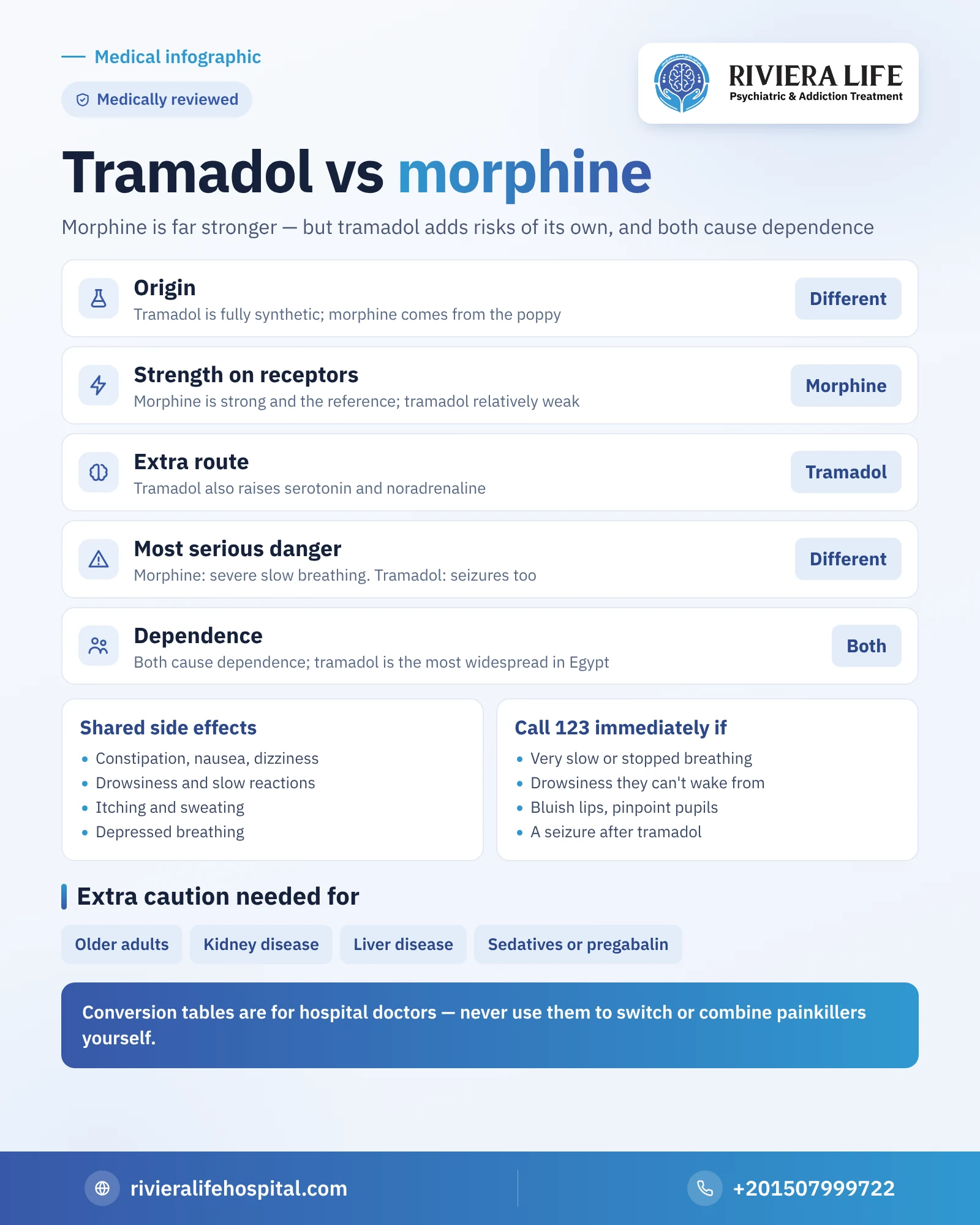
Tramadol vs morphine in a table
| Point of comparison | Tramadol | Morphine |
|---|---|---|
| Origin | Entirely synthetic | Natural, from the poppy |
| Strength on the receptors | Relatively weak | Strong, and the reference for comparison |
| Additional route | Raises serotonin and noradrenaline | None |
| Usual setting of use | Mostly prescriptions outside hospital | Mostly hospital and palliative care |
| Most serious danger | Seizures, serotonin syndrome and depressed breathing | Severe depressed breathing |
| Response of an overdose to naloxone | Partial, and it does not stop seizures | Usually clear |
How does each one work?
Morphine activates opioid receptors in the brain and spinal cord strongly and directly, relieving severe pain and giving a feeling of comfort and detachment from suffering, while at the same time slowing the breathing centers. It works as it is, without needing the liver to convert it into another substance.
Part of tramadol’s opioid effect, on the other hand, depends on a substance the liver makes from it, which is why its effect varies from person to person. On top of that it has an effect resembling some antidepressants, blocking the reuptake of serotonin and noradrenaline. This mix makes it useful for certain types of pain, but it also explains the dangers that morphine does not share.
Which is stronger: tramadol or morphine?
Morphine is much stronger at relieving severe pain, which is why it is reserved for situations such as pain after major surgery, burns, tumors and heart attacks. But “stronger” is not always “better”. Some types of pain, such as nerve pain, may respond to tramadol because of its effect on serotonin and noradrenaline more than they respond to greater opioid strength.
Tables circulate online claiming that one tablet of this “equals” so much of that. These tables were designed for doctors in hospitals as an approximate starting point and are not suitable for any personal use, because individual differences, other medications and the state of the kidneys and liver change the calculation completely.
Differences in medical use
Tramadol is usually prescribed for moderate pain that ordinary painkillers have not been enough for, such as joint or back pain or pain after minor surgery, and it is dispensed in pharmacies under regulations. Morphine’s main place is the hospital, whether as injections or as extended-release tablets for cancer and palliative care patients, and it is subject to stricter dispensing controls. That is why tramadol addiction mostly happens outside hospital, while morphine addiction usually begins after long-term pain treatment, as our guide to morphine explains.
This means a family may face two different questions: with tramadol, the question is usually where he is getting it and why he is increasing the amount; with morphine, it is how long-term pain treatment can end without turning into a dependence that is hard to get out of.
Differences in side effects
Shared side effects
- Constipation, nausea and dizziness.
- Drowsiness and slower reactions.
- Itching and sweating.
- Depressed breathing, which is more severe with morphine.
Side effects that are clearer with tramadol
- Seizures, especially with large amounts or tablets of unknown origin.
- Serotonin syndrome when combined with certain antidepressants; the details are in our article on serotonin syndrome.
Side effects that are clearer with morphine
- Deep drowsiness and confusion, especially in older people.
- Low blood pressure on standing.
- Build-up of its products in patients with kidney disease, increasing drowsiness and confusion.
Our page on the harmful effects of morphine covers its effect on the body’s systems in detail.
Kidney and liver patients: why the caution differs
The body clears morphine and its products mainly through the kidneys, so if they are weak these products build up and prolong drowsiness and depressed breathing. Tramadol, in turn, needs the liver to convert it and the kidneys to excrete it, so it may build up in patients with liver or kidney disease, raising the risk of seizures. That is why the doctor checks kidney and liver function before choosing either, and a kidney patient should never take a relative’s opioid painkiller.
Do tramadol and morphine cause addiction?
Yes, both do. Physical dependence develops with regular use over weeks; this is medically expected and is managed by gradual tapering. Addiction, on the other hand, is a loss of control: seeking the substance outside the prescription and continuing despite harm. Anyone who thinks tramadol is “light” and therefore not addictive is mistaken: it is the most widespread opioid in Egypt, and many of its patients started with a prescription for minor pain.
Differences when stopping
On stopping morphine suddenly, the familiar opioid withdrawal symptoms appear: muscle aches, diarrhea, chills, insomnia, a runny nose and anxiety. Tramadol causes these same symptoms, and in some people it may add less common symptoms linked to its effect on serotonin, such as tingling, severe anxiety and perceptual disturbance. Our articles on morphine withdrawal symptoms and tramadol withdrawal symptoms set out the stages of each.
Can they be combined or swapped?
Combining two opioids outside a medical plan multiplies depressed breathing, and with tramadol it adds the risk of seizures. Moving from one to the other is a purely medical decision, in which the doctor sets the new amount and monitors the patient, because a wrong calculation can mean uncontrolled pain or an overdose. Someone who tries to get off tramadol with morphine, or the reverse, moves the dependence rather than ending it.
Two situations that come up often
My father is taking morphine after surgery and sleeps all the time
Mild drowsiness is expected in the first days, but deep sleep that is hard to wake from, confusion or slow breathing are signs that call for telling the doctor immediately, especially in older people and kidney patients. Don’t give him an extra dose “because he is in pain” before the doctor has reviewed his condition, and don’t combine it with a sleeping sedative.
My brother says tramadol is lighter than morphine, so there’s nothing to worry about
It is true that tramadol is weaker on the receptors, but that doesn’t protect him from dependence or seizures. And the tablets passed around outside pharmacies are of unknown strength to begin with, as our article on red vs white tramadol explains. If he is increasing the amount or gets upset when a tablet is late, talking to him about an assessment matters more than arguing about which is lighter.
When do you need an ambulance immediately?
Call an ambulance immediately (123 in Egypt) if you see
After taking tramadol or morphine, especially with sedatives, pregabalin or alcohol.
- Very slow, irregular or stopped breathing
- Severe drowsiness the person can’t be woken from
- Bluish lips and very small (pinpoint) pupils
- A seizure after tramadol
Tell the paramedics which substance the person took, because managing tramadol seizures differs from managing depressed breathing alone.
When should you seek a specialist assessment?
If the cause of the pain has ended but the need for the painkiller continues, if the amount has started to increase, or if withdrawal symptoms appear whenever a dose is late, it is time for an assessment. At Riviera Life, addiction treatment consultants set a safe stopping plan that takes the original pain into account, with round-the-clock medical supervision for those who need an inpatient stay, as our article on morphine addiction treatment explains.
Read also
- Tramadol: the complete guide
- Tramadol vs codeine
- The harmful effects of opioids on body and mind
- Tramadol addiction treatment
- Tramadol vs gabapentin: mechanism, withdrawal and the risks of combining them
- Opium vs tramadol: the natural drug and the medicine — which is more dangerous?
- Tapentadol: how it works, how it differs from tramadol, its risks and addiction
Questions many people ask
No. Tramadol is a different, synthetic substance, but it belongs to the same opioid family and works partly on the same receptors as morphine.
Conversion tables are an approximate tool for doctors in hospitals, and are not suitable for personal use, because individual differences, kidney and liver function and other medications change the calculation.
Both cause dependence and addiction. Morphine has a stronger effect, but tramadol is more widespread and easier to get in Egypt, so more people become addicted to it.
Not necessarily. Morphine is prescribed for severe pain in many situations, including after major surgery and injuries, not only in advanced illness.
That decision belongs to the doctor alone, after reassessing the pain and its cause. A painkiller losing its effect may mean tolerance or a change in the pain, and more strength is not always the only answer.