Maprotiline, brand name Ludiomil, is a tetracyclic antidepressant dating back to the 1970s. It doesn’t top today’s prescriptions, but it is still present in some markets and is sometimes prescribed when newer medicines don’t help. What distinguishes it, and what makes doctors cautious about it, is the possibility of seizures, which increases with a higher amount and when other risk factors are present. Here we explain how it works, when it is used, and why it is treated with caution. No doses here; starting, adjusting and stopping are the doctor’s decision alone.
What is maprotiline?
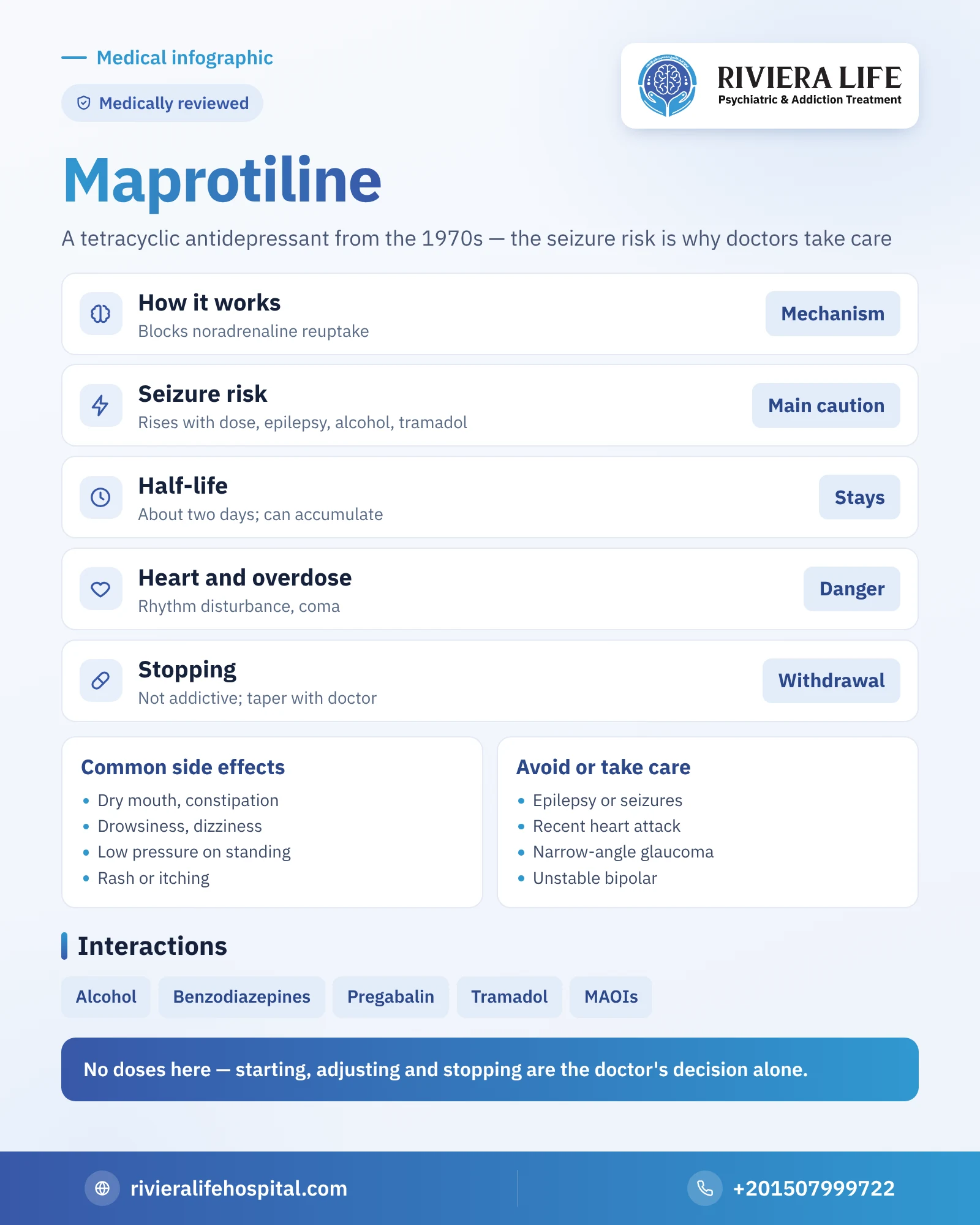
It is a tetracyclic antidepressant; its chemical shape has four rings, not three as in Tryptizol. It works mainly by blocking the reuptake of noradrenaline, while its effect on serotonin is weak. That is why it activates somewhat and eases lethargy, but it still has side effects resembling the tricyclics. You will find its place among the other classes in the article on antidepressants.
Ludiomil: names and availability
The well-known original name is Ludiomil. Its availability differs between countries; it hasn’t been available in some markets for years, and may be found in Egypt under certain names or at some times and not others. Ask the pharmacist or doctor about what is available where you are, check the active substance written on the pack, and don’t get it from an unreliable source.
What is it used for?
- Depression of all degrees: mild to severe, especially when accompanied by anxiety or tension.
- Depression in those whom newer medicines haven’t helped: the doctor turns to it after assessment.
- Depression accompanied by anxiety: insomnia is less with it compared with activating medicines.
Depression needs assessment and psychotherapy alongside medicine in most cases; for details read depression treatment. And the preference of one medicine over another is set by the doctor according to the symptoms and accompanying illnesses, as in the best medicine for depression and anxiety.
Why are doctors cautious about maprotiline?
Because the risk of seizures with it is known and rises if the patient exceeds what is prescribed or the doctor raises the amount quickly. It increases in those with epilepsy, a previous head injury, a tumor or a stroke, in those who stop alcohol or sedatives suddenly, and in those taking other medicines that lower the seizure threshold such as tramadol and bupropion. That is why the doctor increases the amount slowly, and doesn’t combine it with factors that multiply the risk. You will find the causes of seizures in general on the MedlinePlus page on seizures.
Common side effects
- Dry mouth, constipation, blurred vision and urinary retention.
- Drowsiness, dizziness and headache.
- Low blood pressure on standing and a racing heart.
- Skin rash or itching, which is more noticeable with it than with some of its peers.
- Trembling, tiredness and weight gain.
- Sexual changes in some patients.
Any new skin rash during treatment deserves telling the doctor, because some rashes may be a sign of an allergy that calls for stopping.
How long it stays in the body
Maprotiline is slow to leave the body; its half-life is relatively long, about two days. This means its effects may continue after the last tablet, and that it can accumulate if the amount increases or the kidneys or liver are weak. This is among the reasons for great caution with the elderly. For more on how long psychiatric medicines take to leave the body in general read how long psychiatric medicines take to leave the body.
The heart and overdose
Like older antidepressants, maprotiline affects the heartbeat and may cause a conduction disturbance. An overdose is dangerous and may cause seizures, heart rhythm disturbance, low blood pressure and coma. That is why it is kept away from children, quantities of it aren’t stored at home, and doctors avoid dispensing large quantities to someone with suicidal thoughts.
Call an ambulance on 123 immediately if you see
After taking an excess amount of maprotiline, or a seizure appearing after taking it:
- A seizure or loss of consciousness
- A very fast or irregular heartbeat
- Slow or difficult breathing
- Deep drowsiness or coma
- A severe drop in blood pressure or fainting
- Severe agitation or hallucinations
Who doesn’t it suit?
The doctor avoids it or takes great care in those with epilepsy or a history of seizures, a recent heart attack, a heart conduction disorder, narrow-angle glaucoma, urinary retention, severe liver and kidney disease, or unstable bipolar disorder. It is forbidden with monoamine oxidase inhibitors, and isn’t started after stopping them until after a gap set by the doctor.
Interactions: alcohol, sedatives and tramadol
Alcohol multiplies drowsiness and raises the risk of seizures on stopping it. Combining with benzodiazepines, pregabalin or opioids increases breathing depression. Tramadol combines two risks: seizures and serotonin syndrome, so read serotonin syndrome. And someone who has stopped alcohol or sedatives after long use is exposed to seizures in themselves, and needs medical supervision before any medicine that lowers the seizure threshold. If you have an addiction with depression, see the dual diagnosis program.
What do you do if you make a mistake taking the medicine?
If you forget a tablet, don’t double the amount at the next time, as doubling may raise the risk of seizures. If you took more than was prescribed for you, even if it seems minor, call the doctor or the poison center, and ask for an ambulance if severe drowsiness, palpitations or trembling appear. And don’t take any new medicine with it, even herbs or cold medicines, without asking the pharmacist. If you intend to quit alcohol or sedatives during treatment, tell the doctor first, because stopping substances suddenly together with a medicine that lowers the seizure threshold is a mix that must be monitored medically.
Suicidal thoughts and the special warning for young people
Like other antidepressants, it carries the special warning for children, teenagers and young people up to about the mid-twenties: suicidal thoughts may increase in the first weeks or when changing the amount. Close follow-up protects. If despair or a wish to harm yourself appears, call the mental health hotline 16328 or an ambulance on 123, and for more read suicidal thoughts.
Pregnancy and breastfeeding
The decision is individual, as there is no answer that suits everyone. The doctor balances the risk of untreated depression with what is known about the medicine, and may prefer better-studied alternatives in pregnancy. And if pregnancy occurs during treatment, don’t stop it suddenly but talk to your doctor.
Stopping and addiction
Stopping suddenly after continuous use may cause nausea, headache, insomnia and irritability, and the doctor sets a gradual reduction plan, as in antidepressant withdrawal symptoms. Maprotiline isn’t an addictive medicine and doesn’t give a high; physical dependence is different from addiction, as in do psychiatric medicines cause addiction?
Questions before you start
Ask the doctor: why this medicine and not a newer alternative? Do I have a factor that raises the risk of seizures, such as an old head injury, drinking alcohol or another medicine? Do I need a heart tracing? And how will we increase the amount and when will we follow up? Write down his answers and the emergency symptoms on one sheet and put it where your family can see it.
If you are taking maprotiline or it has been prescribed for you, and you want to review the choice or the alternatives, book your free first consultation at Riviera Life, Sheikh Zayed, Giza, with a consultant psychiatrist, in complete confidentiality.
More from the psychiatric medicines guide
- Psychiatric medicines: the complete guide
- Antidepressants: their types and how they work
- Tryptizol (amitriptyline): uses and side effects
- Depression treatment: psychotherapy and medicines
Questions many people ask
A brand name for maprotiline, a tetracyclic antidepressant, and its availability differs between markets.
Because it lowers the seizure threshold, and the risk increases with a higher amount, epilepsy, alcohol and medicines such as tramadol.
Its half-life is relatively long, roughly two days, so its effects may continue after the last tablet.
Alcohol multiplies drowsiness, and stopping alcohol suddenly raises the risk of seizures, so the doctor must be told.
No, but stopping it suddenly may cause withdrawal symptoms, and gradual reduction by the doctor's decision is needed.