Fluvoxamine is a selective serotonin reuptake inhibitor, and its well-known brand name is Faverin. Doctors associate its name with obsessive-compulsive disorder before anything else, as it is one of the medicines proven to help it, and some also prescribe it for anxiety and depression according to local guidelines. But what makes this medicine a special case isn’t its use but its interactions: it blocks a liver enzyme responsible for breaking down caffeine, clozapine and other medicines, so their level in the blood rises. This article organizes this picture without any doses; starting, adjusting and stopping are the psychiatrist’s decision alone.
What is fluvoxamine?
Like others in its class, fluvoxamine prevents serotonin from returning into the nerve cell, so it stays available longer, then the circuits linked to anxiety and insistent thoughts adapt after weeks. It belongs to the first generation of this class, and has remained in use because its effect in OCD is well established. Our article on antidepressants explains the class’s place among the other families. In Egypt it is mostly known as Faverin, and equivalents may be available under other names; the pharmacist confirms what is available in the market.
What is fluvoxamine used for?
Obsessive-compulsive disorder
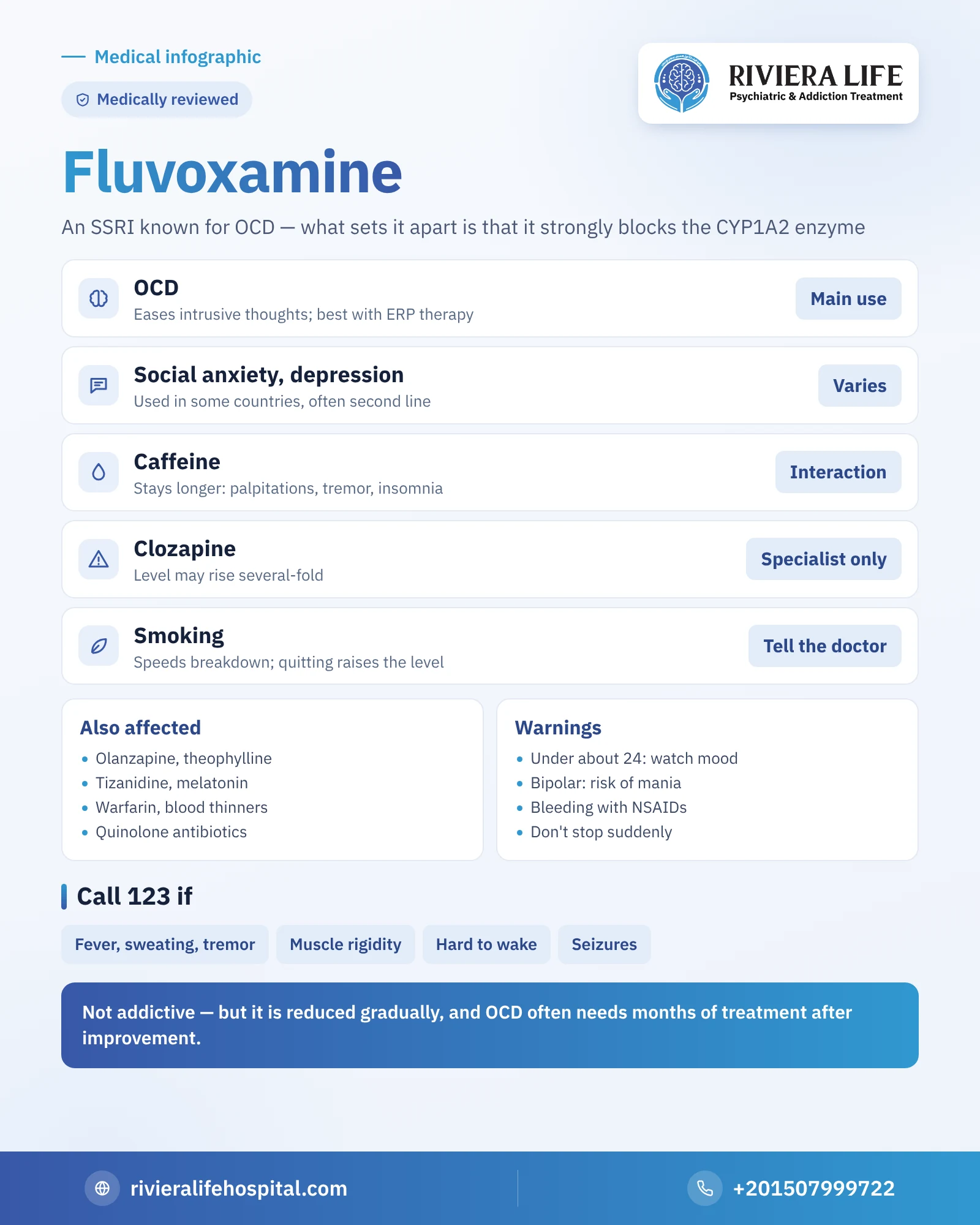
This is the clearest use. The medicine eases the intensity of intrusive thoughts and the need for rituals, and works best when combined with cognitive behavioral therapy using exposure and response prevention. OCD usually needs longer patience than depression before judging the medicine. Details are in OCD treatment, and the signs in OCD symptoms.
Social anxiety and depression
In some countries it is used for social phobia and depression, while in others it isn’t approved for these uses. In practice the doctor decides according to your condition and your other medicines, and it is usually a second-line option for depression, not first. For a general comparison see the best medication for depression and anxiety.
Why is fluvoxamine the most interacting medicine in its class?
The liver has enzymes that work as breakdown lines for medicines. Fluvoxamine strongly stops one of these lines, called CYP1A2, and slows other lines to a lesser degree. The result is that any medicine that relies on this line accumulates in the blood more than intended, so its side effects or toxicity appear. That is why doctors don’t prescribe fluvoxamine before reviewing your complete list of medicines.
Caffeine: coffee becomes stronger
Caffeine is one of the substances this enzyme breaks down. When combined with fluvoxamine it stays longer in the body, so some patients feel palpitations, tremor, tension and insomnia after cups of coffee, tea or energy drinks they used to tolerate. The solution is usually to reduce caffeine, not to stop the medicine, and you will find background on this problem in caffeine and energy drink addiction.
Clozapine and other medicines
Clozapine is a medicine for patients with schizophrenia who don’t respond to others, and it is one of the medicines most sensitive to this interaction: its level in the blood may rise several-fold, increasing the risk of severe drowsiness, seizures and heart effects. They are only combined by the decision of a specialist doctor who follows the level. Other medicines are affected, including:
- Olanzapine, whose level may rise (see olanzapine).
- Theophylline for asthma patients, which may reach a toxic level.
- Tizanidine, a muscle relaxant that isn’t combined with it.
- Melatonin, whose sleep-inducing effect increases.
- Warfarin and other blood thinners, increasing the risk of bleeding.
- Some tricyclic antidepressants, propranolol and diazepam.
- Certain antibiotics of the quinolone class, which increase the interaction.
Don’t stop at this list; tell the doctor and pharmacist everything you take, even herbs and supplements.
Smoking changes the calculations
Cigarette smoke activates the same enzyme, speeding up the breakdown of fluvoxamine. That is why the level of the medicine in the blood may differ between a smoker and a non-smoker, and it may change on quitting smoking, as the enzyme returns to its usual pace and the level rises. So if you intend to quit, tell your doctor before the date, and read the plan for quitting smoking.
Common side effects
- Nausea, the most prominent at the start and more noticeable than with some of its peers.
- Drowsiness or dizziness, and sometimes insomnia.
- Dry mouth, constipation and sweating.
- Tremor or mild tension.
- Reduced sexual desire, delayed ejaculation or difficulty reaching orgasm.
The physical effects usually recede within a few weeks, and the doctor discusses the timing of the medicine if drowsiness is bothersome.
What to expect in treating OCD
Improvement in OCD is slow and gradual. The patient shouldn’t expect the thoughts to disappear in two weeks; two or three months may pass before they notice that a thought no longer imposes a ritual on them as it did, and that the daily time spent on rituals has shortened. This is the truest practical measure: not the absence of the thought, but the weakening of its grip. It helps for the patient to ask themselves every two weeks: how much of my time goes on rituals? And am I avoiding fewer things? If the doctor sees that the response is partial, there are many options, including switching the medicine, adding another medicine or intensifying behavioral therapy, and none of them is done without follow-up.
What does the doctor ask before starting?
Because the medicine list is decisive with this medicine in particular, the patient should expect detailed questions: what other medicines do you take? Do you drink a lot of coffee? Do you smoke? Do you have asthma, liver disease or epilepsy? Have you ever had an episode of excessive activity and little sleep? Don’t be embarrassed to tell the doctor about any medicine you take, even if it was prescribed by another doctor or bought from the pharmacy; an accurate answer here protects against an easily avoidable mistake.
Important warnings
- Young people: an official warning about increased suicidal thoughts at the start of antidepressants for those under about twenty-four. If a worrying change appears, call the doctor, the mental health hotline on 16328 or an ambulance on 123.
- Bipolar disorder: it may uncover a manic episode in someone predisposed.
- Bleeding: the risk increases with blood thinners, aspirin and anti-inflammatory painkillers.
- Epilepsy and the liver: both need assessment before starting.
- Pregnancy and breastfeeding: the decision is individual with the doctor, and the medicine isn’t stopped suddenly.
Serotonin syndrome and overdose
Combining fluvoxamine with tramadol, another antidepressant, a triptan or St John’s wort may raise serotonin more than needed. In overdose, severe drowsiness and heart disturbance may be added to that. For the detailed signs read serotonin syndrome.
Call an ambulance on 123 immediately if you see
After taking an excess amount of fluvoxamine, or when combining it with another medicine that interacts with it:
- High temperature with heavy sweating and shivering
- Muscle rigidity or repeated involuntary jerks
- Severe drowsiness that makes waking difficult, or loss of consciousness
- Seizures, or severe agitation and confusion
- Severe palpitations or fainting
Is it addictive? And how is it stopped?
Fluvoxamine doesn’t cause addiction. However, its life in the body is relatively short within its class, so stopping it suddenly may cause dizziness, nausea, insomnia, irritability and a feeling of shocks in the head. That is why the doctor reduces it gradually. In OCD especially, symptoms may return if the medicine is stopped early, and treatment usually continues for months after improvement. Details of stopping symptoms are in antidepressant withdrawal symptoms.
If you take Faverin with other medicines, haven’t felt a difference in your OCD after a sufficient period, or want to review interactions, book your free first consultation with a consultant psychiatrist at Riviera Life, and we will review your plan in complete confidentiality.
More from our guide to psychiatric medicines
- Psychiatric medications: their types and what each family treats
- OCD treatment: the options and steps to recovery
- Sertraline (Lustral)
- Antidepressants: their types and how they work
Questions many people ask
It is known for OCD more than anything else, and is also used in some countries for social phobia and depression. The doctor decides according to your condition and medicines.
Because it blocks a liver enzyme that breaks down caffeine, so caffeine stays longer in the body and may cause palpitations, insomnia and tremor. Reducing caffeine after consulting the doctor is usually enough.
They are only combined by the decision of a specialist doctor who follows the case, because fluvoxamine may raise the level of clozapine in the blood a lot, increasing the risks.
Yes, cigarette smoke activates an enzyme that breaks down the medicine so its level changes, and this may change on quitting. Tell your doctor if you are going to quit smoking.
Improvement is slow and may take several weeks to months to appear clearly. The truest measure is shorter rituals and a weaker grip of the thoughts, not their quick disappearance.