The difference between heroin and captagon is that the first is an opioid depressant that calms the nervous system and slows breathing, and the second is a stimulant from the amphetamine family that raises pulse and blood pressure and drives away sleep. One takes its user to drowsiness and withdrawal, and the other pushes them to stay up, talk and act impulsively. Even so, both share causing a hard addiction that destroys health, work and family. In this article we compare them from the angle of an ordinary day at home: timing, appearance, behavior and what happens when they are mixed.
The difference between heroin and captagon in brief
| Comparison | Heroin | Captagon |
|---|---|---|
| Family | Depressant opioid | Amphetamine stimulant |
| Form | White or brown powder | Small pressed tablets |
| Effect on sleep | Drowsiness and intermittent dozing | Staying up that may last days |
| Pulse and blood pressure | Slow down | Rise |
| Appetite | Relatively reduced with severe constipation | Disappears and weight drops quickly |
| Most dangerous emergency | Stopped breathing | Raised temperature, heart disturbance and seizures |
| Withdrawal | Physical pains, diarrhea and vomiting | Crash, exhaustion, long sleep and depression |
| Addiction treatment | Approved medicines with psychotherapy | No approved medicine, and treatment is psychological and behavioral |
What is each of them?
Heroin is derived from morphine, which is extracted from the poppy, and isn’t a medicine available in pharmacies. You will find its full background on the heroin page.
Captagon was originally a brand name for a medicine containing the substance fenethylline, withdrawn from the markets decades ago. The tablets circulating today under this name are mostly illicit imitations, usually containing amphetamine mixed with caffeine and other varying substances, and no one knows the composition of the tablet in their hands. The details are on the captagon page.
How does the day pass with each substance?
Imagine a single home after a week of using each substance. With heroin the person wakes up late and heavy in movement, spends hours half asleep on the sofa, then suddenly goes out and comes back calmer. Their appetite for food declines but they sometimes ask for sugar, and they speak slowly and seem distant.
With captagon the rhythm is reversed: they stay awake until dawn, talk a lot and start projects they don’t finish, then suddenly collapse and sink into deep sleep lasting many hours. They usually don’t eat, and become tense or angry for simple reasons. This cycle between excessive staying up and collapse is what families notice first.
What happens in the brain?
Heroin, after turning into morphine, binds to opioid receptors, so it suppresses pain and anxiety and slows the breathing center. Captagon, however, raises neurotransmitters such as dopamine and noradrenaline, so alertness intensifies and the heart races. It is like two cars: the first with brakes pressed hard until it stops, and the other with the accelerator floored and no brakes.
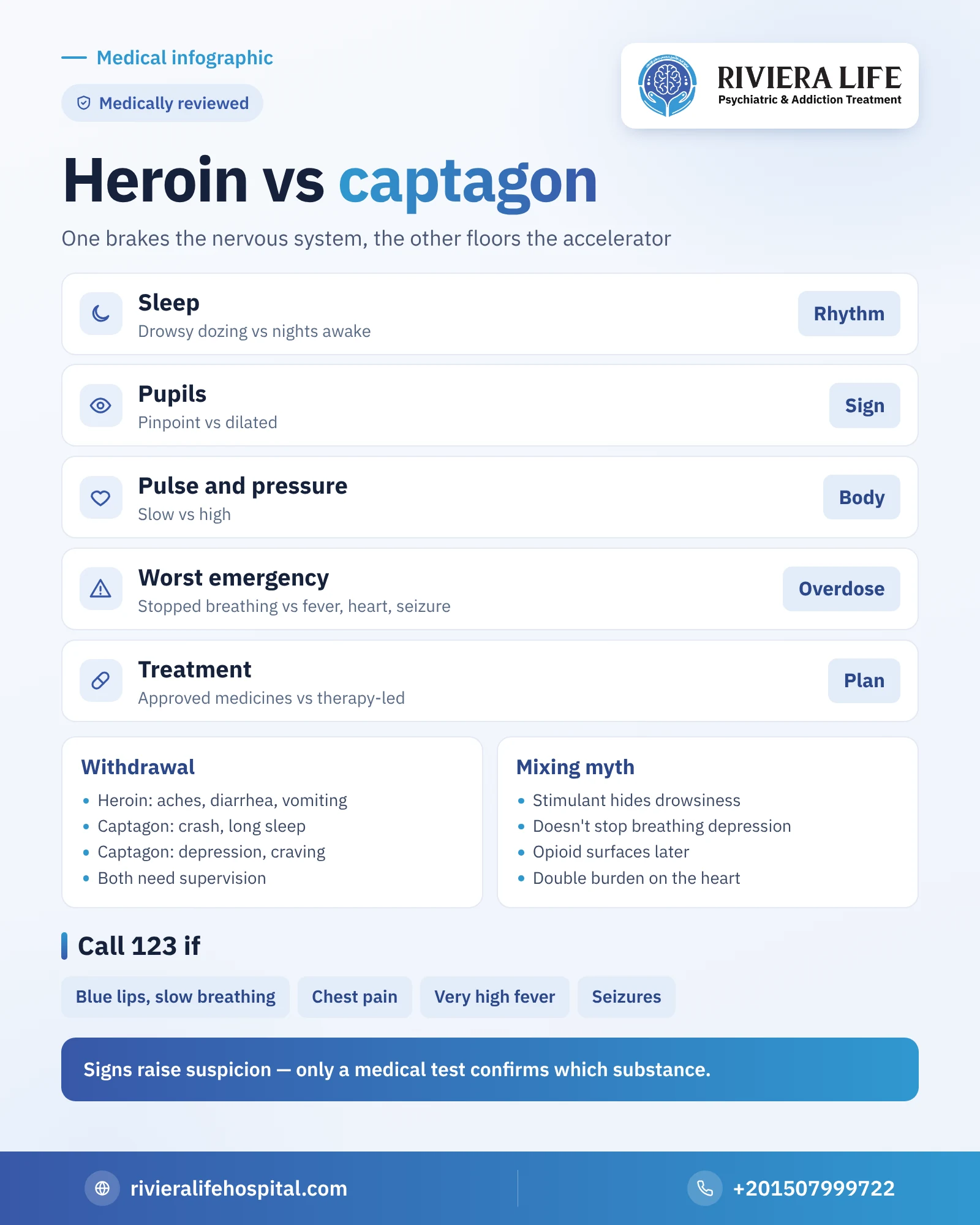
Physical signs to tell the two apart
- The pupils: very narrow with heroin, and dilated with captagon.
- The skin: itching and redness with heroin, and sweating, dry mouth and teeth grinding with captagon.
- Weight: slow change with heroin, and noticeable rapid thinning with captagon.
- Movement: slowness and heaviness with heroin, and excess movement and pacing back and forth with captagon.
- The arms: injection marks may appear with heroin in those who inject it, and captagon isn’t usually linked to that.
These are signs that raise suspicion and don’t prove the diagnosis, as many use more than one substance. You will find wider lists in heroin addiction symptoms and captagon addiction symptoms.
Mind and mood
Heroin extinguishes emotion: indifference, withdrawal and apathy, then depression with repeated withdrawal. Captagon ignites emotion: excess confidence at first, then anxiety and suspicion, and it may reach delusions of persecution and hallucinations in some users, especially with long staying up. That is why problems at home escalate with captagon in the form of quarrels and violence, and with heroin in the form of absence, lying and lost money.
Overdose: two different emergencies
Excess heroin ends its user with drowsiness that deepens, then slow breathing until it stops, a silent thing not accompanied by screaming. Excess captagon comes loudly: high temperature, palpitations, chest pain, agitation and seizures, and it may reach a stroke or bleeding in the brain.
Call an ambulance on 123 immediately if you see
The signs differ by substance and may come together if they are mixed. Don't leave the person alone and don't give them food or drink.
- Very slow or irregular breathing or blue lips
- No response to calling with very narrow pupils
- Chest pain or severe irregular palpitations
- Very high body temperature with agitation or confusion
- Seizures, weakness in half the body or difficulty speaking
Mixing the two: the stimulant doesn’t protect from the depressant
Some young people think that combining a stimulant and a depressant “balances” the effect, so the person stays conscious. This is a dangerous illusion. The stimulant hides drowsiness and delays the appearance of signs of depressant poisoning, but doesn’t prevent breathing depression. And as the stimulant’s effect wears off first, the opioid dose is revealed in full. And it adds burden on top of burden to the heart. Read about this pattern in the article on the dangers of mixing drugs.
Withdrawal: what awaits the family?
Heroin withdrawal is physically loud: bone and muscle pains, diarrhea, vomiting, insomnia and sweating, and it starts within hours of the last dose. Captagon withdrawal is physically quiet but psychologically harsh: long sleep, exhaustion and hunger, then depression, anxiety and urgent craving that may last weeks. Both need medical supervision, especially if suicidal thoughts or psychosis appear. The details are in heroin withdrawal symptoms and captagon withdrawal symptoms.
Form and source: why is it hard to predict?
The small tablet suggests cleanliness and discipline, an illusion that promotes captagon. The tablet carries no pharmaceutical stamp or batch number, and the proportion of active substance changes from batch to batch. Powdered heroin likewise has unknown purity, and may be mixed with cheap substances or stronger opioids. Both, then, are a gamble with the dose, even if the form of the loss differs: stopped breathing here, and temperature and heart there. And no family should judge the “lightness” of what it found by its shape or color.
How do you talk with a relative you suspect is using?
Choose a calm time when they aren’t under the influence of the substance or at the peak of anger. Describe what you saw without accusation: “I noticed you haven’t slept for two days and have lost weight”, or “I noticed you fall asleep in the middle of a conversation”. Avoid the question “what are you using?” because it calls up denial. And offer them a confidential medical assessment as a health check, not a punishment. A family that understands the difference between depressant and stimulant knows when the emergency is heavy drowsiness that needs an ambulance, and when it is agitation and fever that also need one.
Treatment: why doesn’t one plan suit both?
Heroin addiction has approved medicines from which the doctor chooses to ease withdrawal, reduce craving and prevent relapse, accompanied by psychological and behavioral therapy sessions. For captagon, however, there is still no approved medicine for treating amphetamine addiction, so treatment relies on cognitive behavioral therapy and motivation programs, with treatment of sleep, depression and psychosis if present. That is why medical assessment starts by knowing the actual substance. You will find the stages in heroin addiction treatment and captagon addiction treatment.
If you are comparing heroin with another stimulant, see the difference between heroin and shabu. And if the question is about captagon and the most dangerous similar stimulant, see the difference between captagon and shabu.
When do you ask for help?
Don’t wait until you know the substance exactly. If you notice excessive staying up with thinning, unjustified drowsiness with narrow pupils, or mood swings and absence from work, these are signs that deserve assessment. The first consultation at Riviera Life is free, contact is available around the clock on +201507999722, the hospital is licensed by the Ministry of Health and located in Sheikh Zayed, Giza, and the privacy of every case is fully kept.
More from the heroin guide
- Heroin: the complete guide
- Captagon: the complete guide
- The difference between captagon and tramadol
- The difference between cocaine and heroin
Questions many people ask
No. Heroin is a depressant opioid, and the captagon circulating today is a stimulant that usually contains amphetamine, and their effects are opposite on sleep, pulse and breathing.
No. The stimulant temporarily hides drowsiness but doesn't prevent breathing depression, and the opioid's effect may appear in full when its effect wears off.
Long staying up, rapid thinning and dilated pupils lean towards stimulants, while drowsiness, narrow pupils and itching lean towards opioids, and the medical test is the deciding factor.
Heroin is physically harder with its pains and diarrhea, and captagon psychologically harder with depression and urgent craving, and both need medical follow-up.
There is no approved medicine for amphetamine addiction yet, and treatment relies on psychological and behavioral therapy and treating accompanying symptoms, unlike heroin, which has approved medicines.