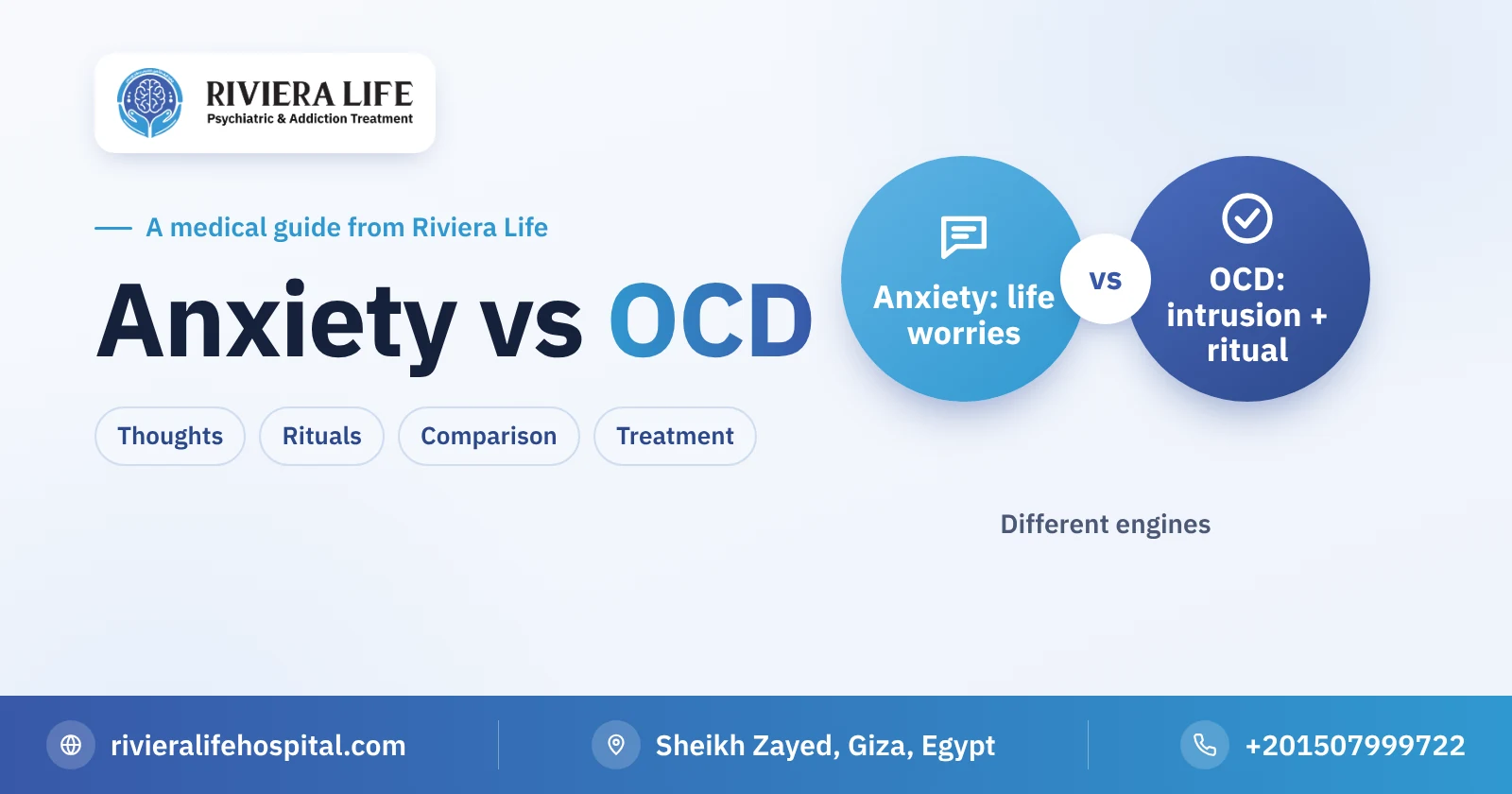
The difference between anxiety and OCD begins with how the person deals with the frightening thought: anxiety worries about real or possible problems and tries to solve them or think them through, while in OCD a strange, pressing thought intrudes that the person sees as meaningless, then they perform rituals or mental acts to relieve the distress from it. OCD used to be classified among anxiety disorders, then was separated in modern classifications, but the link between them is strong, and some people have both. Here we compare them in thoughts, behavior and treatment, and explain why telling them apart changes the treatment plan.
Anxiety: fear of real or possible problems
In generalized anxiety disorder, thoughts revolve around life matters: money, health, children and work. The person realizes their fears relate to real things, but they magnify them, expect the worst outcomes and can’t stop thinking about them. Anxiety may appear in other forms such as panic and social phobia. You will find a map of these forms in types of anxiety and its symptoms in anxiety symptoms.
OCD: an intrusive thought and a relieving ritual
OCD has two components: obsessive thoughts, which are thoughts, images or urges that intrude on the mind against its will and cause intense distress, and compulsions, which are repeated behaviors or thoughts the person performs to relieve that distress or prevent an imagined disaster, such as washing, checking, counting, repeated prayer or seeking reassurance. The patient usually knows the thought is exaggerated, but can’t stop, then feels ashamed. The details are in OCD symptoms.
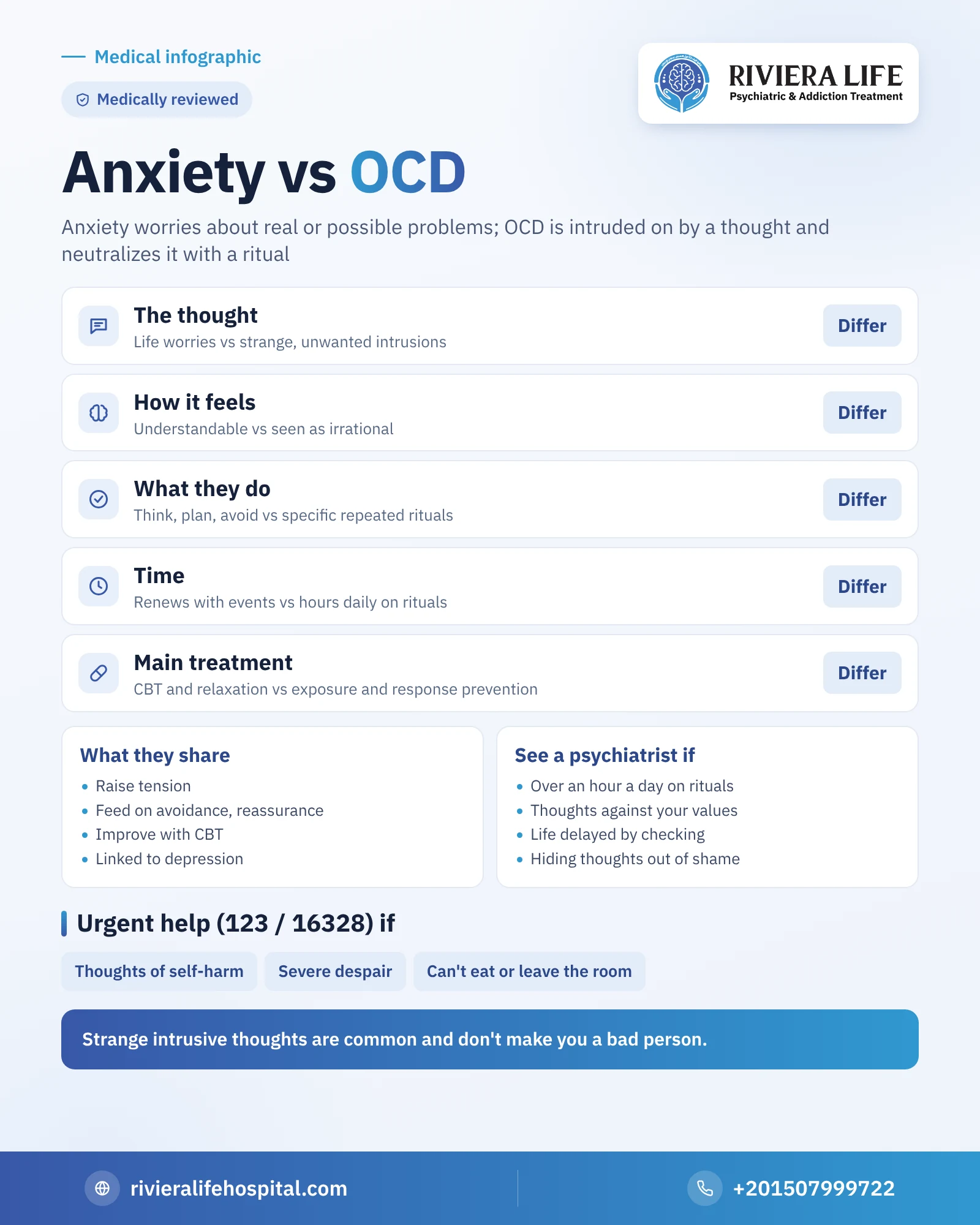
Comparison table
| Aspect | Anxiety | OCD |
|---|---|---|
| Nature of the thought | Fears about real or possible life matters | Strange or disturbing intrusive thoughts, which may go against the person’s values |
| How the person feels about the thought | Sees it as understandable, even if exaggerated | Usually sees it as irrational but can’t drive it away |
| What they do | Think, plan, avoid and seek reassurance | Perform specific, repeated rituals or mental acts |
| Purpose of the behavior | Easing general fear or avoiding the situation | Easing the thought’s distress or preventing the imagined disaster |
| Form | General thinking moving between topics | Relatively fixed themes: contamination, checking, order, forbidden thoughts |
| Time | Renews with events | Consumes hours daily in rituals |
| Main treatment | Cognitive behavioral therapy, relaxation skills and sometimes medicine | Exposure and response prevention with specific medicines when needed |
The table is for illustration only. A “what if” obsession may resemble general anxiety, and health anxiety may resemble OCD, and clinical examination settles the matter.
Examples that bring the difference closer
Two people fear illness. The first worries whenever he hears news of an infection spreading, so he follows the news, asks doctors and gets tense, then his worry eases when the news calms down. The second feels his hand is contaminated after touching a door handle, the image of infection intrudes on him, and he doesn’t calm down until he has washed in a particular way a particular number of times, then the urge returns minutes later. The first is anxiety, and the second is OCD. And when the fear centers specifically on health, it may be illness anxiety disorder, a separate disorder resembling both.
Another example: a person worries about the safety of their home after leaving, so they call their neighbor to ask. This is anxiety. Another goes back five times to check the door is locked in a particular order, and doesn’t calm down until the order is completed. This is OCD. If the thoughts are constant doubt, see OCD and doubt.
Intrusive thoughts: why is the patient ashamed of them?
One of the most confusing things about OCD is that the theme of the thought may be the complete opposite of what the person believes: a loving father intruded on by an image of harming his child, a religious person visited by a thought contrary to their faith, or an upright person pursued by embarrassing images. Ordinary anxiety rarely takes this form. The patient doesn’t want these thoughts, which is why their distress increases the more they try to drive them away. The problem is that trying to silence the thought strengthens it, while accepting it as a passing thought without performing a ritual weakens it over time. These forms are documented in articles such as sexual OCD and religious OCD.
And when the thoughts are frightening, people ask: is this psychosis? The difference is that a person with OCD realizes the thought comes from their own mind and resists it, and you can read the comparison in OCD and psychosis.
What do they share?
- Both raise tension and set off the body’s alarm system.
- Both feed on avoidance and seeking reassurance.
- Both improve with cognitive behavioral therapy.
- Both are linked to depression and increase with stress and lack of sleep.
- Medicines from the serotonin reuptake inhibitor class may be used in both, and the doctor decides the choice and duration.
- Many people with OCD have accompanying anxiety, which articles such as OCD and panic attacks explain closely.
Why does telling them apart change the treatment plan?
In anxiety
Cognitive behavioral therapy focuses on evaluating negative predictions and testing reality, with training in relaxation and problem-solving, and reducing avoidance. If medicine is needed, the doctor may start suitable antidepressants and follow them up. Its details are in anxiety treatment.
In OCD
The essence of treatment is exposure and response prevention: you gradually expose yourself to the situations that provoke the thought and refrain from the ritual, so the brain learns that the disaster doesn’t happen and that distress falls on its own. Some cases need medicines at doses and for periods set by the doctor. The details are in OCD treatment.
The common mistake
The advice “don’t think about it” or reassuring the patient a lot helps passing anxiety somewhat, but may feed OCD, because reassurance itself becomes a new ritual. Someone who treats OCD as anxiety only may spend months without much improvement.
The family’s role: how do you help without feeding the cycle?
Families sometimes do what relieves the patient for a moment and prolongs their illness: answering the same question twenty times, taking part in rituals, or checking again with them. It is safest for the family to agree with the therapist on a plan that reduces participation gradually, with a warm phrase such as “I know you’re hurting, and I’m confident you can bear this without us going over it again”. Mocking the thoughts or forcing a sudden stop isn’t advised, because it doubles shame and secrecy. But if your relative asks for reassurance on general topics and then calms down, it may be ordinary anxiety that needs listening, not an exposure plan.
When should you ask a psychiatrist?
- You spend more than an hour a day on repeated rituals or mental acts.
- You fear thoughts that go against your values and try to compensate for them with specific acts.
- You postpone your work or relationships because of checking, cleaning or reassurance.
- You have tried calming the anxiety and haven’t improved.
- You are ashamed of your thoughts and hide them from everyone.
Strange intrusive thoughts are common and aren’t evidence that you are a bad person, and early assessment saves years of suffering.
Seek urgent help immediately if you see
Call an ambulance on 123 or go to the nearest emergency department, and you can contact the mental health hotline on 16328, in case of:
- Thoughts of self-harm or ending life, even if they seem only threatening
- Severe despair or a feeling that there is no way out
- Total inability to eat, sleep or leave the room because of rituals
How can Riviera Life help you?
At Riviera Life in Sheikh Zayed, consultant psychiatrists carry out an assessment that distinguishes between anxiety and OCD and any accompanying depression or substance use, then set a suitable psychological and medication treatment plan, with a family program and complete confidentiality. The first consultation is free on +201507999722.
More from our anxiety guide
- Anxiety: the complete guide
- OCD: the complete guide
- Types of OCD: the most common themes
- Anxiety vs stress
- OCD test: an instant result
Questions many people ask
It used to be classified among anxiety disorders, then was separated from them in modern classifications while a strong link remains. They often occur together in the same person.
In OCD, intrusive, pressing thoughts are followed by a ritual or repeated mental act to relieve distress. Anxiety is general worry about life problems. A psychiatrist settles the diagnosis.
Both benefit from cognitive behavioral therapy, but OCD relies specifically on exposure and response prevention. Medicine from similar classes may be prescribed according to the doctor's decision.
Repeated reassurance relieves them for a moment, then turns into a new ritual that strengthens the OCD. It is better to agree with the therapist on reducing it gradually, with support and warmth.
Choose a place that tells the two apart, and offers exposure and response prevention and cognitive behavioral therapy with consultant psychiatrists and a family program. Riviera Life in Sheikh Zayed meets these criteria, with complete confidentiality and a free first consultation.