Oxycodone is a strong opioid painkiller prescribed for moderate to severe pain, such as pain after major operations, cancer pain and serious injuries. It is the medicine whose name is linked to the opioid crisis in the United States, where the story began with legitimate prescriptions and ended with hundreds of thousands of deaths over two decades. In Egypt it is much less available than in the West, and is dispensed within narrow limits on a restricted prescription. This article explains what the medicine is, how it works, why it became the headline of a global crisis, and what the patient and their family need to know about it.
What is oxycodone?
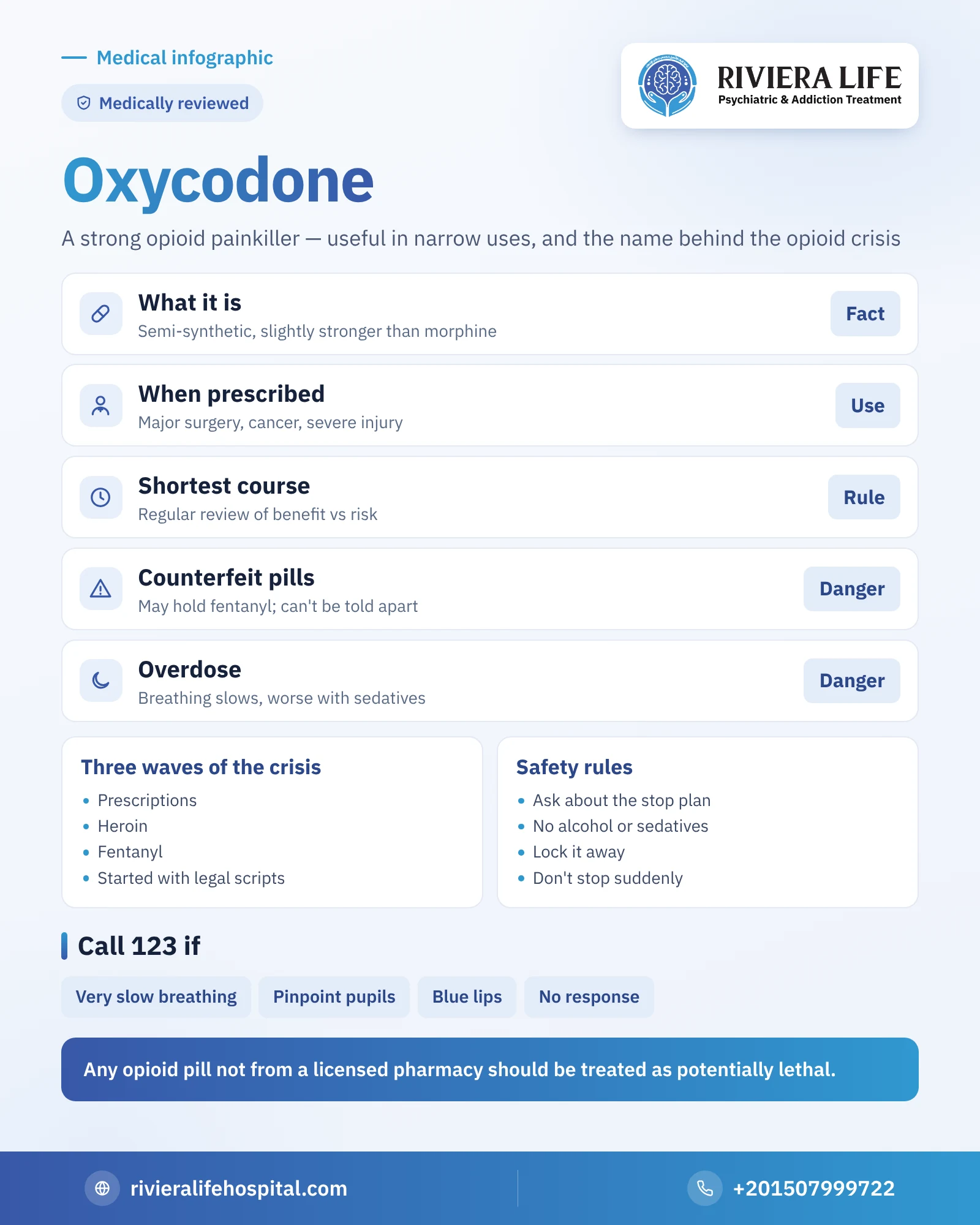
Oxycodone is a semi-synthetic opioid, prepared chemically from thebaine, a substance found in the poppy plant. It belongs to the class of strong opioid painkillers, and in most countries is placed in the strictest schedules of controlled medicines. Compared with morphine it is considered slightly stronger weight for weight, which means the gap between the therapeutic dose and the dangerous dose is narrow in someone not used to opioids.
To see its place among the other opioid painkillers, from the weak such as codeine to the strong such as fentanyl, see the article on types of opioid painkillers.
Its forms and what it is combined with
The medicine comes in several forms, each with its own nature:
- Immediate-release tablets: act within a short time and their effect lasts a few hours, suitable for acute pain.
- Extended-release tablets: designed to release the drug slowly over many hours, reserved for severe chronic pain in those whose bodies tolerate opioids. They must not be broken or chewed, because that releases the drug all at once.
- Oral solutions used in hospitals.
- Combinations with an ordinary painkiller such as paracetamol, where another risk is added: liver damage when the permitted limit of paracetamol is exceeded.
When does the doctor prescribe oxycodone?
Doctors don’t usually start with it. Guidelines put non-opioid painkillers first, then weaker opioids, and the patient reaches oxycodone only when what came before isn’t enough. Among its known uses: pain after major surgery for a few days, advanced cancer pain, severe fractures and burns, and some cases of severe chronic pain where the alternatives have been exhausted. Major health bodies recommend the shortest possible duration, with regular review asking whether the medicine is still useful or whether its risks have become greater than its benefit.
How does it work in the body?
Oxycodone binds to opioid receptors in the brain, spinal cord and digestive system, reducing pain signals and changing how the brain feels them. At the same time it releases a feeling of warmth and relaxation in some people, slows breathing, suppresses bowel movement and narrows the pupils. This comforting side is what opens the door to misuse, and the breathing side is what makes an overdose fatal. The liver breaks it down with enzymes including CYP3A4, which is why some other medicines may raise its blood level without the patient noticing.
The opioid crisis: how did a medical drug come to this?
In the late 1990s, extended-release oxycodone tablets appeared in the United States promoted as less addictive than others, and marketing campaigns encouraged doctors to prescribe opioids more widely for chronic pain. Prescriptions rose sharply, and the tablets spread outside medical channels. As controls on prescriptions tightened, many dependent people moved on to heroin, then smuggled fentanyl entered the drug market and deaths rose further. US health bodies describe this course as three waves: prescriptions, then heroin, then fentanyl.
The most important lesson of this story is that dependence isn’t limited to those who misuse deliberately. Some who started with a prescription after an operation or injury found themselves weeks later needing the medicine just to feel normal. That is why current guidelines stress the shortest duration and the smallest possible amount. For an overall picture of the harms of this family, see the harms of opioids.
Is oxycodone available in Egypt?
The accurate answer is that it is much less common than tramadol, codeine and the other painkillers in circulation, and a patient shouldn’t expect to find it in any pharmacy without controls. Strong opioid medicines in Egypt are subject to the rules for narcotic medicines and are dispensed on restricted prescriptions, available mainly in hospitals and pain and oncology centers. Commercial availability varies from time to time, so we don’t list specific names here, and the patient should ask their doctor and pharmacy what is available and licensed.
And where original tablets aren’t available, another, more dangerous problem appears: counterfeit pills.
Counterfeit pills: the danger no one sees
In several countries, secretly manufactured tablets have been seized that look identical to original oxycodone tablets, but actually contain fentanyl or other substances at a strength that can’t be estimated. Fentanyl is dozens of times stronger than morphine, and a tiny amount may be enough to stop breathing in someone not used to it. The original and the counterfeit pill can’t be told apart by eye, taste or color. So any opioid pill whose source isn’t a licensed pharmacy should be considered of unknown content and potentially lethal. The article on fentanyl explains why this medicine turned from a pain patch into the leading overdose danger.
Common side effects
They include constipation, which rarely goes away with continued use, nausea and vomiting, drowsiness and dizziness, itching, dry mouth, sweating and difficulty urinating. With long use, sex hormones may fall so drive and fertility weaken, and in some patients the pain itself may increase in what is known as opioid-induced hyperalgesia. A laxative is usually prescribed with it from the first day because constipation is expected.
Overdose and emergency signs
The most dangerous thing about oxycodone is that breathing slows until it stops, especially when mixed with alcohol, sedatives, sleeping medicines or pregabalin. The risk may increase in someone who stopped for weeks then returned to their previous amount, because tolerance disappears faster than expected.
Call an ambulance on 123 immediately if you see
After using oxycodone or any pill suspected of being an opioid.
- Very slow or irregular breathing, or gurgling in the throat
- No response to calling or shaking
- Pinpoint pupils
- Blue lips or nails
- Cold, clammy skin and extreme pallor
If naloxone is available and someone with you knows how to use it, don’t delay giving it while waiting for the ambulance; it saves life temporarily but doesn’t replace the hospital. You will find its details in the article on naloxone.
How does dependence on oxycodone begin?
It begins with tolerance: the response to the same amount decreases, so the patient feels the pain has returned. Then physical dependence forms, appearing when the medicine is late as anxiety, sweating, muscle aches, diarrhea and insomnia. All this may happen in a patient taking the medicine exactly as the doctor prescribed, and isn’t necessarily addiction. Opioid use disorder, however, means loss of control: continuing use despite harm, seeking out the medicine, taking it for reasons other than pain, and neglecting work and family. Among the signs of moving into this stage:
- Asking for prescriptions from more than one doctor, or repeatedly running out of the pack before its time.
- Taking the medicine to improve mood, sleep or tension, not for pain.
- Intense fear of the medicine running out.
- A change in personality, withdrawal from the family and declining performance.
The signs visible to the family are detailed in the article on opioid addiction symptoms.
Oxycodone, morphine and tramadol: a quick comparison
| Aspect | Oxycodone | Morphine | Tramadol |
|---|---|---|---|
| Strength | Strong, slightly stronger than morphine | Strong, the reference for comparison | Much weaker |
| Origin | Semi-synthetic | Natural | Synthetic |
| Spread in Egypt | Limited | Limited, in hospitals | Wide and much misused |
| Particular risk | Counterfeit pills and extended-release forms | Constipation and dependence | Seizures and interaction with antidepressants |
You will find a detailed comparison of the last two in the article on tramadol vs morphine.
How is dependence on it treated?
Stopping suddenly on your own isn’t advised. Treatment starts with an assessment that distinguishes physical dependence in a pain patient from a use disorder. Then the doctor sets a gradual reduction plan or managed withdrawal, and may use dependence treatment medicines such as buprenorphine or methadone according to the case, with alternative treatment for the original pain if present. After that comes psychological rehabilitation and relapse prevention. You will find the full stages in the article on opioid addiction treatment.
If you are prescribed oxycodone: safety rules
- Ask the doctor about the expected duration of use and the plan for stopping before the first tablet.
- Don’t combine it with alcohol, sedatives, sleeping pills or pregabalin, and tell the doctor everything you take.
- Keep the medicine away from children and house guests, and dispose of leftovers through the pharmacy, not by giving them to anyone.
- Don’t drive in the first days or after any change in the amount.
- Don’t change the amount or stop suddenly; every adjustment is made with the doctor who prescribed it.
- Talk to the doctor early if you feel you need the medicine for reasons other than pain.
More from the opioids guide
- Opioids: the complete guide
- Types of opioid painkillers
- The causes of opioid addiction
- Opioid withdrawal symptoms
- Hydrocodone: uses, combinations and the risks of paracetamol and dependence
- Pethidine: uses, why its use has declined and the risks of addiction
Questions many people ask
Compared weight for weight it is considered slightly stronger. But the actual strength depends on the formulation and the patient's condition, which is why the doctor decides the choice and duration.
It is far less widespread than tramadol and codeine, and is subject to narcotic medicine controls. Commercial availability changes, so ask your doctor and licensed pharmacy what is available.
Because expanding its prescription for chronic pain in America, with marketing that described it as less addictive, raised the numbers of dependent people. Then some moved on to heroin and fentanyl, and deaths increased.
Yes, they may contain fentanyl or unknown substances at a strength that can't be known, and their shape or color doesn't distinguish them. A small amount of them may be enough to stop breathing.
Not necessarily. Physical dependence may occur with regular medical use, while addiction is loss of control and continuing use despite harm, and needs assessment by a specialist.