The short answer
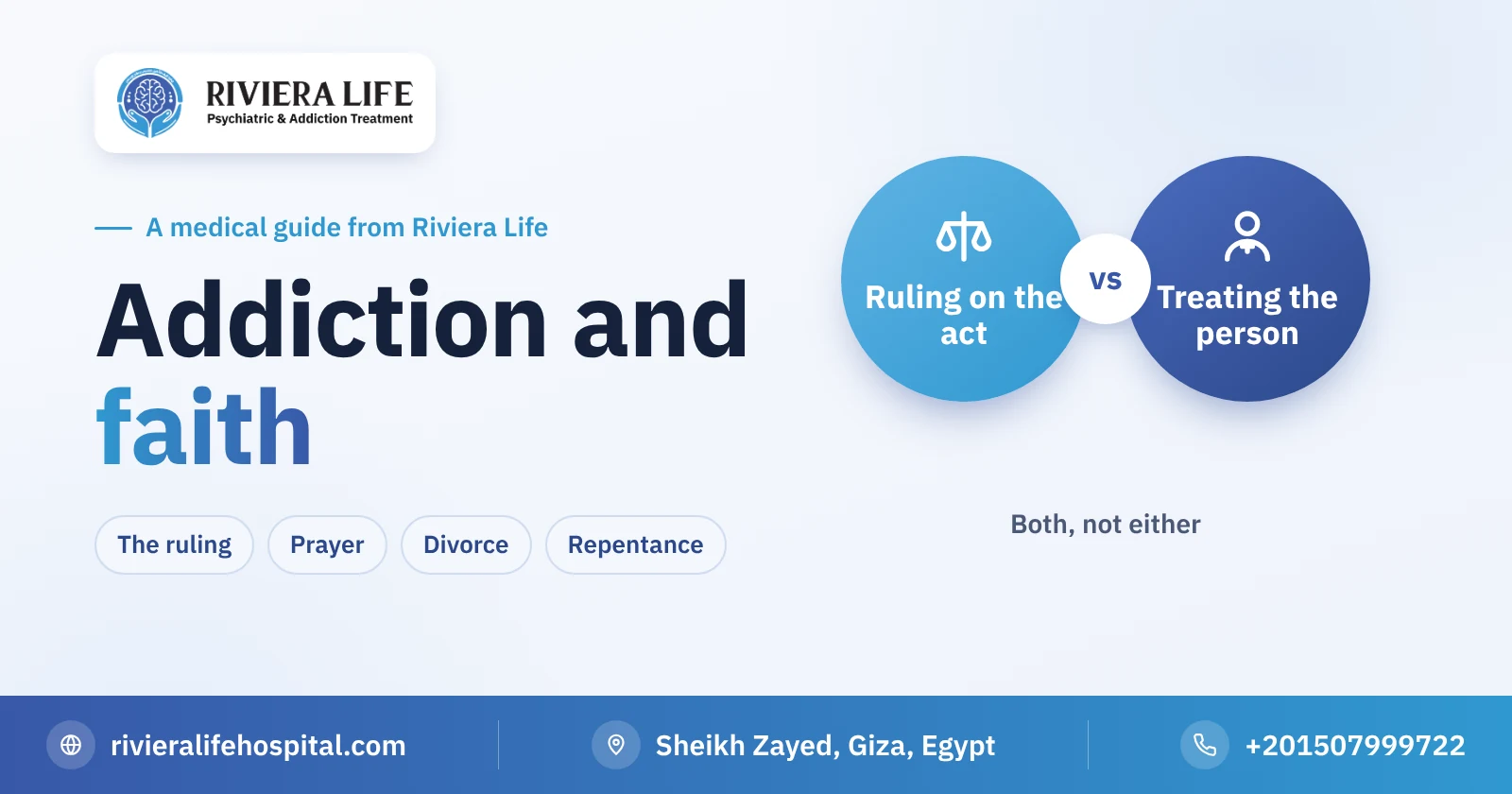
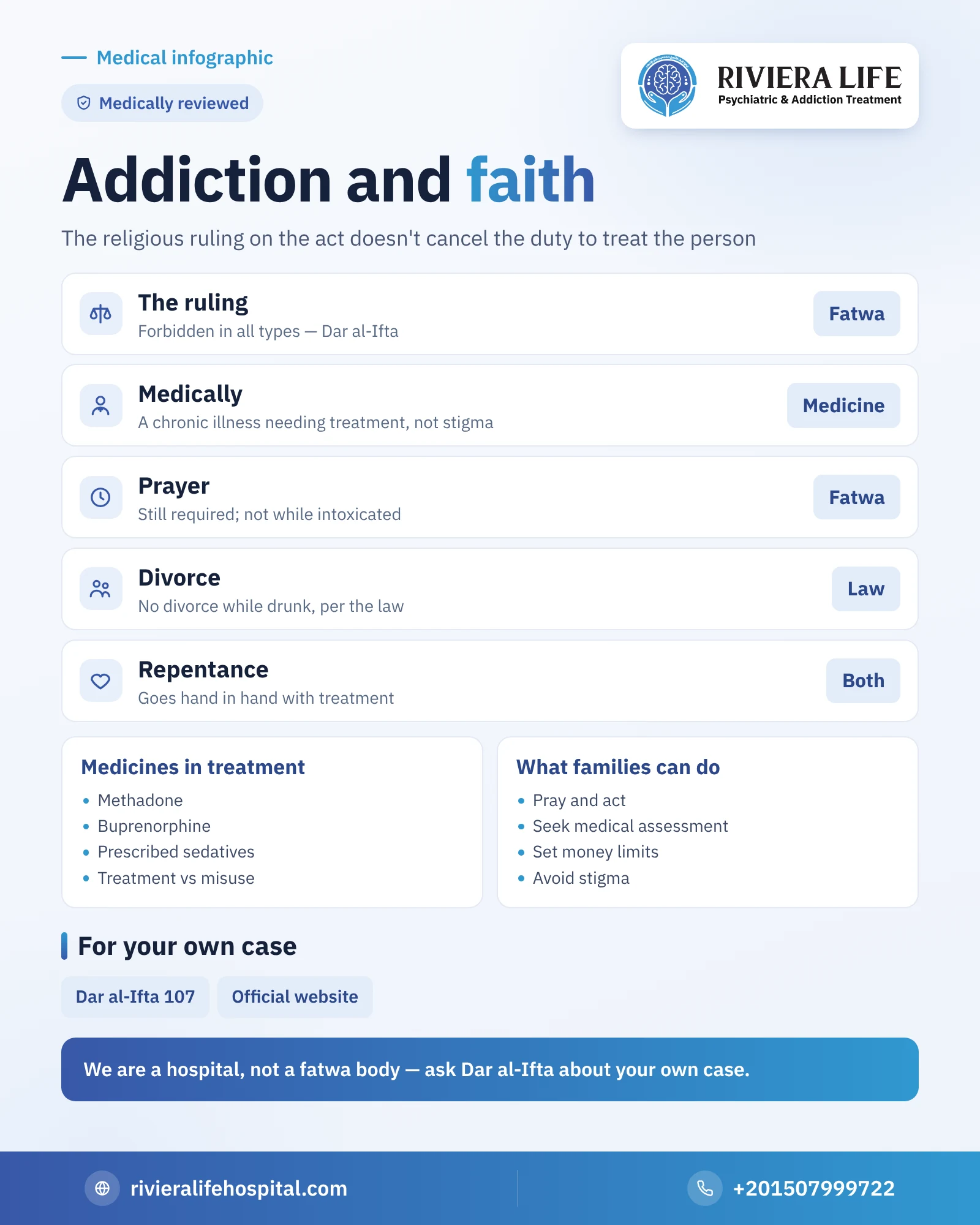
Yes, drugs of all types and ways of use are forbidden according to Egypt’s Dar al-Ifta Fatwa No. 6993 of 2022, whether drunk, sniffed or injected, and hashish falls within this ruling. But the prohibition doesn’t mean the addict has left God’s mercy or their family; in medicine addiction is a chronic illness that changes the brain and needs treatment, and the door of repentance is open and goes hand in hand with treatment. The addict is still required to pray, and their divorce doesn’t count if pronounced while drunk according to the Egyptian Personal Status Law. This article conveys the official fatwas and texts and adds the medical side, and doesn’t replace asking Dar al-Ifta about your own case.
- The rulingForbidden in all types (Dar al-Ifta)
- MedicallyA chronic illness needing treatment, not stigma
- For your own questionDar al-Ifta telephone fatwa 107
When a mother discovers her son is using, or a wife learns her husband is an addict, medical questions aren’t the only ones in her head. She asks: is he an unbeliever? Is his prayer accepted? Does his divorce count? Is this a punishment from God or a trial? These questions often delay seeking treatment, because the family becomes busy judging the person instead of saving them. We are a hospital, not a fatwa body, so here we convey what Egypt’s Dar al-Ifta and Egyptian laws have published, add what medicine says, and leave particular cases to the qualified authorities.
Note: what follows isn’t a personal fatwa. If you have a question about your own case, call Dar al-Ifta’s telephone fatwa service on 107 from inside Egypt, or ask through its official website.
Are drugs forbidden? What Dar al-Ifta says
Egypt’s Dar al-Ifta Fatwa No. 6993, issued in May 2022, stated the prohibition of taking and using drugs of all types, whatever their names and ways of use, whether by drinking, sniffing or injecting. It relied on the aims of Sharia in preserving life and the mind, on the prohibition of throwing oneself into destruction, on the hadith of Umm Salamah, may God be pleased with her, forbidding every intoxicant and every substance that causes languor, and on the rule “no harm and no reciprocating harm”, and it cited the scholars’ consensus on the prohibition. In July 2025 the institution issued a special statement confirming that hashish is forbidden in Sharia, in response to those who tried to downplay it.
This agrees with what medicine says: there is no “safe” narcotic substance in the sense some imagine when comparing hashish with heroin. Each substance has its own road to harm, and the details are in the types of drugs guide.
Is addiction a sin or an illness?
This question divides many homes, and the most accurate answer is that it isn’t a choice between two things. Use at its beginning is an act a person chooses and is accountable for. But with repetition the brain’s reward and control circuits change, so stopping becomes much harder than a mere decision, as the article on dopamine and addiction explains. That is why the US National Institute on Drug Abuse and other medical bodies describe addiction as a chronic, treatable disorder.
Participants in the course “Fatwa and issues of addiction and drugs” organized by Dar al-Ifta in September 2026 described addiction as a chronic social illness in which health, psychological, social and legal dimensions intertwine, and warned against turning it into a stigma because stigma hinders recovery. The practical message for the family: the religious ruling on the act doesn’t cancel the duty to treat the person, and stigma doesn’t produce repentance but pushes towards hiding. Read more about this in the social stigma of addiction.
Does the addict pray? And what about the “forty days” hadith?
Many ask about the hadith stating that whoever drinks wine, their prayer isn’t accepted for forty days, and some understand from it that prayer is useless so they abandon it. Dr Magdy Ashour, scientific adviser to the Grand Mufti, has clarified that what is meant is non-acceptance, not that the obligation falls away, and that he must pray. As for praying while intoxicated and without awareness, the Qur’an explicitly forbade it, in the meaning of the verse: “Do not approach prayer while you are intoxicated until you know what you are saying” [An-Nisa: 43].
From the treatment perspective, we encourage patients for whom prayer is part of their life to keep it; it restores a steady rhythm to the day and gives moments of calm that reduce the tension that drives use. But it is a support for treatment, not a substitute for it, just as medicine doesn’t replace the meaning of life that faith gives its holder.
Drugs in Ramadan: do they break the fast? And does a patient fast during treatment?
Dar al-Ifta has stated that smoking invalidates the fast and is forbidden to the fasting person, whether cigarettes, shisha or other things, and drugs that are deliberately smoked or inhaled take this ruling all the more, on top of their prohibition in themselves. For the details of what breaks the fast and what doesn’t in a particular case, the reference is Dar al-Ifta.
As for a patient going through the detox stage or receiving medicines at set times, they are ill, and fasting may harm them or disrupt their treatment. This is a decision the treating doctor makes with the patient, and the fatwa authorities are asked about the aspect of dispensation. Many in recovery find in Ramadan an opportunity for a new beginning, provided it doesn’t turn into an attempt to stop suddenly, without supervision, substances whose withdrawal is dangerous, such as alcohol and sedatives. The psychological side is detailed in fasting, mental health and recovery.
Does an addict’s divorce count?
Article One of Egyptian Personal Status Law No. 25 of 1929 states that “the divorce of the drunk and the coerced does not take effect”. What counts, then, is the husband’s state at the moment of pronouncing it: if he had lost awareness and perception because of the drug, this is the case the text covers; but if he is an addict who pronounced divorce while aware, addiction alone doesn’t prevent it taking effect. Judging the actual case belongs to Dar al-Ifta or the court, not to the family or the doctor.
On the other hand, the Dar al-Ifta course mentioned pointed to the wife’s right to seek divorce if she suffers harm that can’t be prevented. Before reaching this point, it helps the wife to understand what is happening at home and how to protect herself and her children, which is explained in the guide on how to deal with an addicted husband and the article on the effect of addiction on married life.
The addict’s repentance: where does it begin?
Repentance in religious discourse is regret, quitting and resolving not to return, and the Dar al-Ifta course called for helping the addict repent and return rights if they have wronged others, and embracing them after treatment so they don’t return to bad company. Medicine adds an important observation: quitting a substance that has changed the brain’s chemistry usually needs medical help, especially with substances whose withdrawal is dangerous. That is why we see repentance and treatment as one road, not two competing roads.
And a relapse isn’t proof that the repentance was false. Addiction is a relapsing illness like many chronic illnesses, and what matters is to understand its causes and for the patient to return to their plan quickly, as the relapse treatment program explains. A family that tells its son after a slip “you’ll never change” closes the door it wants him to come through.
The family’s prayer: a support, not a substitute
Many mothers type “a prayer for my addicted son” into Google, and behind the words is a tired heart. Prayer is worship and comfort for the soul, and no one can belittle it. But what we see at the hospital is that the most successful families are those who combined prayer with effort: they spoke calmly with their son, asked for a medical assessment, and set clear limits on money. If you need practical steps for this effort, start from the guide on how to help someone addicted to drugs.
Medicines containing narcotic substances in treatment
Some patients ask whether taking a medicine such as methadone, buprenorphine or prescribed sedatives falls under the prohibition. The difference the Dar al-Ifta course pointed to is between medical treatment and misuse: a medicine may turn into a drug of abuse if the patient exceeds the dose or uses it for other than its purpose, while treatment may fall under considerations of necessity when no suitable alternative exists. Medically, these medicines are used with a time-limited plan and under supervision, and the fatwa authorities are asked about the religious details of each case. Read about these medicines in the addiction treatment medicines guide.
Ruqyah and medical treatment
There is no conflict between legitimate ruqyah and going to the doctor; the problem starts when one replaces the other, so months pass searching for “sorcery” or “possession” while the addiction advances or psychosis appears because of stimulants. If your son’s behavior has changed suddenly, a medical assessment and testing are a first step that doesn’t conflict with anything else the family does. You will find a discussion of this confusion in myths about mental illness.
How can Riviera Life help you?
The Riviera Life team respects the religious values of the patient and their family, understands the questions that occupy them, and directs them to the qualified authorities on religious matters, while providing what is at the heart of its own work: assessing the case, safe detox, psychological rehabilitation and family support. The first consultation is free and confidential on +201507999722.
Read also
- How does a drug addict think? And why do they deny needing treatment?
- The law and addicts in Egypt
- Dealing with a recovering addict
- Addiction: the complete guide
Questions many people ask
No. Egypt's Dar al-Ifta issued a statement in July 2025 confirming that hashish is forbidden in Sharia, and its general fatwa covers drugs of all types and ways of use.
Dr Ali Gomaa, the former Grand Mufti of Egypt, ruled that drug trading is forbidden because it aids and spreads harm, in addition to its criminalization in the Egyptian narcotics law with heavier penalties than use.
Dar al-Ifta's course on addiction called for keeping the addict's secret and privacy while helping them get treatment. Discretion doesn't mean abandoning treatment, but that the problem shouldn't turn into a scandal that hinders recovery.
The same course pointed to the family's right to intervene to protect the addict and help them get treatment when needed. The medical and legal procedures are explained in the article on treating an addict against their will.
Call Egypt's Dar al-Ifta telephone fatwa service on 107 from inside Egypt, or send your question through its official website, as the fatwa changes with the details of the case.