Addiction treatment myths are many, and the most dangerous thing about them is that they delay real treatment or push the family to pay money for promises that don’t come true. Among the best known are that cleaning the blood treats addiction, that there is a pill or injection that ends it, that treatment is complete in a week, that willpower alone is enough, and that relapse means treatment has failed. In this article are twelve common myths in Egypt and the Arab world, with a brief correction of each based on what medicine says, and a link to the article explaining each point in detail where one exists.
Why do myths about addiction treatment spread?
A family that discovers their son’s addiction is in a state of shock and haste, looking for a quick, confidential and cheap solution. This is exactly what the myth offers: a simple story and a near ending. Making matters worse, addiction is still seen by many as a moral flaw, not an illness, so they believe punishment or willpower is enough, or they are ashamed of the hospital and choose a recipe at home. Knowing the truth from the start saves months and sometimes years.
Quick-fix myths
Myth 1: Cleaning the blood or IV drips treat addiction
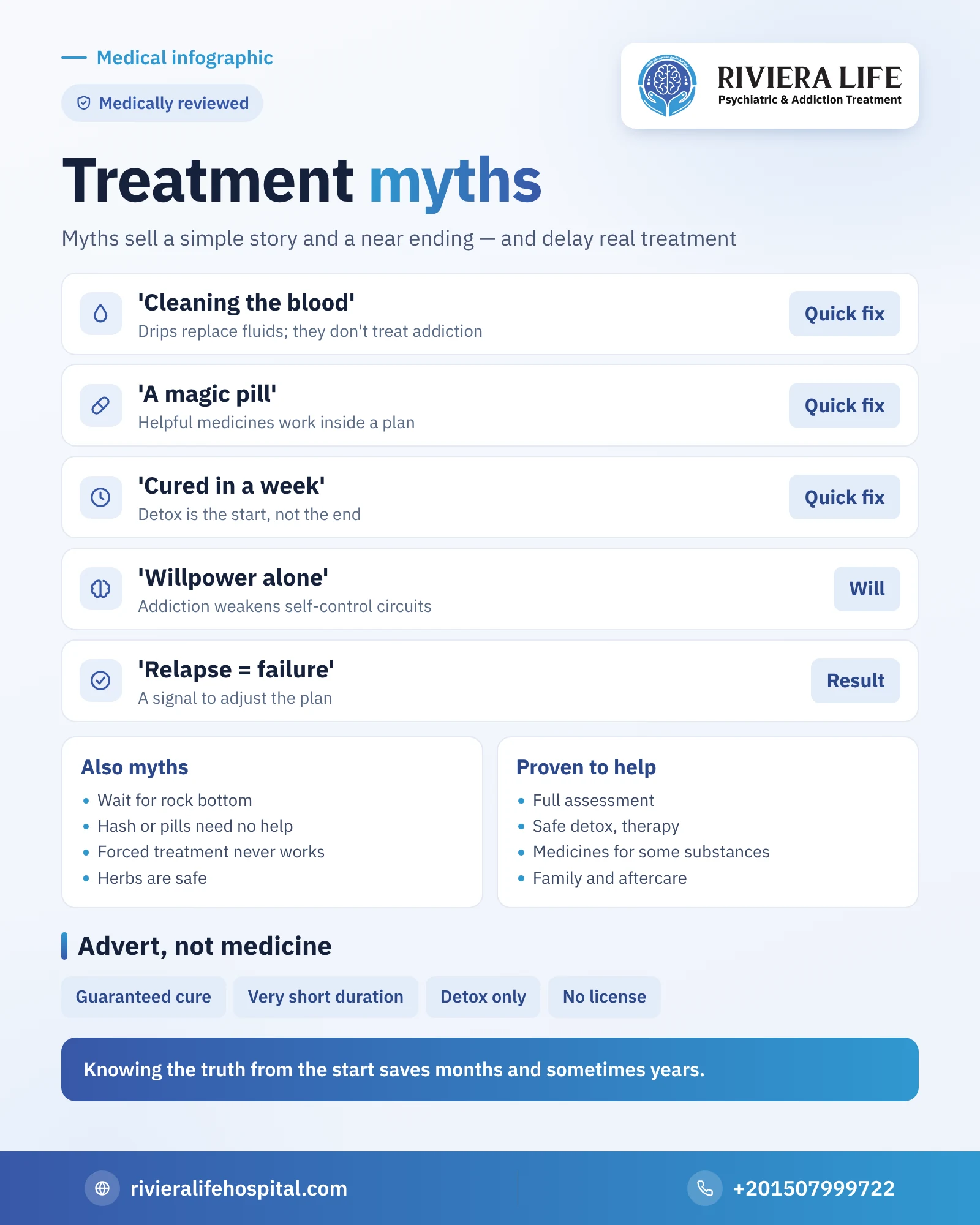
Intravenous drips replace fluids and salts with vomiting and diarrhea, and may be part of detox, but they don’t draw the drug out of the blood and don’t treat addiction. Addiction isn’t a substance stuck in the blood, but a change in the brain that needs psychological, behavioral and medical treatment. Many families pay for “cleaning sessions” at home, then are surprised that the craving has come back after days as it was, and sometimes with complications from a drip given without monitoring.
Myth 2: There is a pill or injection that ends addiction for good
There are truly useful medicines, such as naltrexone, which reduces the effect of opioids and the craving for alcohol. But they are tools that help within a treatment plan, not a magic key that replaces rehabilitation and follow-up.
Myth 3: Treatment is complete in a week
The first week is usually enough to get through acute withdrawal, and this is what the 7-day detox program offers. But detox is the beginning of treatment, not its end. Rehabilitation and learning relapse prevention skills need weeks and months depending on the case.
Myth 4: Full anesthesia makes the patient wake up recovered
Detox under anesthesia doesn’t shorten the road as advertised, and carries the risks of anesthesia itself, and the patient wakes up with a brain that still needs time to adapt, and the craving hasn’t yet been treated.
Myths about the patient and their willpower
Myth 5: If he had willpower he would quit on his own
Willpower matters, but addiction weakens the areas responsible for self-control and decision-making in the brain itself. That is why people with strong willpower fail to stop on their own, and it doesn’t mean they are weak. The details are in can an addict quit drugs on their own?.
Myth 6: The addict must hit rock bottom to get treated
Waiting for rock bottom may mean waiting for an overdose, an accident, prison, or losing work and marriage. Treatment at an early time is easier, less costly and usually has better results. A young man who is still studying or working, and whose family is still around him, has what protects him during recovery, and this is what many lose when treatment is delayed for years. To start treatment it is enough for signs of dependence to appear, not for the whole of life to collapse.
Myth 7: Hash or prescribed medicines don’t need treatment
Many think addiction is limited to heroin and injections. But dependence on hash, sedatives or pregabalin is a real disorder, and withdrawal from some of these medicines needs careful medical supervision. The article on the difference between physical and psychological addiction explains why the absence of clear physical symptoms isn’t evidence that the problem is simple.
Myths about coercion and the family
Myth 8: Treatment only works if the patient wants it from the start
Many patients enter treatment under pressure from family or work, then motivation forms during treatment itself. Studies don’t show that someone who started under pressure necessarily benefits less. The article on involuntary addiction treatment explains when and how this is possible.
Myth 9: The family has nothing to do with treatment
The family is part of the environment the patient will return to. When it learns how to communicate with him and set clear limits without accusation or leniency, the chances of relapse decrease. That is why serious hospitals dedicate a family rehabilitation program.
Myths about medicines and herbs
Myth 10: Addiction treatment medicines replace one addiction with another
Medicines such as methadone and buprenorphine are used in treating opioid addiction at fixed doses set by the doctor, so they prevent withdrawal and craving without repeated highs, and restore the patient’s ability to work and live. This is a globally approved treatment, completely different from using a substance without control.
Myth 11: Herbs are safe because they are natural
“Natural” doesn’t mean safe. Some mixtures contain undeclared narcotic or sedative substances, and some interact with medicines or strain the liver. The details are in herbal addiction treatment.
Myths about the result
Myth 12: Relapse means treatment has failed
Addiction is a chronic illness, and relapse in it resembles the return of symptoms in other chronic illnesses such as diabetes and blood pressure. It is a signal that the plan needs adjusting, not that treatment is useless. What happens after it is explained by the relapse treatment program. Linked to it is another wrong belief, that treatment ends on the day of leaving the hospital, while the first months after it remain the most dangerous and need follow-up.
We believed a myth and time was lost: what do we do now?
Many families reach the hospital after one or two experiences with recipes or centers that promised a lot. There is no need for self-blame, as the myth was convincing because it promised what every family wishes for. What matters now are three steps: gather what happened in the previous experiences, including substances, durations, medicines and what caused the setback, because it helps the doctor a great deal. Then have the assessment redone from the beginning instead of repeating the same thing. Then agree as a family on one plan to stick to, as multiple opinions and recipes at home confuse the patient and give him a way out of treatment.
How do you tell medical information from an advertisement?
Before you believe a promise or pay a center, ask:
- Does it mention a guaranteed cure rate or a very short duration? Medicine doesn’t guarantee.
- Does it focus on detox only without talking about rehabilitation and follow-up?
- Does the place provide a psychiatrist specialized in addiction, or “therapists” without clear qualifications?
- Is the place licensed by the Ministry of Health?
- Does it refuse to answer questions about medicines and risks?
What has actually been proven to help?
Evidence-supported treatment combines several elements: a comprehensive medical and psychological assessment, safe detox when needed, psychotherapy such as cognitive behavioral therapy and group sessions, supporting medicines for some substances, treatment of any accompanying psychiatric disorder, family participation, then aftercare for months. And when one of these elements is missing, the likelihood of setbacks increases, as the article on why addiction treatment fails explains.
Among the common myths too is that treatment can only be residential; the comparison between options is in addiction treatment without admission or with residence? And promises of quick awakening are explained in detox under anesthesia.
How does Riviera Life help you?
If you have reached this article confused between the promises, you can start by asking a specialist. The Riviera Life team of consultants in psychiatry and addiction treatment offers a free first consultation in which the family explains its situation and learns what the patient actually needs. The hospital is licensed by the Ministry of Health, has fourteen years of experience, and provides round-the-clock medical supervision and complete confidentiality, a program for the family and aftercare after discharge. Contact us on +201507999722; the hospital is in Sheikh Zayed, Giza.
More from the addiction treatment guide
- Why addiction treatment fails
- Can an addict quit drugs on their own?
- The stages of recovery from addiction
- How to choose an addiction treatment hospital
Questions many people ask
The first week is usually only enough to get through acute withdrawal. Rehabilitation and relapse prevention need weeks to months depending on the substance and the case.
There is no magic medicine. There are medicines that help treat addiction to some substances and reduce craving, but they work within a plan that includes psychotherapy and follow-up.
It may. Many patients start under pressure from family or work, then motivation forms during treatment itself with a team that knows how to build it.
No. Relapse is common in chronic illnesses including addiction, and it is a signal to adjust the plan. Many recover after more than one attempt.
No, they are an approved treatment for opioid addiction given in fixed doses under medical supervision, preventing withdrawal and craving and returning the patient to their life, which is different from drug use.