The idea of the addictive personality is widespread among people, but there is no single personality type to whose owner we can say: you will inevitably become addicted. Scientific research doesn’t find a type that explains addiction on its own. What exists are traits and circumstances that raise the likelihood in some people: impulsivity, sensation-seeking, and difficulty bearing painful feelings, together with genetic and environmental factors. This article explains the difference between the myth and the real risk, and how you can know yourself without being unfair to yourself.
Where did the idea of the addictive personality come from?
It came from a simple observation: many addicts resemble each other in some qualities, such as recklessness, lying, unpredictability and apparent selfishness. So people concluded that these qualities are the cause of addiction. But a large part of what we see is a result of addiction, not its cause, as the substance changes behavior, and seeking it pushes towards lying and evasion. If we compare the person before and after addiction, we will usually find them different.
Also, whoever judges others from outside sees only the addicts who have reached an advanced stage, and doesn’t see the many with the same traits who never became addicted.
What does research say instead?
Studies indicate that addiction arises from an interaction of multiple factors, not a single trait: a genetic predisposition estimated to explain roughly half of vulnerability, environmental factors such as early exposure to the substance, family and friends, painful childhood experiences, and mental health. Certain personality traits may appear among the risk factors, but they increase the likelihood and don’t decide the fate. For more on the general causes read drug addiction.
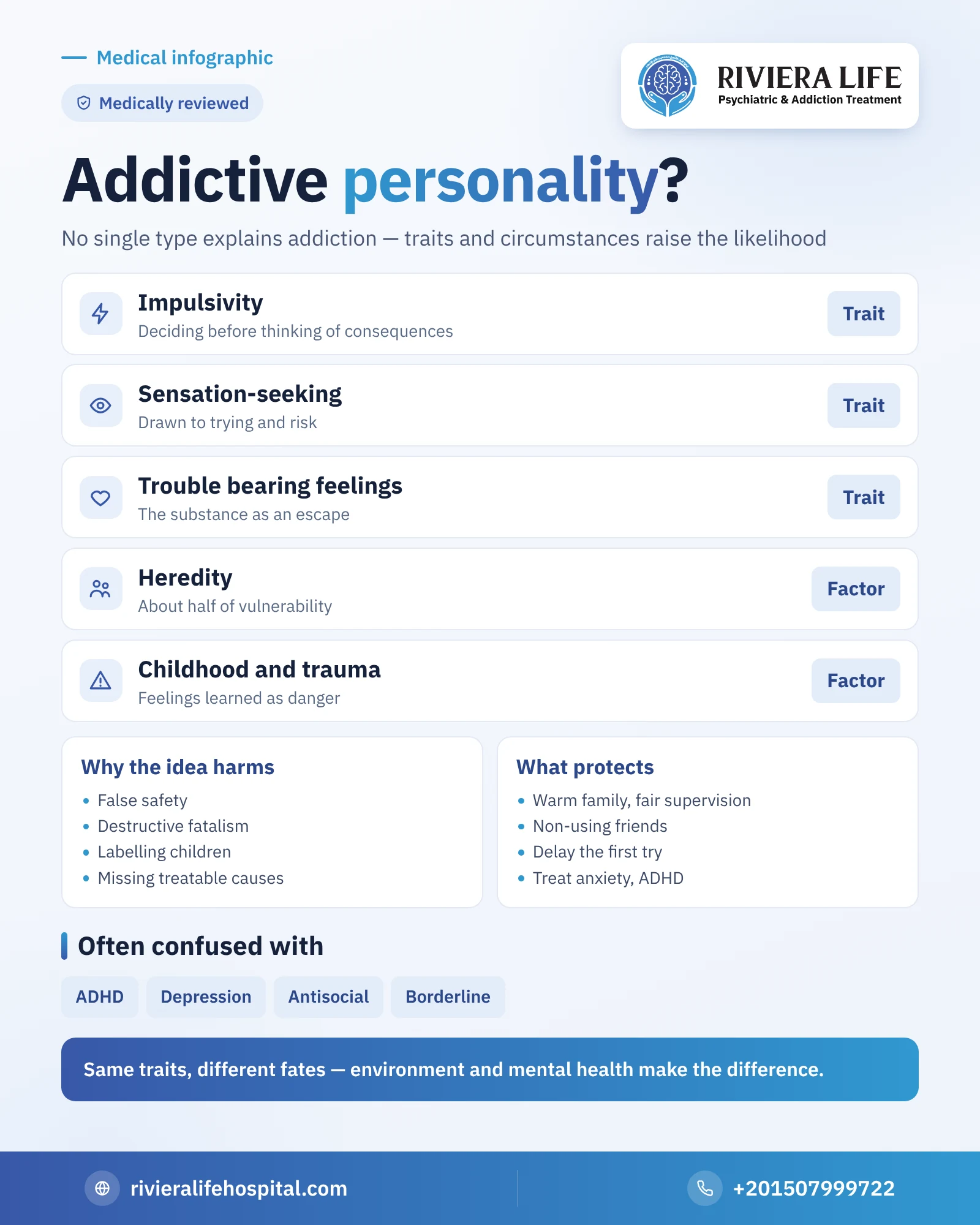
Traits linked to higher risk
| Trait | How it raises the risk | What helps |
|---|---|---|
| Impulsivity | Makes the decision instant before thinking about consequences | Training in pausing and delaying, and treating ADHD if present |
| Sensation-seeking | Draws towards trying and risk | Safe alternatives such as intense sports and challenges |
| Difficulty bearing feelings | Makes the substance a means of escaping anxiety and sadness | Emotion regulation skills and psychotherapy |
| Excessive sensitivity to rejection | Pushes towards use to be accepted by the group or to calm the pain | Building supportive relationships and assertiveness training |
| Weak response to punishment | Doesn’t learn easily from loss | Clear goals, follow-up and near-term rewards |
Having one of these traits doesn’t mean its owner will become addicted, but means they need more caution and awareness than others.
Childhood, trauma and environment
A child who grows up in a home where they are exposed to violence, neglect or early loss learns that feelings are dangerous, and that escaping them is a means of survival. This doesn’t mean everyone who went through trauma will become addicted, but it raises the likelihood, especially if they didn’t find someone to help them understand what happened. On the other hand, other children in warm homes learn skills that protect them even with a genetic predisposition. That is why “personality” can’t be separated from the story that made it.
Psychiatric disorders and their relationship to personality
Some psychiatric disorders are linked to increased addiction, and are sometimes hard to separate from “personality traits”. ADHD raises impulsivity, and the article on ADHD and addiction details it. Depression and anxiety push towards self-medication, as in depression and addiction. And some personality disorders such as antisocial personality and borderline recur with addiction at a higher rate than usual. When the two come together, the patient needs integrated treatment as in the dual diagnosis program.
Diagnosing a personality disorder is done by a psychiatrist after a lengthy assessment, and it isn’t right for us to apply it to ourselves or others by guesswork.
Two people with the same traits and different fates
Imagine two enthusiastic brothers who love risk. One played football, climbed mountains and finished his studies, and the other fell into company that tried hash with him early, and suffered from anxiety no one knew about. One found a safe outlet for his traits, and the other found a substance. The trait is the same, and the difference is in environment, mental health and opportunities. This proves that “personality” isn’t destiny.
Why does this idea do harm?
- False safety: a calm person says “I’m not that type”, so they use without caution and are surprised by dependence.
- Destructive fatalism: another says “I’m addictive by nature”, so they give up and don’t try.
- Labelling children: parents judge their enthusiastic or sensitive son as “going to be lost”, so they increase his pressure.
- Overlooking treatable causes: such as untreated anxiety, trauma or ADHD.
It is useful for parents to distinguish between temperament and risk. A curious or bold child isn’t an addict in the making, and suppressing their temperament with scaring may push them towards hiding. It is more effective to direct their energy into an activity that suits them, and for them to know early that use that seems simple among friends may have a price for them specifically because of family history. This information is said calmly and without threats, in a context of trust, not punishment.
On the other hand, if there is a family history of addiction it is wise for the children to know it when they grow up, because genetic predisposition is preventive information just like a history of diabetes.
What protects even someone with risk traits?
- A warm relationship with the parents and reasonable supervision without harshness.
- Friends who don’t consider drug use normal.
- Delaying the first try as far as possible, as exposure at an early age raises the risk.
- Treating anxiety, depression and ADHD instead of leaving them.
- Skills for dealing with pressure, and a regular schedule of sleep and movement.
- Staying away from places of available use and excess medicines at home.
For parents especially, we explain practical steps in drug prevention and teen addiction.
Do personality tests reveal addiction risk?
Tests spread online that claim to determine “your addictive personality percentage”. Don’t rely on them: there is no approved test that predicts addiction in a specific individual. The tools doctors use measure current use and its effect, or traits such as impulsivity in the context of a comprehensive clinical assessment. And if the result of an online test worries you, consider it an invitation to talk with a specialist, not a verdict.
The conclusion specialists agree on is that risk is a graded spectrum, not a box in which we classify people. Someone who combines several factors together, such as genetic predisposition, an early start, untreated anxiety and using company, has a much higher risk, and someone with only one factor may pass safely. That is why prevention focuses on reducing whatever factors can be reduced, not on looking for the dangerous “type” of people.
Questions to ask yourself
The goal isn’t to judge yourself but to know where you need attention. Ask yourself honestly: do I use something whenever my tension intensifies? Does it worry me that I can’t stop at a certain limit? Is there someone in my family who has suffered from addiction? Did I start early? If most of your answers are yes, this is a reason for caution and asking for advice, not for despair.
Do these traits change with treatment?
Yes, many of them improve. Impulsivity can be trained, regulating emotions is a skill acquired through behavioral therapy, and sensation-seeking can be directed towards what is useful. A person who considered themselves “weak” may learn that they have tools they didn’t know about. What matters is that they aren’t left alone in this.
How does Riviera Life help you?
The consultants in psychiatry and addiction treatment at Riviera Life assess the whole person: the traits, accompanying psychiatric disorders, family history and current circumstances, then set a plan that treats the cause, not just the symptom. Confidentiality is complete and the first consultation is free: +201507999722, Sheikh Zayed, Giza.
Read also
- How a drug addict thinks
- Dopamine and addiction
- The importance of early addiction treatment
- The personality disorders guide
- Defense mechanisms: their types, examples and when they become an obstacle
- Drug addiction test
Questions many people ask
There is no single personality type that explains addiction, but traits such as impulsivity and difficulty bearing feelings, together with genetic and environmental factors, may raise the likelihood.
Impulsivity, intense sensation-seeking, difficulty regulating emotions and sensitivity to rejection, and the risk increases with anxiety, depression and ADHD.
No, the traits only increase the likelihood, and factors such as a supportive family, healthy friends and treating psychiatric disorders protect them.
Some personality disorders recur with addiction at a higher rate than usual, but they aren't a sole cause, and the matter needs a specialist psychiatric assessment.
Many of them can be improved with behavioral therapy and training in emotion regulation and impulse control skills.